
Skip to content
The Encyclopedia of Horology

Clock · Shelf clock

Forestville Manufacturing Company Acorn Shelf Clock

Partially verified

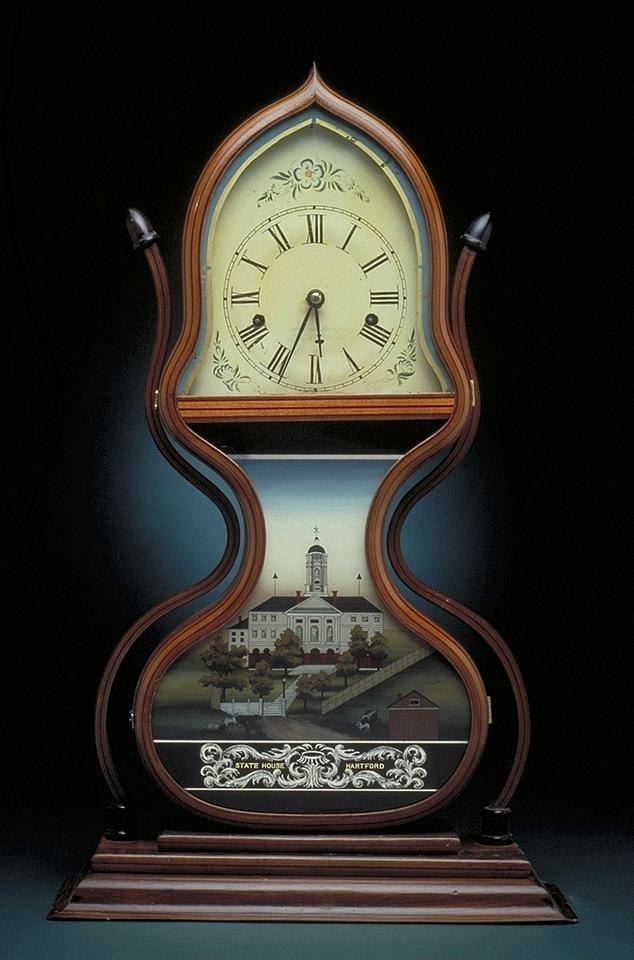
This American acorn shelf clock was produced by the Forestville Manufacturing Company in Bristol, Connecticut, around 1847 to 1849. The source reports that its curved silhouette was achieved through laminating and bending wood, facilitated by early coiled-steel spring-driven mechanisms rather than falling weights. The movement utilized coiled springs linked to fusees mounted at the bottom of the case to power conventional trains. The upper arched section frames an off-white dial with Roman numerals and floral corner decorations, while the lower body features a tablet depicting the State House in Hartford.

Front view of the Forestville Manufacturing Company acorn shelf clock showing the dial and painted Hartford State House tablet
Front view of the Forestville Manufacturing Company acorn shelf clock showing the dial and painted Hartford State House tablet — Smithsonian Institution. Rights pending — permission not yet requested. Original source

Catalogue identity

Source
www.si.edu
Category
Clock · Shelf clock
Maker / attribution
Forestville Manufacturing Company
Reference
Not recorded
Catalogue / lot identifier
Source URL identifies the listing
Source-reported date
ca 1847-1849
Source-reported place
United States

Source-reported attribution and specifications are not independent authentication. A listing does not establish present ownership, current display, availability or permission to reproduce.

Object description

Construction and Case Design

The acorn-shaped shelf clock, produced by the Forestville Manufacturing Company, is defined by a curved silhouette. The source attributes this form to the technique of laminating and bending wood, which allowed for a departure from elongated clock cases previously required for falling weights.

The exterior of the clock consists of an arched upper hood with a pointed gothic top and flanking acorn-form side finials. The case is supported by a stepped rectangular wooden plinth base.

Evidence for this section
  • “This new freedom, along with the technique of laminating and bending wood, made possible the characteristic acorn shape of the case.”
  • “Arched upper hood with a pointed gothic top and flanking acorn-form side finials”
  • “Stepped rectangular wooden plinth base supporting the curved case frame”

Dial and Visual Features

The upper arched section of the clock contains a cream-colored dial featuring Roman numerals, floral corner flourishes, and twin winding arbors.

The lower body of the clock features a glass tablet decorated with a painted view of the Hartford State House and a labeled banner.

Evidence for this section
  • “Cream-colored dial with Roman numerals, floral corner flourishes, and twin winding arbors”
  • “Lower glass tablet decorated with a painted view of the Hartford State House and labeled banner”

Mechanism and Technical Notes

The clock utilizes early locally made coiled-steel springs. Rather than being integrated into the movement, these springs were mounted at the bottom of the case and attached to a conventional weight-driven movement in a manner described as 'rough-and-ready.'

Two springs—one for the going train and one for the hour-striking train—were connected to fusees, which are described as cone-shaped pulleys designed to equalize the changing force of the unwinding spring.

Evidence for this section
  • “Acorn clocks were among the first to use the locally made coiled-steel springs that had recently become available.”
  • “These springs were not installed as integral parts of the movement. Instead they were attached to a conventional weight-driven movement in a notably rough-and-ready manner.”
  • “The two springs, one for the going train and another for the hour-striking train, were each combined with a fusee, a cone-shaped pulley designed to equalize the changing force of the unwinding spring.”

Open research questions

  • Does the Smithsonian collection hold documentation confirming if the Hartford State House tablet was a standard feature for all Forestville acorn clocks?
  • Are there other examples of Forestville acorn clocks that retain the 'rough-and-ready' fusee configuration?

Source evidence

Recorded claims and source quotations for Forestville Manufacturing Company Acorn Shelf Clock
FieldSource-reported valueSource quotation
ManufacturerForestville Manufacturing Company“manufacturer Forestville Manufacturing Company”
Place MadeBristol, Connecticut, United States“Place Made United States: Connecticut, Bristol”
Catalog Number311601“catalog number 311601”
Measurements24 1/2 in x 15 in x 5 1/4 in; 62.23 cm x 38.1 cm x 13.335 cm“Measurements overall: 24 1/2 in x 15 in x 5 1/4 in; 62.23 cm x 38.1 cm x 13.335 cm”
Overall Materialwood“wood (overall material)”
ManufacturerForestville Manufacturing Company“manufacturer Forestville Manufacturing Company”
Estimated Datingca 1847-1849“Date made ca 1849 date made ca 1847-1848”
Measurements24 1/2 in x 15 in x 5 1/4 in“Measurements overall: 24 1/2 in x 15 in x 5 1/4 in; 62.23 cm x 38.1 cm x 13.335 cm”

Visible details

  • Arched upper hood with a pointed gothic top and flanking acorn-form side finials
  • Lower glass tablet decorated with a painted view of the Hartford State House and labeled banner
  • Cream-colored dial with Roman numerals, floral corner flourishes, and twin winding arbors
  • Stepped rectangular wooden plinth base supporting the curved case frame

Research qualifications

  • Internal spring-and-fusee movement components are not visible in the exterior photograph
  • Source notes conflicting dates of manufacture: 'ca 1849' and 'ca 1847-1848'

Photograph identity and source facts were screened before import; rights clearance remains pending.

Consulted source

An Acorn Clock | Smithsonian Institution

Reviewed 2026-10-25 · Record 6ba4ad21d1

Terms in this record

Glossary explanations for terms named in this object’s record.