
Skip to content
The Encyclopedia of Horology

Clock · Skeleton clock

Scissors Skeleton Clock

Partially verified

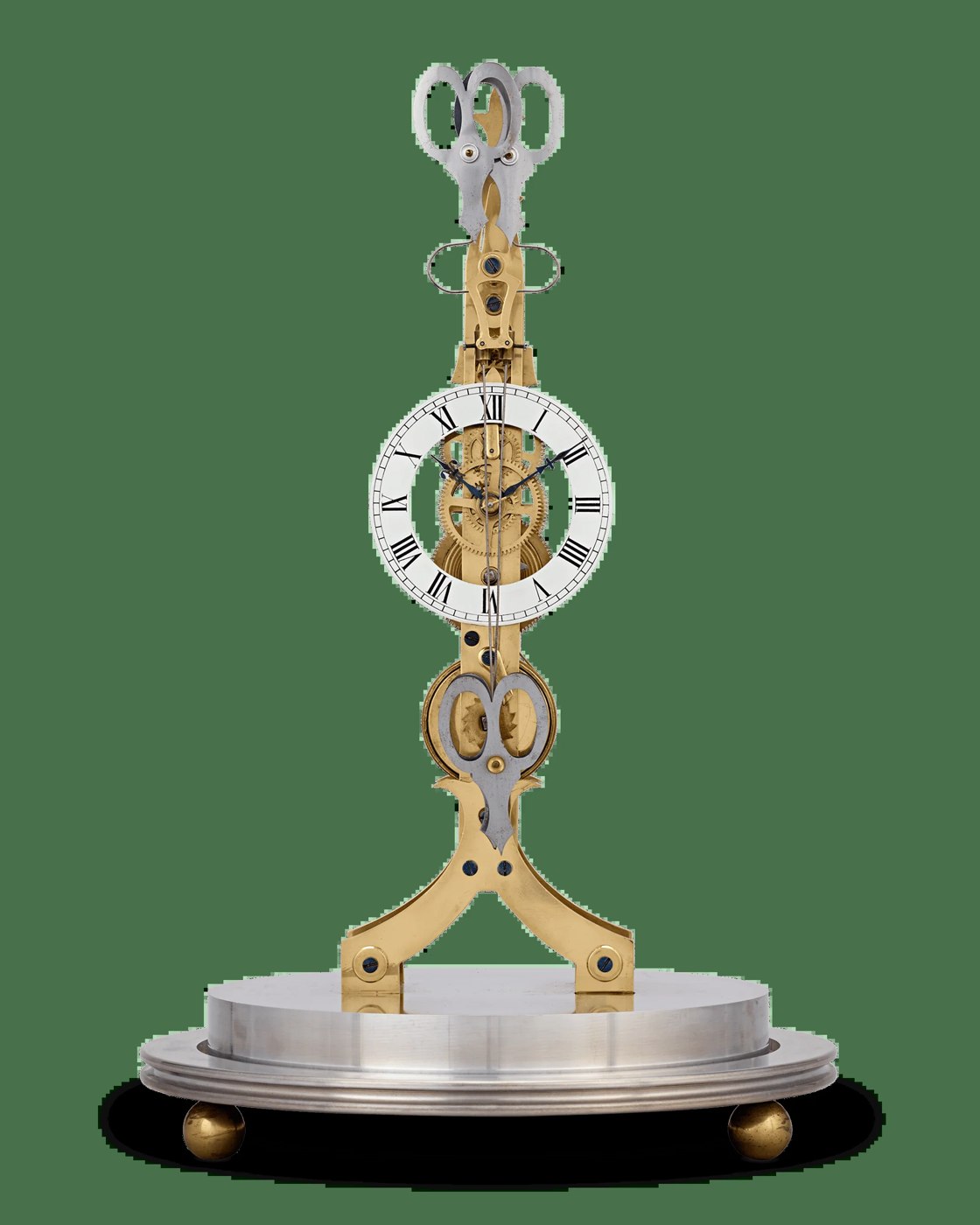
This 20th-century skeleton clock features a design characterized by the use of scissor-shaped components. The movement is constructed with a fusee mechanism intended to regulate torque from the mainspring to the wheel train. The clock is driven by twin pendulums that oscillate in opposing directions, a motion reflected in the design of the hands and the brass movement plate. A silvered chapter ring with Roman numerals surrounds the exposed brass wheel train. The entire mechanism is mounted on a stand and the clock is supplied with a glass dome, measuring 23 inches in height and 12 inches in diameter. The clock's visual configuration is stated to be related to the Scissors Clock by British horologist John Wilding, whose published construction guides influenced 20th-century horological production. The clock is designed with an emphasis on visible mechanical components.

Front view of the scissors skeleton clock showing the twin pendulums and the exposed brass wheel train inside a silvered Roman numeral chapter ring.
Front view of the scissors skeleton clock showing the twin pendulums and the exposed brass wheel train inside a silvered Roman numeral chapter ring. — M.S. Rau. Rights pending — permission not yet requested. Original source

Catalogue identity

Source
rauantiques.com
Category
Clock · Skeleton clock
Maker / attribution
Not established
Reference
Not recorded
Catalogue / lot identifier
Source URL identifies the listing
Source-reported date
20th Century
Source-reported place
Not established

Source-reported attribution and specifications are not independent authentication. A listing does not establish present ownership, current display, availability or permission to reproduce.

Object description

Design and Construction

The clock is built as a skeleton movement, a form intended to expose the internal mechanical operation of the timekeeper. The frame and primary components are constructed from brass, with the wheel train left visible to the observer. A silvered chapter ring featuring Roman numerals is positioned centrally within the frame, encircling the gear train.

A distinct scissor motif is integrated throughout the object's assembly. This form is present in the shape of the clock hands, the movement plate, and the two pendulums. The pendulums are mounted to oscillate in opposite directions, simulating the action of scissor blades.

Evidence for this section
  • “The exposed mechanism incorporates a fusee”
  • “Encircled by a silvered Roman numeral chapter ring, the visible brass wheel train makes the clock’s mechanism a central part of its design.”
  • “Two pendulums swing in opposite directions like the blades of a pair of scissors, a motif repeated in the hands and the shaped brass movement plate.”

Mechanism and Movement

The timekeeping function is powered by a fusee movement. This mechanism is employed to compensate for the reduction in torque generated by the mainspring as it unwinds, ensuring the wheel train receives a consistent force.

The time is regulated by twin pendulums. These pendulums are animated, swinging in opposing motions to control the beat of the clock. The mechanical assembly is designed for visual impact, with the reduction of the case allowing for the observation of the internal movement parts.

Evidence for this section
  • “The exposed mechanism incorporates a fusee, which compensates for the mainspring’s diminishing torque as it unwinds, delivering more consistent force to the wheel train.”
  • “With its fusee movement, animated twin pendulums and clever repetition of the scissor motif, this clock is an especially intriguing example of the tradition.”

Origins and Context

The design of the clock is linked to the work of the British horologist John Wilding. Construction guides produced by Wilding in the 20th century provided technical instructions that allowed skilled makers to produce complex clock designs, including the Scissors Clock.

The item is noted as being of 20th-century origin. It is presented with a glass dome for display, measuring 23 inches in height and 12 inches in diameter.

Evidence for this section
  • “The design is closely related to the celebrated Scissors Clock popularized by British horologist John Wilding, whose construction guides brought complex traditional clockmaking within reach of skilled 20th-century makers.”
  • “With glass dome: 23" high x 12" diameter”

Open research questions

  • What specific materials constitute the scissor-shaped hands and pendulums?
  • Is there an identifiable maker's mark or serial number present on the movement plates?

Source evidence

Recorded claims and source quotations for Scissors Skeleton Clock
FieldSource-reported valueSource quotation
Product TypeSkeleton Clocks“Product type: Skeleton Clocks”
Dating20th Century“20th-century skeleton clock”
Dimensions23 inches high by 12 inches diameter“With glass dome: 23" high x 12" diameter”
Mechanism FeatureFusee“The exposed mechanism incorporates a fusee”
Pendulum configurationTwin“twin pendulum movement”
Design motifScissor-form“striking scissor-form design”

Visible details

  • Twin pendulums are shaped like scissor blades.
  • A silvered chapter ring features black Roman numerals.
  • The mechanism is constructed primarily of brass.
  • The clock stands on a base and is covered by a glass dome.

Research qualifications

  • The exact maker is not identified, only the design influence of John Wilding.
  • The precise date of manufacture is not specified beyond '20th century'.

Photograph identity and source facts were screened before import; rights clearance remains pending.

Consulted source

ساعت اسکلتون قیچی‌شکل با دو پاندول

Reviewed 2026-11-02 · Record 69c234959b

Terms in this record

Glossary explanations for terms named in this object’s record.