
Skip to content
The Encyclopedia of Horology

Tool · Historical model

Scale model of Su Song's water-balance escapement

Partially verified

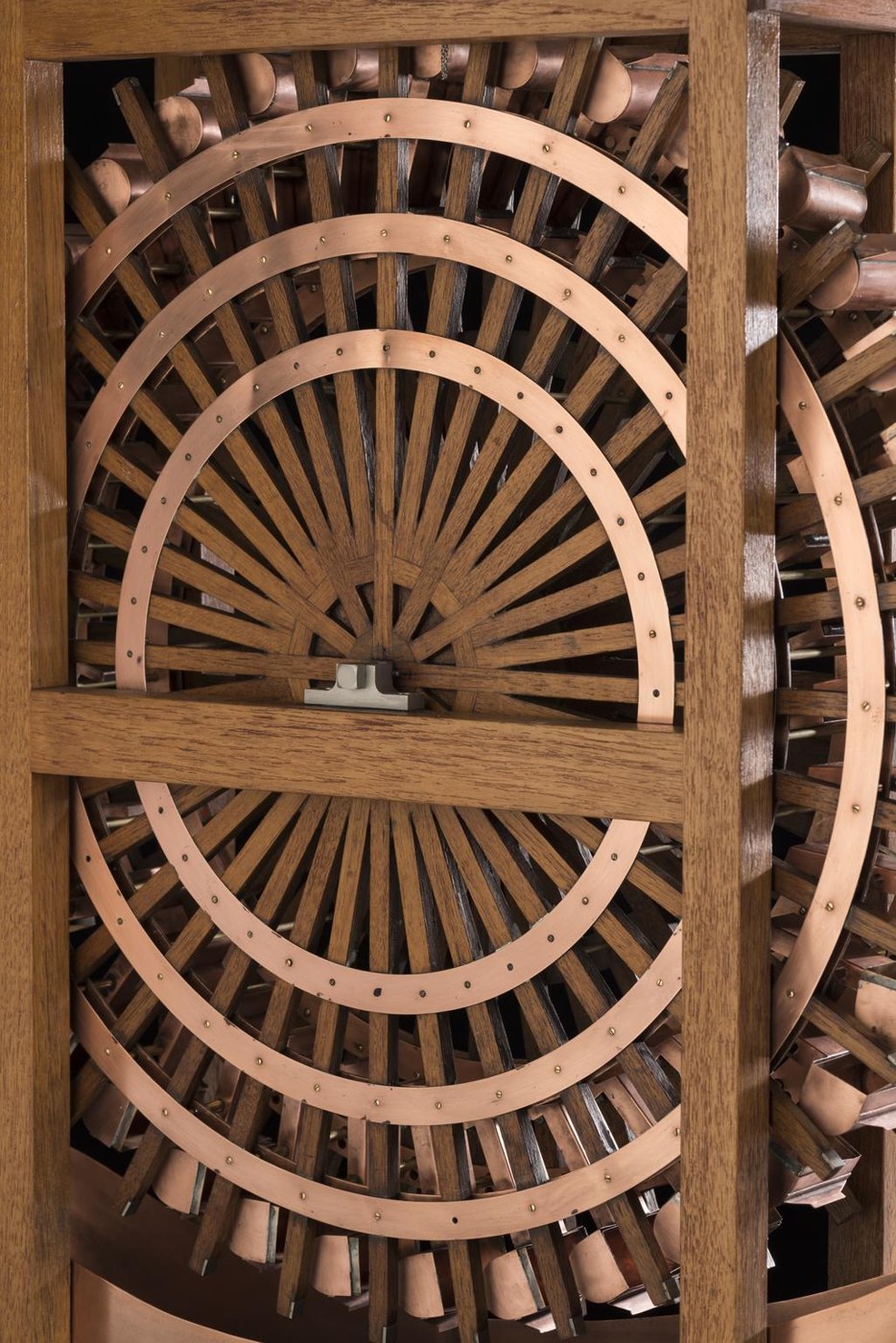
This 1:6 scale model represents the water-balance escapement mechanism from the astronomical clock tower created by Su Song in 1088. Fabricated by the Science Museum Workshops in 1965, the object demonstrates the function of the water-powered escapement, a component designed to regulate energy release at regular intervals. The physical assembly comprises a wooden frame supporting a rotatable wheel integrated with a series of metal buckets, reflecting the historical design principles identified in research regarding 11th-century Chinese clockwork. The model serves as an educational representation of the original clock-tower escapement mechanism, illustrating the historical use of a waterwheel to control temporal output. It stands 750 mm by 730 mm by 225 mm and utilizes materials such as wood and metal to recreate the functional geometry of the ancient device within a museum context.

A detailed view of the water-balance wheel assembly, featuring the wooden frame construction, central spoked wheel, and copper buckets.
A detailed view of the water-balance wheel assembly, featuring the wooden frame construction, central spoked wheel, and copper buckets. — Science Museum. Rights pending — permission not yet requested. Original source

Catalogue identity

Source
collection.sciencemuseumgroup.org.uk
Category
Tool · Historical model
Maker / attribution
Science Museum
Reference
Not recorded
Catalogue / lot identifier
1965-8
Source-reported date
1965
Source-reported place
United Kingdom

Source-reported attribution and specifications are not independent authentication. A listing does not establish present ownership, current display, availability or permission to reproduce.

Object description

Mechanical Design and Construction

The object is a functional scale representation of a water-balance escapement, constructed at a 1:6 ratio. The frame is primarily wood, containing a central rotating wheel. This wheel incorporates a series of copper buckets fixed to the outer rim, designed to capture water to facilitate the regulated rotation required for timekeeping.

Associated metal hardware, including threaded rods and adjustment nuts, serves to mount and balance the rotating components. A secondary suspension mechanism, visible in the detailed view, consists of a small chain supporting a metallic bob, intended to mimic the movement regulation of the original 11th-century water-clock tower.

Evidence for this section
  • “Scale model, (scale 1:6), of Su Song's astronomical clock-tower water-balance escapement”
  • “The text revealed that the clock tower contained a waterwheel which functioned as an escapement.”

Historical Context and Research

This model was produced in 1965 by the Science Museum following scholarly re-examination of ancient Chinese texts. These documents detailed the astronomical clock tower created by Su Song (1020–1101) in 1088, which utilized water power to operate its internal mechanisms.

The development of the model followed the identification of this technology in the original manuscripts. It serves to document the operational theory of early Chinese mechanical clockwork as understood by researchers during the mid-20th century, challenging historical narratives regarding the singular origins of mechanical timekeeping.

Evidence for this section
  • “In the 1960s, scholars rediscovered an ancient text about a water-powered astronomical clock tower made in China by Su Song (1020-1101, Song dynasty) in 1088.”
  • “This discovery challened the long-held belief that mechanical clocks originated entirely in Europe.”

Provenance and Documentation

The object is held within the collection of the Science Museum, London, and is registered under the accession number 1965-8. It was manufactured by the museum's own workshops as a record of the historical study of the Su Song clock.

The provenance is tied to the Science Museum's internal documentation project involving historical horological devices. The record explicitly links the creation of this object to the 1965 efforts to illustrate the mechanics described in historical scholarly analysis.

Evidence for this section
  • “This scale model was made by the Science Museum Workshops in 1965.”
  • “Accession number: 1965-8”

Open research questions

  • To what extent does the internal linkage reflect the specific gear ratios hypothesized in 1965 versus modern interpretations?
  • Are the bucket shapes based on specific archaeological fragments or purely on literary descriptions?

Source evidence

Recorded claims and source quotations for Scale model of Su Song's water-balance escapement
FieldSource-reported valueSource quotation
Accession Number1965-8“Accession number: 1965-8”
MakerScience Museum“Maker: Science Museum”
Scale1:6“Scale model, (scale 1:6)”
Date of Construction1965“Model made in 1965.”
MaterialsWood and metal“There was a tradition of mechanical knowledge in China for thousands of years”
Dimensions750 mm x 730 mm x 225 mm“overall: 750 mm x 730 mm x 225 mm,”
FunctionRegulate energy release“An escapement is a mechanism which controls the release of energy in small quantities at regular intervals.”

Visible details

  • Wooden frame assembly with central spoked wheel
  • Peripheral copper buckets mounted on the wheel rim
  • Metallic pendulum or bob suspended by a small chain
  • Visible threaded adjustment screws on the metallic support structure

Research qualifications

  • Exact historical accuracy of the internal mechanism remains subject to the limitations of 1960s interpretation of the ancient text
  • Object is a 1965 reconstruction rather than an original device from 1088

Photograph identity and source facts were screened before import; rights clearance remains pending.

Consulted source

Scale model of Su Song's Water-Balance Escapement

Reviewed 2026-10-26 · Record 7d1a34f9bb

Terms in this record

Glossary explanations for terms named in this object’s record.