
Skip to content
The Encyclopedia of Horology

Clock · Wall clock

Sansom Mahogany Wall Clock

Partially verified

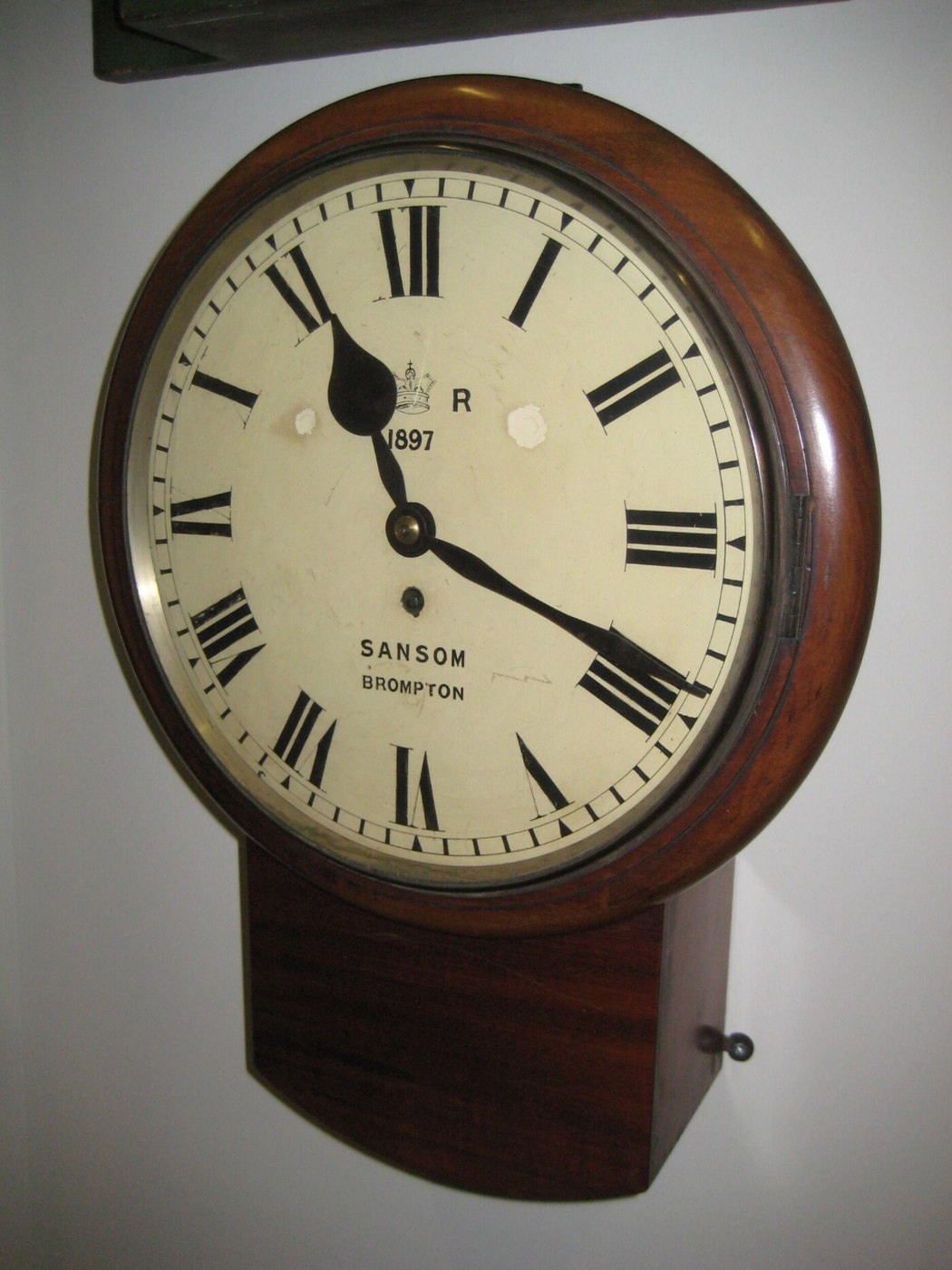
This mahogany wall clock with an enamel dial was produced by C. Sansom between 1890 and 1900. It features a circular upper housing for the dial and a lower rectangular case with a curved base, constructed from mahogany. The cream enamel dial displays Roman numerals, two black hands, and the inscription 'SANSOM, BROMPTON' below the winding hole. The clock contains a brass movement. It was originally installed within the offices of the South Kensington Museum (now the Victoria and Albert Museum), serving in the Chief Warder's office and later the Department of Furniture and Woodwork.

Front view of the mahogany wall clock showing the enamel dial, 'VR' 1897 marking, and maker signature 'SANSOM, BROMPTON'.
Front view of the mahogany wall clock showing the enamel dial, 'VR' 1897 marking, and maker signature 'SANSOM, BROMPTON'. — Victoria and Albert Museum. Rights pending — permission not yet requested. Original source

Catalogue identity

Source
collections.vam.ac.uk
Category
Clock · Wall clock
Maker / attribution
C. Sansom
Reference
Not recorded
Catalogue / lot identifier
W.2-2003
Source-reported date
1890-1900
Source-reported place
London

Source-reported attribution and specifications are not independent authentication. A listing does not establish present ownership, current display, availability or permission to reproduce.

Object description

Case and Dial Construction

The wall clock is constructed primarily from mahogany and features a distinct two-part housing. The upper portion contains a large cream enamel dial, which backs onto a small, rectangular mahogany casing that extends to a curved base at the bottom. The dial exhibits standard Roman numerals and is equipped with two black hands.

Visible markings on the dial include a crown with the initials 'VR' and the date 1897 located above the central hand mounting. Below the winding hole, the maker's name is painted directly onto the enamel. Access to the internal mechanism is provided via a door on the right-hand side of the case and a trap door located in the base. The exterior of the clock includes an iron loop at the top for mounting, complemented by mirror plates on the sides.

Evidence for this section
  • “Wall-clock with cream enamel dial backing on to and partially hiding a small rectangular mahogany clock case with a curved base”
  • “Above the hands is a crown with the initials 'VR' and the date 1897”
  • “There is a door in the right-hand side and a trap door in the base of the case”

Institutional History and Provenance

The clock was manufactured for use within the offices of the South Kensington Museum, now known as the Victoria and Albert Museum. The presence of the 'VR' initials and the 1897 date suggests it was acquired during the later years of Queen Victoria's reign to support official institutional functions. A crown with the initials 'VR' and the date 1897 is positioned above the hands, marking its association with official government use during the reign of Queen Victoria.

Throughout its service life, the clock occupied several administrative spaces, notably the Chief Warder's office in the 1950s and the Department of Furniture and Woodwork. It remained in active service until the department offices were merged in 2003, at which point the item was transferred to the permanent collection to represent the furnishings of public offices during the late 19th century.

Evidence for this section
  • “purchased for use in the offices of the Victoria and Albert Museum (known at that time as the South Kensington Museum)”
  • “This clock hung on the wall of the Furniture Department offices until the offices moved to merge with Textiles and Dress in 2003”
  • “the kind of plain, good quality furnishings supplied for public offices during the reign of Queen Victoria”

Marks and Inventory

The object retains several labels underneath the case which provide evidence of its internal administrative history within the museum environment. One label identifies it with the Chief Warder's Office and includes the date 15.6.53.

These layers of labels demonstrate the tracking and inventory systems used by the museum for its functional furniture. The clock is officially catalogued under the accession number W.2-2003, reflecting its transition from an active utility object to a curated museum piece.

Evidence for this section
  • “underneath: 3 labels stuck one on top of another”
  • “top one: V&A Museum Chief Warders Office w/o 5985 15.6.53 69 (within circle)”
  • “Accession number: W.2-2003”

Open research questions

  • What is the full name of the maker C. Sansom who operated in Brompton?
  • Are there extant company records for Sansom of Brompton regarding their supply contracts to the South Kensington Museum?

Source evidence

Recorded claims and source quotations for Sansom Mahogany Wall Clock
FieldSource-reported valueSource quotation
MakerC. Sansom“C. Sansom (maker)”
Date1890-1900“1890-1900”
MaterialsMahogany, enamel, brass“Mahogany and enamel with brass movement”
Accession NumberW.2-2003“W.2-2003”
InscriptionsSANSOM, BROMPTON“'SANSOM, BROMPTON'”
Dimensions50.5 x 37 x 14.5 cm“Height: 50.5 cm; Width: 37 cm; Depth: 14.5 cm”
Original locationSouth Kensington Museum“offices of the Victoria and Albert Museum (known at that time as the South Kensington Museum)”

Visible details

  • Cream enamel dial with black Roman numerals
  • Crown symbol above hands with initials VR and date 1897
  • Rectangular lower mahogany case section with curved base
  • Side-mounted winding hole access door

Research qualifications

  • Maker identity as C. Sansom is source-attributed but initials are not fully specified in maker field
  • Specific movement mechanics are not detailed beyond material composition

Photograph identity and source facts were screened before import; rights clearance remains pending.

Consulted source

Clock

Reviewed 2026-10-26 · Record 86003dfcb3

Terms in this record

Glossary explanations for terms named in this object’s record.