
Skip to content
The Encyclopedia of Horology

Clock · Cuckoo and quail mantel clock

Samuel Kammerer Exposed Cuckoo & Quail Mantel Clock

Partially verified

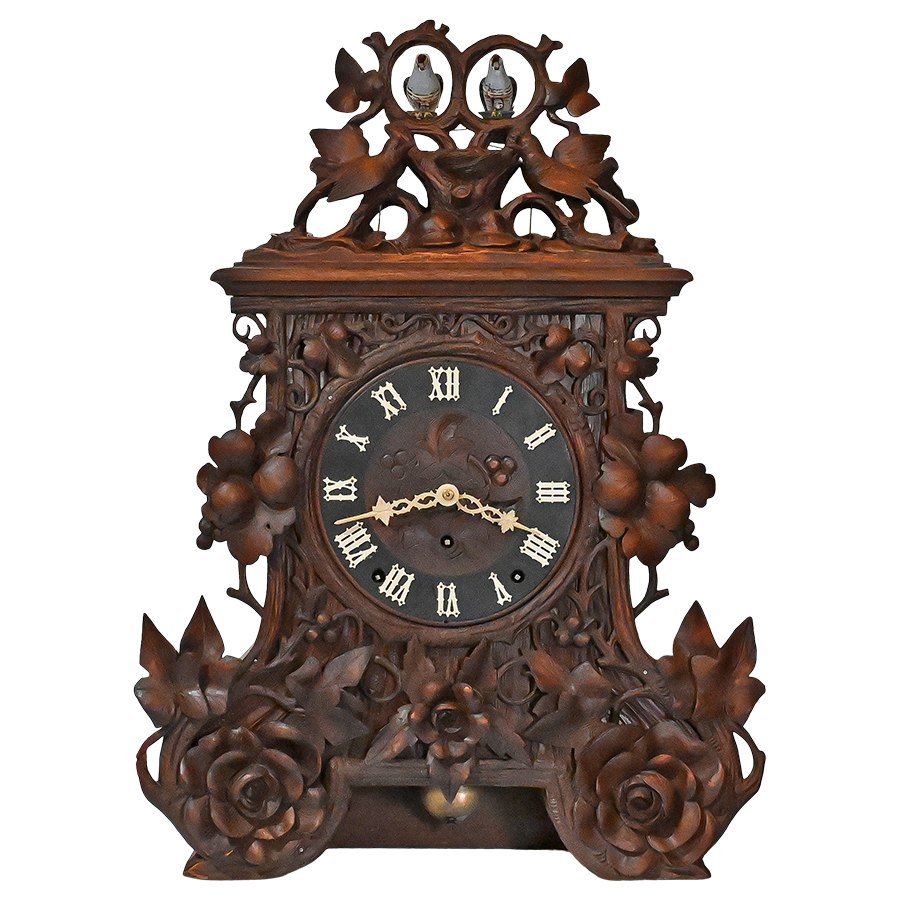
Attributed by the source to Samuel Kammerer of Furtwangen and dated to circa 1885, this German Black Forest mantel clock features an intricately hand-carved wooden case ornamented with vine and leaf fretwork and boldly carved roses. The crest displays an openwork design featuring two exposed birds flanking a nest of eggs. A dark circular wooden dial is set with applied Gothic bone Roman numerals and pierced bone hands. According to the seller, the clock is powered by an eight-day triple-fusee brass movement striking quarter hours on two coiled gongs.

Front view of the carved Black Forest cuckoo and quail mantel clock attributed to Samuel Kammerer
Front view of the carved Black Forest cuckoo and quail mantel clock attributed to Samuel Kammerer — Renaissance Antiques. Rights pending — permission not yet requested. Original source

Catalogue identity

Source
www.renaissanceantiques.com
Category
Clock · Cuckoo and quail mantel clock
Maker / attribution
Samuel Kammerer
Reference
AGER 21
Catalogue / lot identifier
Source URL identifies the listing
Source-reported date
Circa 1885
Country
Germany

Source-reported attribution and specifications are not independent authentication. A listing does not establish present ownership, current display, availability or permission to reproduce.

Object description

Case Design and Carved Motifs

The clock is housed in a richly hand-carved wooden mantel case centered on botanical and avian motifs. Flowing vine and leaf fretwork surrounds the body of the case, terminating at the base in boldly carved roses.

The crest features an openwork crown occupied by two exposed birds—described by the vendor as a cuckoo and a quail—flanking and guarding a nest of eggs atop branch fretwork, departing from typical enclosed automaton apertures.

Evidence for this section
  • “Carved openwork crest displays two birds flanking a nest of eggs atop branch fretwork, surmounted by two smaller figures in circular openings.”
  • “Flowing vine and leaf fretwork surrounds the body of the case, while boldly carved roses comprise the base.”

Dial Configuration

The circular dial is turned from dark wood and set directly into the carved facade. It is fitted with applied light-toned Gothic Roman numerals, which the vendor describes as bone.

Time is indicated by matching pierced openwork hands, also reported by the source to be made of bone, contrasting against the dark wooden dial plate.

Evidence for this section
  • “Dark circular wooden dial features applied light-toned Gothic Roman numerals and pierced openwork hands.”
  • “The circular wooden dial is fitted with Gothic bone Roman numerals and pierced bone hands”

Movement and Striking Train

According to the seller's description, the clock is powered by an eight-day triple-fusee brass movement featuring quarter-hour striking on two coiled gongs.

While the pendulum bob is visible through an opening in the lower base foliage, the internal movement plates, fusees, and striking trains remain enclosed within the casework and are not visible in the provided photograph.

Evidence for this section
  • “Powering the clock is a massive 8-day triple-fusee brass movement, featuring a quarter-hour striking on two coiled gongs”
  • “Base of the case is decorated with prominent carved multi-petal roses and foliage surrounding an opening through which the pendulum bob is visible.”

Open research questions

  • Are there maker stamps, trade labels, or serial inscriptions on the movement backplate or case interior confirming the Samuel Kammerer attribution?
  • How does the mechanical linkage actuate the exposed cuckoo and quail figures atop the crest during the striking sequence?
  • What specific restoration work was performed on the movement, fusee assemblies, and carved wooden fretwork?

Source evidence

Recorded claims and source quotations for Samuel Kammerer Exposed Cuckoo & Quail Mantel Clock
FieldSource-reported valueSource quotation
Maker AttributionSamuel Kammerer of Furtwangen“Samuel Kammerer of Furtwangen”
Movement8-day triple-fusee brass movement“8-day triple-fusee brass movement”
StrikingQuarter-hour striking on two coiled gongs“quarter-hour striking on two coiled gongs”
Dimensions27-½” High x 20” Wide x 7” Deep“27-½” High x 20” Wide x 7” Deep”
DateCirca 1885“Circa 1885”
Case Condition NoteSeller notes the clock has been restored“This clock has been restored and carries a one-year warranty.”
Dial Numerals and Hands MaterialBone“Gothic bone Roman numerals and pierced bone hands”

Visible details

  • Carved openwork crest displays two birds flanking a nest of eggs atop branch fretwork, surmounted by two smaller figures in circular openings.
  • Dark circular wooden dial features applied light-toned Gothic Roman numerals and pierced openwork hands.
  • Base of the case is decorated with prominent carved multi-petal roses and foliage surrounding an opening through which the pendulum bob is visible.

Research qualifications

  • Internal movement, fusees, and striking mechanism are not visible in the provided photograph.
  • Attribution to Samuel Kammerer of Furtwangen is source-reported and not independently verifiable from external marks in the photograph.

Photograph identity and source facts were screened before import; rights clearance remains pending.

Terms in this record

Glossary explanations for terms named in this object’s record.