
Skip to content
The Encyclopedia of Horology

Pocket watch · Quarter repeating watch

Repeating Watch with a Striking Mechanism

Partially verified

This gentleman's repeating watch, held in the collection of the Rijksmuseum (accession number BK-15090), is an example of early 19th-century horological engineering. Attributed to the period between circa 1800 and circa 1815, the timepiece is constructed from gold and features a diameter of 5 cm. Visually, the case is distinguished by engine-turned decoration on the back cover. The institutional records for this object state that there are no visible inscriptions, legends, or specific maker's marks present on the exterior or housing. The object is classified by the museum under the categories of jewellery and watch, though the specific horological classification remains a subject for further investigative research.

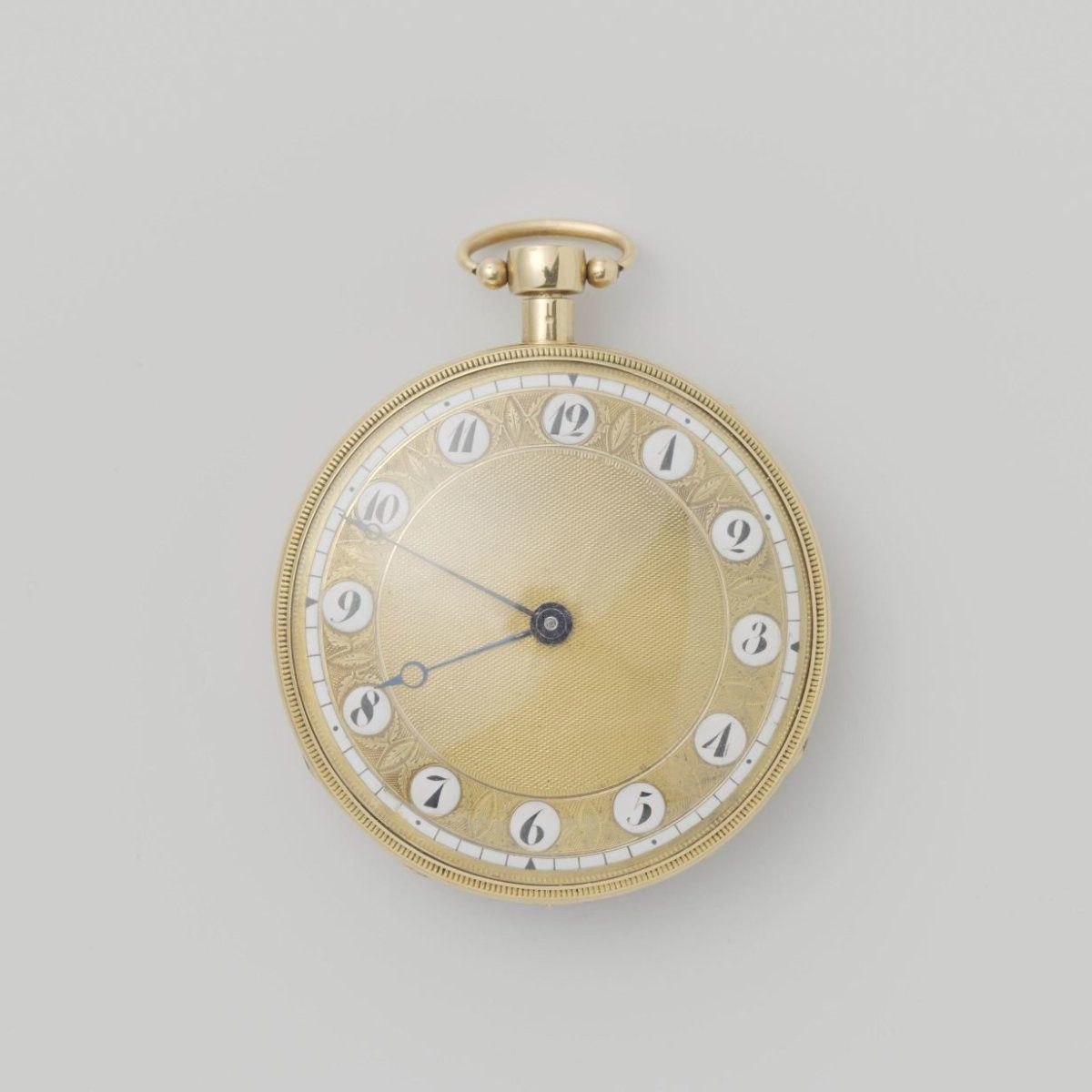
Front view of the gold repeating watch showing the engine-turned dial and chapter ring.
Front view of the gold repeating watch showing the engine-turned dial and chapter ring. — Rijksmuseum, Amsterdam. Rights pending — permission not yet requested. Original source

Catalogue identity

Source
orbiscollectibles.com
Category
Pocket watch · Quarter repeating watch
Maker / attribution
Not established
Reference
Not recorded
Catalogue / lot identifier
BK-15090
Source-reported date
c. 1800 - c. 1815
Source-reported place
Not established

Source-reported attribution and specifications are not independent authentication. A listing does not establish present ownership, current display, availability or permission to reproduce.

Object description

Construction and Design

The object is a gold-cased timepiece measuring 5 cm in diameter. The exterior back cover is finished with engine-turned patterns, a mechanical decorative technique consistent with the object's production era. The dial surface is also highly textured with a central engine-turned engine-turned finish that contrasts with the outer chapter ring.

The hour and minute hands are slender and appear dark in contrast to the gold-toned dial. The overall design features a minimalist aesthetic in terms of iconography, as the museum documentation explicitly notes the absence of any inscriptions or identifying legends on the piece. The housing includes a standard pendant and bow arrangement for suspension or attachment.

Evidence for this section
  • “made of gold (metal)”
  • “engine-turning applied to the back cover”
  • “diameter of 5 cm”
  • “The museum record does not note any inscriptions, legends, or markings on the object.”

Mechanism and Functionality

The watch functions as a repeating timepiece, specifically equipped with a quarter-repeating mechanism. This complication allows the user to trigger the watch to sound the time audibly, indicating the hours and the most recent quarter hour. Furthermore, the object contains a musical comb movement, providing an additional layer of mechanical complexity often found in high-end horological pieces of this era.

These two systems operate in tandem, housed within the 5 cm gold case. The presence of a musical comb suggests the object was intended to provide auditory entertainment beyond simple timekeeping functionality, a combination of technologies that indicates a high level of specialized mechanical assembly for the period.

Evidence for this section
  • “equipped with a quarter repeater mechanism and a musical comb movement”

Provenance and Documentation

The watch is currently part of the permanent collection of the Rijksmuseum in Amsterdam, where it is formally catalogued under the object number BK-15090. The museum provides the primary documentation for this object, with the data presented here representing a translation of the institutional catalogue.

As the object has no visible maker's marks or signatures, its exact origin and maker remain currently unattributed within the official record. The provided date range of circa 1800 to 1815 reflects the institution's assessment of its historical placement. Further research is necessary to compare the internal movement or construction techniques against known horological catalogs to better establish its manufacturing origins.

Evidence for this section
  • “The object is held by the Rijksmuseum in Amsterdam, where it is catalogued under the museum object number BK-15090.”
  • “dated to circa 1800 – circa 1815.”
  • “The record lists no maker or place of origin for the piece.”

Open research questions

  • What is the name of the movement manufacturer, given the lack of exterior signatures?
  • Are there internal hallmarks under the case back that indicate the assay office or date of the gold?
  • Does the musical movement have a known manufacturer associated with the Rijksmuseum's collection records?

Source evidence

Recorded claims and source quotations for Repeating Watch with a Striking Mechanism
FieldSource-reported valueSource quotation
Materialgold (metal)“made of gold (metal)”
Diameter5 cm“diameter of 5 cm”
Museum numberBK-15090“museum object number BK-15090”
Datec. 1800 - c. 1815“c. 1800 - c. 1815”
Mechanismquarter repeater and musical comb“equipped with a quarter repeater mechanism and a musical comb movement”
Decorationengine-turned“engine-turning applied to the back cover”
InscriptionsNone recorded“The museum record does not note any inscriptions, legends, or markings on the object.”

Visible details

  • Engine-turned dial surface with textured center
  • Chapter ring featuring applied or recessed numerals
  • Dark blue-toned hour and minute hands
  • Gold casing with decorative engine-turning on the back

Research qualifications

  • Maker and country of origin remain undocumented
  • The 'wrist watch' classification in the source is potentially anachronistic given the date range

Photograph identity and source facts were screened before import; rights clearance remains pending.

Consulted source

Repeating Watch with a Striking Mechanism

Reviewed 2026-11-02 · Record 4546d8797c

Terms in this record

Glossary explanations for terms named in this object’s record.