
Skip to content
The Encyclopedia of Horology

Tool · Italian polyhedral dial

Polyhedral sundial

Partially verified

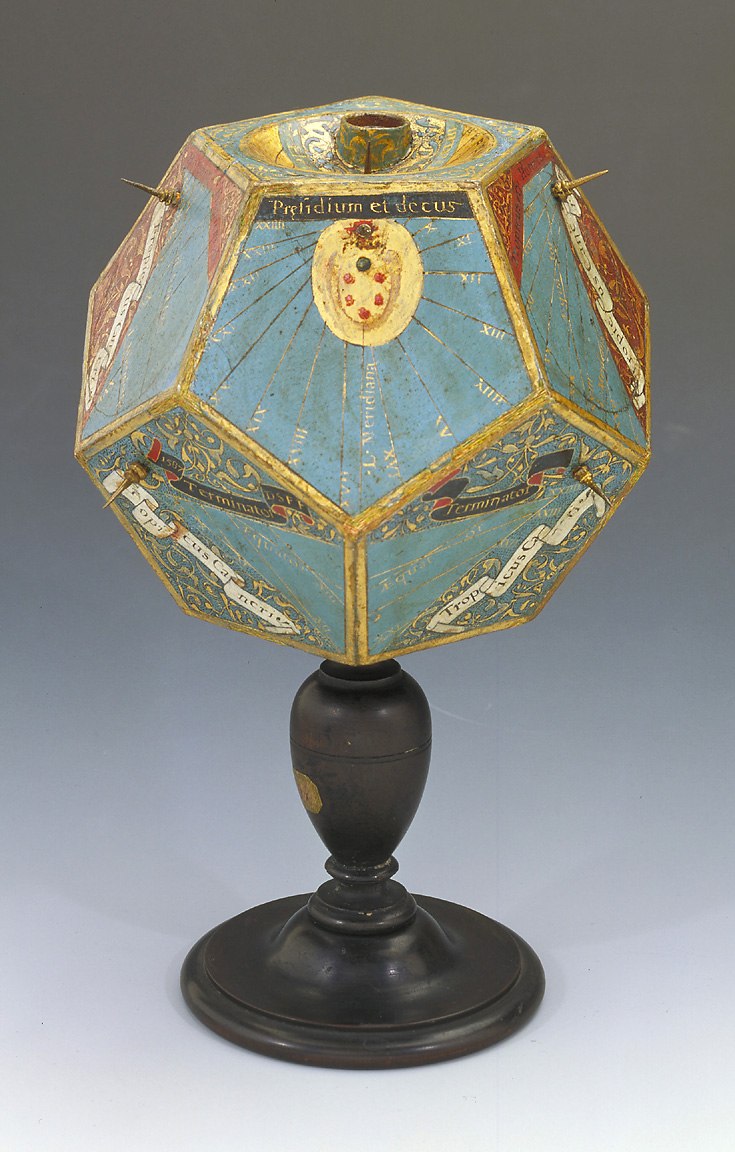
This polyhedral sundial, dated 1587 and signed by Stefano Buonsignori, is held at the Istituto e Museo di Storia della Scienza in Florence. Constructed from wood and standing 195 mm in height, the instrument is shaped as a regular dodecahedron mounted on a turned single-stem baluster pillar stand. The object features five reclining and declining faces, five inclining and declining faces, and one horizontal face. The horizontal top surface contains a pin gnomon scaphe dial intended for Italian hours, with a cavity that formerly held a compass. The faces are decorated with painted foliate designs, the Medici coat of arms, and Latin inscriptions. The dial surface of the scaphe is finished in gold and black with red detailing. Several surfaces bear moralizing mottoes in Latin, while the maker's initials, 'D.S.F.F.', representing 'Don Stefano Fiorentino Fecit', are present on the instrument.

Polyhedral sundial by Stefano Buonsignori, 1587.
Polyhedral sundial by Stefano Buonsignori, 1587. — © Istituto e Museo di Storia della Scienza, Firenze. Rights pending — permission not yet requested. Original source

Catalogue identity

Source
www.mhs.ox.ac.uk
Category
Tool · Italian polyhedral dial
Maker / attribution
Stefano Buonsignori
Reference
Not recorded
Catalogue / lot identifier
2456
Source-reported date
1587
Source-reported place
Italy

Source-reported attribution and specifications are not independent authentication. A listing does not establish present ownership, current display, availability or permission to reproduce.

Object description

Construction and Form

The object is formed as a regular dodecahedron, which serves as the base for multiple sundial surfaces. It stands on a turned single-stem baluster pillar. The geometric arrangement allows for various orientations, including five reclining and declining faces, five inclining and declining faces, and one horizontal face. The horizontal top face features a pin gnomon scaphe dial designed for Italian hours. A recess or cavity is positioned in the center above the gnomon, noted as having formerly contained a compass used for orienting the device towards the North to ensure accurate timekeeping through the projection of shadows.

The surface treatment involves detailed painting. The scaphe dial utilizes a gold-painted surface with black lines and numerals, accented by a red band inscribed with references to the Tropic of Capricorn and gold foliate patterns. Other faces incorporate blue grounds with gold foliation and white banderols identifying the tropics. The symmetry of the instrument's decoration is a deliberate feature, with dials and ornamentation mirrored across the opposing faces of the dodecahedron.

Evidence for this section
  • “Regular dodecahedron mounted on a turned single stem baluster pillar stand”
  • “The horizontal surface contains a pin gnomon scaphe dial for Italian hours with a small compass set in the free space above the gnomon.”
  • “The remaining spaces above and around the dial are filled with gold painted foliate decoration on a light blue ground.”

Decoration and Inscriptions

The instrument is heavily decorated with heraldic and didactic elements. One reclined face displays the Medici coat of arms, featuring a Cardinal's hat and the motto 'Presidium et decus'. This section is executed in gold, red, and black on a blue ground. The maker's identity is recorded through the monogram 'D.S.F.F.', which translates to 'Don Stefano Fiorentino Fecit'. This is accompanied by the date 1587, appearing on the left-hand dial of the lower grouping.

In addition to heraldic markers, the instrument carries lengthy Latin mottoes. These are found on the rims of the reclining scaphe dials situated beneath the horizontal top dial. The text includes phrases such as 'Hora diees mentiq{ue} simul ptervolat annus' and 'Tempus abit volat hora fugax'. These inscriptions are rendered in black lettering, integrating timekeeping functionality with philosophical themes prevalent in the object's construction period.

Evidence for this section
  • “Medici arms surmounted by a Cardinal's hat and the motto 'Presidium et decus' are painted in gold, red and black”
  • “The dial bears the monogram 'D.S.F.F.', an abbreviation of 'Don Stefano Fiorentino Fecit'.”
  • “the rims of the scaphe carrying the mottoes (left) 'Hora diees mentiq{ue} simul ptervolat annus non hic sed furtum et vera petendaq{u}es'”

Provenance and Attribution

The sundial is attributed to Stefano Buonsignori, an Olivetan friar who served as the cosmographer to Francesco I de' Medici. The association with the Medici dynasty is further reinforced by the presence of the family's coat of arms on the dial. The instrument is currently part of the collection at the Istituto e Museo di Storia della Scienza in Florence, identified by inventory number 2456.

Historical analysis by Anthony J. Turner describes the instrument's complexity and the specific arrangement of its faces. The object is officially documented within the Epact catalogue of scientific instruments from Medieval and Renaissance Europe.

Evidence for this section
  • “Polyhedral sundials of this kind, with finely decorated faces, are typical of the production of Stefano Buonsignori”
  • “Stefano Buonsignori , an Olivetan friar, who was cosmographer to Francesco I de' Medici.”
  • “Istituto e Museo di Storia della Scienza, Firenze”

Open research questions

  • What specific purpose did the missing compass serve in the function of the Italian hour dial?
  • Are there records of the original location or intended owner of this sundial within the Medici court?

Source evidence

Recorded claims and source quotations for Polyhedral sundial
FieldSource-reported valueSource quotation
MakerStefano Buonsignori“Signed by Stefano Buonsignori”
Date1587“Dated 1587”
Height195 mm“195 mm in height”
Inventory Number2456“Inventory number: 2456”
Maker's AbbreviationDon Stefano Fiorentino Fecit“'D.S.F.F.', an abbreviation of 'Don Stefano Fiorentino Fecit'”
ProvenanceIstituto e Museo di Storia della Scienza, Firenze“Istituto e Museo di Storia della Scienza, Firenze”

Visible details

  • Painted Medici coat of arms surmounted by a Cardinal's hat
  • Turned wood baluster pillar stand
  • Multifaceted dodecahedron form with individual gnomons on each face
  • Painted Latin inscriptions and scrollwork

Research qualifications

  • The compass for the upper cavity is missing
  • The specific intended location for the instrument's use is not stated

Photograph identity and source facts were screened before import; rights clearance remains pending.

Consulted source

Polyhedral Dial

Reviewed 2026-10-26 · Record c6928b8a27

Terms in this record

Glossary explanations for terms named in this object’s record.