
Skip to content
The Encyclopedia of Horology

Tool · Italian polyhedral dial

Polyhedral Dial by Girolamo della Volpaia

Partially verified

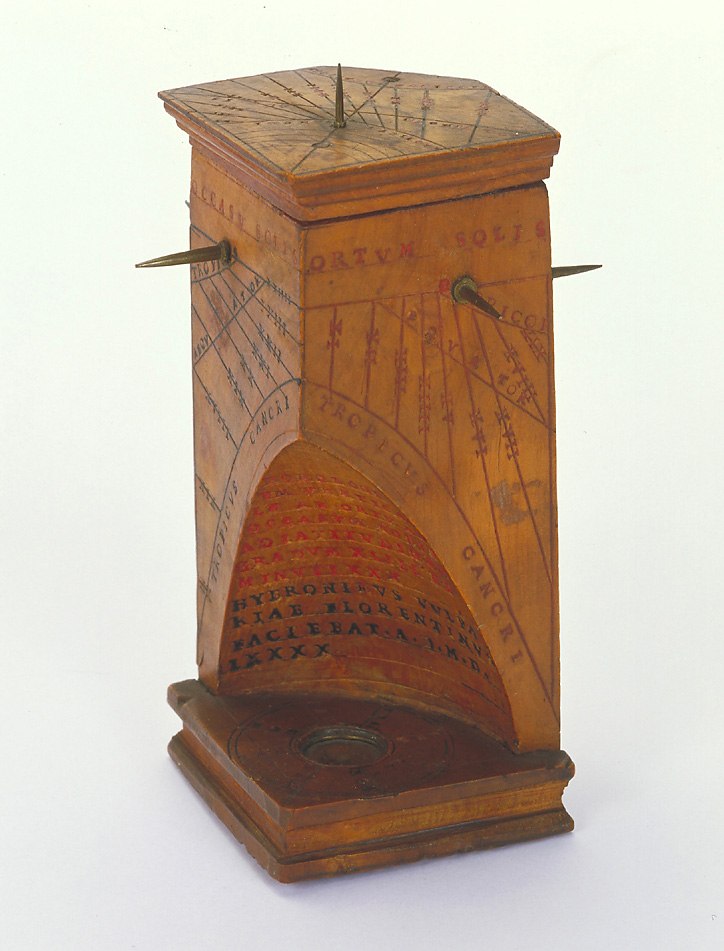
This wooden polyhedral sundial, measuring 110 mm in height, is signed by Girolamo della Volpaia and dated 1590. The instrument consists of a cube cut into six dial surfaces, mounted on a base containing an inset compass. Each face features specific hour lines and individual gnomons, designed for a latitude of 43 degrees 30 minutes, corresponding to Florence. The various dial surfaces indicate Italian hours, with lines and text highlighted in alternating red and black pigments. The central conical cut-out houses an extensive Latin inscription detailing the intended latitude and the maker's signature. The object is held in the collection of the Istituto e Museo di Storia della Scienza in Florence.

A wooden polyhedral sundial, inventory number 2460, featuring multiple gnomons, an integrated compass in the base, and an inscribed conical recess.
A wooden polyhedral sundial, inventory number 2460, featuring multiple gnomons, an integrated compass in the base, and an inscribed conical recess. — © Istituto e Museo di Storia della Scienza, Firenze. Rights pending — permission not yet requested. Original source

Catalogue identity

Source
www.mhs.ox.ac.uk
Category
Tool · Italian polyhedral dial
Maker / attribution
Girolamo della Volpaia
Reference
2460
Catalogue / lot identifier
2460
Source-reported date
1590
Source-reported place
Italy

Source-reported attribution and specifications are not independent authentication. A listing does not establish present ownership, current display, availability or permission to reproduce.

Object description

Construction and Design

The instrument is constructed from wood, reaching a total height of 110 mm. Its primary form is a cube that has been symmetrically carved to provide six distinct functional dial surfaces. These surfaces are calibrated for a latitude of 43 degrees 30 minutes, specifically for the location of Florence. To facilitate proper use, a small compass is inset directly into the base of the instrument, allowing the user to align the dials toward the north.

Each of the six surfaces is equipped with individual gnomons for shadow-casting. The hour lines and associated inscriptions are filled with alternating red and black colouring to improve legibility. The top face features a horizontal dial, while the side faces are dedicated to declining dials for various ranges of Italian hours.

Evidence for this section
  • “A cube symmetrically cut to give six dial surfaces”
  • “All the dials on the instrument are thus for 43? 30' (Florence) and are alternately filled with red or black colouring.”
  • “Below the inscription a small compass is set into the horizontal base”

Signatures and Inscriptions

The instrument bears a clear signature identifying the maker as Girolamo della Volpaia, the son of Camillo and descendant of the instrument maker Lorenzo della Volpaia. This signature is integrated into a Latin inscription located within a conical recess carved into the front of the cube. The text states the geographical purpose and the date of the instrument's manufacture.

The inscription is engraved directly into the wood. Additional markings are present on the dial faces themselves, providing specific hours for different directional orientations. These include phrases such as 'ORTVM SOLI' and 'OCCASV SOLI', along with specific Latin mottos and technical designations for the declining dials.

Evidence for this section
  • “Below the surface of these two dials the cube is undercut in conical form to carry the inscription 'AB ORTV AD OCCASVM SOLIS AD LATITVDINEM GRADVM XLIII ET MINVTII XXX' followed by the signature.”
  • “The front two faces of the instrument marked 'OCCASV SOLI' and 'ORTVM SOLI' carry declining dials”

Context and Provenance

This sundial is preserved within the collection of the Istituto e Museo di Storia della Scienza in Florence. It is noted as being part of the Medicean collection, which historically contained a variety of scientific instruments used at the Medici court.

The maker, Girolamo della Volpaia, was part of a prominent family of instrument makers in Florence. His work is historically linked to the needs and patronage of the Medici family, who were significant collectors and users of such specialized scientific apparatus during the Renaissance period.

Evidence for this section
  • “It is of the same type, and of similar style and material, to an anonymous instrument preserved, like this one, in the Medicean collection”
  • “a member of the family of instrument makers, beginning with Lorenzo, who worked for the Medici court.”

Open research questions

  • What specific methods were used to seal or treat the wood surface to preserve the red and black colour in the engravings?
  • Are there other documented polyhedral dials by the same maker that share identical conical inscription carvings?

Source evidence

Recorded claims and source quotations for Polyhedral Dial by Girolamo della Volpaia
FieldSource-reported valueSource quotation
MakerGirolamo della Volpaia“Signed by Girolamo della Volpaia”
Inventory Number2460“Inventory no. 2460”
Date1590“Dated 1590”
Dimensions110 mm height“110 mm in height”
Latitude43 degrees 30 minutes“All the dials on the instrument are thus for 43? 30' (Florence)”
OriginFlorence“Florence”

Visible details

  • Horizontal dial surface features a central gnomon
  • Visible conical recession with engraved Latin text and signature
  • Compass integrated into the wooden base for orientation
  • Multiple protruding metallic gnomons for different dial faces

Research qualifications

  • The source describes the object as a triangular prism in the overview but clarifies it is a cube cut to six surfaces in the detail section
  • Attribution relies entirely on the signature present on the instrument itself

Photograph identity and source facts were screened before import; rights clearance remains pending.

Consulted source

Polyhedral Dial

Reviewed 2026-10-26 · Record 610eb90af6

Terms in this record

Glossary explanations for terms named in this object’s record.

Other italian polyhedral dial records