
Skip to content
The Encyclopedia of Horology

Tool · Italian polyhedral dial

Polyhedral Sundial

Partially verified

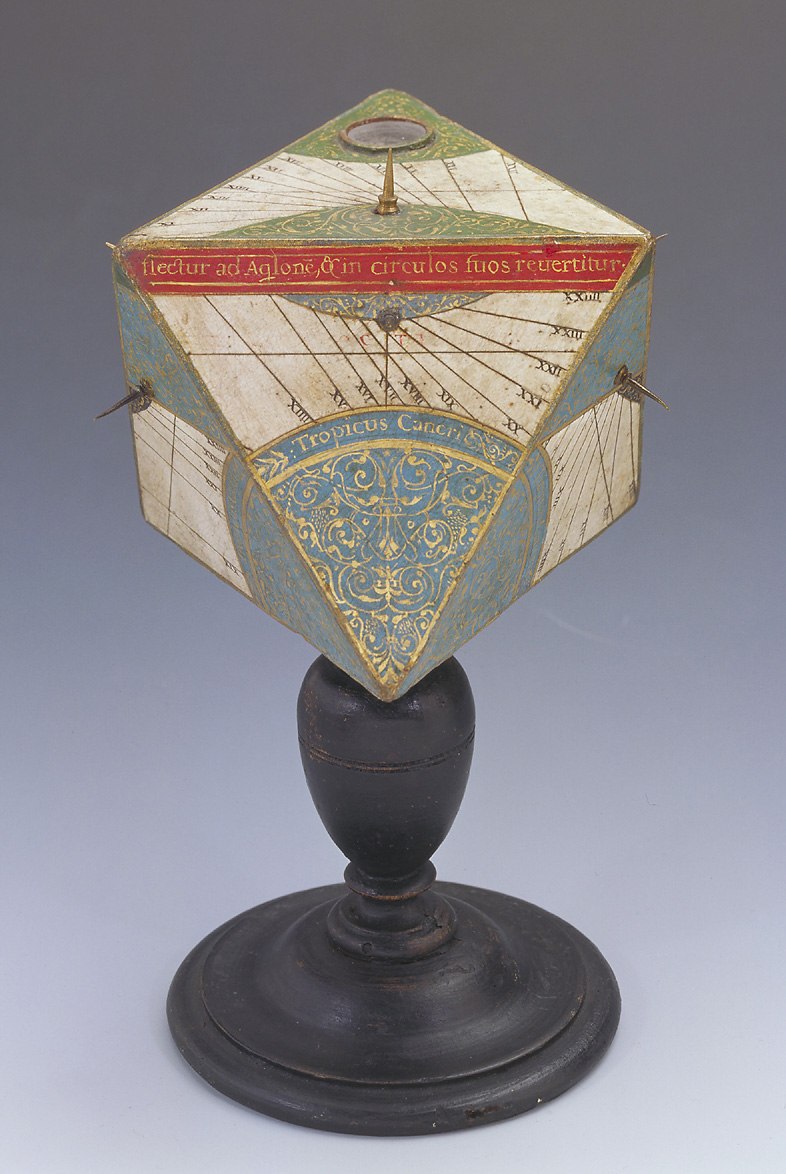
This table-top polyhedral sundial is an octahedron measuring 160 mm in height, mounted on a turned baluster pillar stand. The instrument is crafted from wood and features painted decorations in blue, red, and gold. The surfaces are calibrated for a latitude of 43° 30', intended for use in Florence and Pisa. The dial surfaces include horizontal, reclining, and inclining faces, each featuring pin gnomons and hour lines traced for Italian timekeeping. The horizontal surface incorporates an inset magnetic compass. While unsigned, the instrument is attributed to Stefano Buonsignori, an Olivetan friar who served Francesco I de' Medici, based on the construction techniques and the specific style of the applied foliate ornamentation. The dial surfaces are painted in white with black line work, contrasted by areas of red, blue, and green grounds decorated with flowing gold foliate patterns.

A polyhedral wooden sundial with an octagonal head (regular octahedron) and a turned wooden pedestal, featuring a compass on the top surface and decorative gold foliate motifs.
A polyhedral wooden sundial with an octagonal head (regular octahedron) and a turned wooden pedestal, featuring a compass on the top surface and decorative gold foliate motifs. — Istituto e Museo di Storia della Scienza, Firenze. Rights pending — permission not yet requested. Original source

Catalogue identity

Source
www.mhs.ox.ac.uk
Category
Tool · Italian polyhedral dial
Maker / attribution
attributed to Stefano Buonsignori
Reference
2455
Catalogue / lot identifier
2455
Source-reported date
16th century
Source-reported place
Italy

Source-reported attribution and specifications are not independent authentication. A listing does not establish present ownership, current display, availability or permission to reproduce.

Object description

Construction and Geometry

The sundial is constructed as a regular octahedron made of wood, measuring 160 mm in height. It is supported by a turned single-stem baluster pillar stand, which elevates the dial for observation. The geometry of the octahedron allows for a variety of dial surfaces, including three inclining and declining faces, three reclining and declining faces, and a single horizontal top surface.

The surfaces are finished with a white ground upon which the hour lines are drawn in black. The dial includes pin gnomons on various faces, consistent with the requirements for the indicated latitude. The horizontal surface, which houses an inset compass, is painted on a green ground, a feature that distinguishes it from the red, blue, or black backgrounds found elsewhere on the instrument.

Evidence for this section
  • “Octahedron mounted on a turned single stem baluster pillar stand and thus offering three inclining and declining dial surfaces”
  • “Wood; 160 mm in height”
  • “The single horizontal surface has an inset compass and an Italian hours dial IX to XXII and foliate decoration which, although typical of Buonsignori, is unusually drawn on a green ground.”

Calibration and Inscriptions

The dial is calibrated specifically for a latitude of 43° 30', corresponding to the cities of Florence and Pisa. This specification is explicitly stated in an inscription on the north inclining face: 'Elevatio poli Boreales Graduum Quadragintatrium Minutorum XXX'. The dials are designed to indicate Italian hours.

The three reclining dials feature a Latin motto arranged in horizontal bands across the top of each dial. The text reads: 'Oritur sol & occidit & at locum suum / revertitur ibiq{ue} renasces girat p{er} meridien' / 'flectur ad Aq{ui}lone, & in circulos suos revertitur'. These inscriptions are painted in a clear, legible script on the face of the instrument.

Evidence for this section
  • “The dials are drawn for Italian hours with pin gnomons for latitude 43? 30' as is stated in an inscription on the north inclining face”
  • “The three reclining dials carry a motto in an horizontal band at the top of the dial.”

Attribution and Decoration

Although the instrument does not bear a signature, it is attributed to Stefano Buonsignori, an Olivetan friar who was in the service of Francesco I de' Medici during the 16th century. The attribution rests on the specific construction and the decoration techniques employed.

The instrument displays controlled, flowing foliate decoration in gold applied over grounds of red, blue, or black. While the dials are drawn in black on a white ground, the overall decorative scheme aligns with the known output of the friar's workshop.

Evidence for this section
  • “Although the instrument is unsigned, the way in which it is decorated and constructed suggest its attribution to Stefano Buonsignori”
  • “The instrument otherwise employs the controlled flowing foliate decoration in gold on a red, blue or black ground characteristic of Buonsignori's dials”

Open research questions

  • Are there other extant polyhedral dials attributed to Buonsignori that share this specific octagonal geometry?
  • What is the function of the 'season and equator lines' mentioned in the source, and how are they integrated into the primary hour-line layout?

Source evidence

Recorded claims and source quotations for Polyhedral Sundial
FieldSource-reported valueSource quotation
Inventory Number2455“Inventory no. 2455”
MakerStefano Buonsignori“Attributed to Stefano Buonsignori”
MaterialWood“Wood; 160 mm in height”
Latitude43° 30'“calibrated for a latitude of 43? 30'”
FormOctahedron“Octahedron mounted on a turned single stem baluster pillar stand”
InscriptionElevatio poli Boreales Graduum Quadragintatrium Minutorum XXX“inscription on the north inclining face 'Elevatio poli Boreales Graduum Quadragintatrium Minutorum XXX'”
Dial markingsItalian hours“The dials are drawn for Italian hours”

Visible details

  • The dial is shaped as a regular octahedron.
  • It stands on a dark, turned wood baluster pillar.
  • A compass is set into the horizontal top surface.

Research qualifications

  • The attribution to Stefano Buonsignori is based on stylistic analysis rather than a signature.
  • The green ground used on the horizontal surface is noted as an unusual departure from the maker's typical color palette.

Photograph identity and source facts were screened before import; rights clearance remains pending.

Consulted source

Polyhedral Dial

Reviewed 2026-10-26 · Record 45d760e8ed

Terms in this record

Glossary explanations for terms named in this object’s record.