
Skip to content
The Encyclopedia of Horology

Tool · Italian polyhedral dial

Polyhedral Sundial

Partially verified

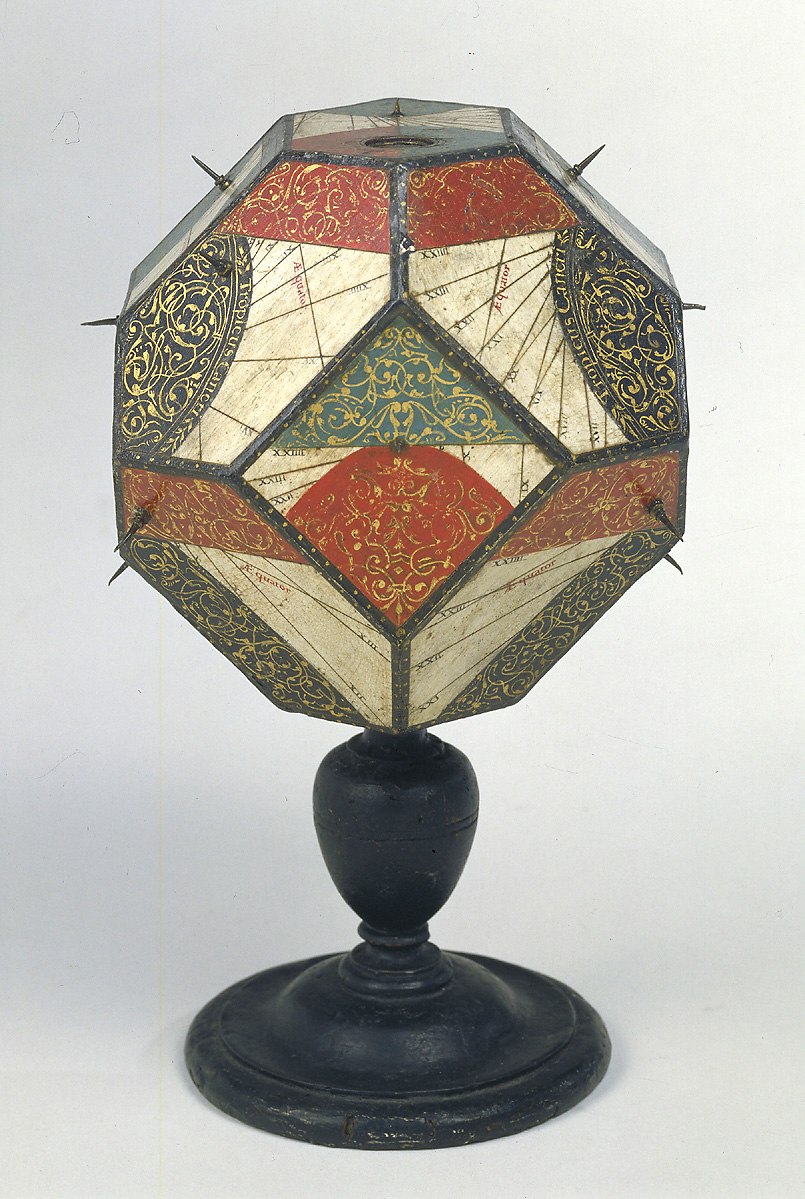
This polyhedral sundial, inventory number 2458, is held by the Istituto e Museo di Storia della Scienza in Florence. Constructed of wood and standing 205 mm in height, it features an eighteen-faced polyhedron mounted upon a turned single stem baluster pillar. The instrument serves as a table sundial with various dial surfaces, including inclining, declining, reclining, vertical, and horizontal faces, which incorporate pin gnomons and are inscribed for Italian hours. Decoration consists of gold foliate patterns set against red, blue, or black grounds, with dial markings in black on a white ground. The object includes an inset compass for orientation and bears signatures attributed to Stefano Buonsignori, an Olivetan Friar and cosmographer. The dial construction includes season and equator lines, with symmetrical decoration around the north and south faces, and utilizes a wood stand for support.

Polyhedral sundial in wood with gold foliate decoration and black-on-white dial markings, supported by a baluster stand.
Polyhedral sundial in wood with gold foliate decoration and black-on-white dial markings, supported by a baluster stand. — Istituto e Museo di Storia della Scienza, Firenze. Rights pending — permission not yet requested. Original source

Catalogue identity

Source
www.mhs.ox.ac.uk
Category
Tool · Italian polyhedral dial
Maker / attribution
Stefano Buonsignori
Reference
Not recorded
Catalogue / lot identifier
2458
Source-reported date
16th century
Source-reported place
Italy

Source-reported attribution and specifications are not independent authentication. A listing does not establish present ownership, current display, availability or permission to reproduce.

Object description

Physical Structure and Geometry

The instrument is a polyhedral table sundial composed of eighteen distinct faces. These surfaces are oriented to provide a variety of dial types, encompassing six inclining and declining surfaces, six reclining and declining surfaces, four vertical faces, and a single horizontal face. The entire assembly is supported by a turned wood baluster pillar stand.

The faces themselves are decorated with gold foliate designs applied over painted grounds of red, blue, or black. In contrast, the dial markings and inscriptions are drawn in black ink on white grounds. The unit includes an inset compass within the horizontal face, intended for proper solar orientation during use.

Evidence for this section
  • “eighteen decorated and painted faces”
  • “Eighteen-faced polyhedron mounted on a turned single stem baluster pillar stand”
  • “the single horizontal dial having an inset compass”

Dial Markings and Gnomonics

The sundial is configured for Italian hours, indicated by pin gnomons protruding from the faces. While the hour markings are described as undivided, the surface details include the frequent inclusion of equator and season lines. The layout of the faces is symmetrical, centered around the north and south orientations of the device.

The inscriptions are varied across the different surfaces to accommodate the specific geometry of horizontal, vertical, and declining dial configurations. The precision of these markings allows for the identification of the different types of sundials integrated into the single polyhedral form.

Evidence for this section
  • “The dials are drawn for Italian hours with pin gnomons”
  • “All hours are undivided although season and equator lines are frequently marked”
  • “The decoration is symmetrical around the north and south faces”

Signatures and Attribution

The instrument carries evidence of its creation, featuring the initials 'DSF' and a distinct 'S'. This signage is associated with Stefano Buonsignori, who served as a cosmographer at the court of Francesco I de' Medici. The 'DSF' mark is located near the 'Tropicus Cancri' band, while the 'S' is found on the red-painted lower horizontal surface near the stand.

The combination of these markings and the specific decorative techniques provide the basis for the museum's attribution to the Florentine maker.

Evidence for this section
  • “The instrument is signed 'DSF'”
  • “The dial is signed at the end of the 'Tropicus Cancri' band”
  • “It is further signed by a single 'S' marked on the red painted lower horizontal surface”

Open research questions

  • What is the exact functional relationship between the 'DSF' signature and the documented career of Stefano Buonsignori?
  • Are there missing pin gnomons from any of the eighteen faces visible in the photograph?

Source evidence

Recorded claims and source quotations for Polyhedral Sundial
FieldSource-reported valueSource quotation
MakerStefano Buonsignori“Signed by Stefano Buonsignori”
Height205 mm“205 mm in height”
Date16th century“16th century”
Inventory number2458“Inventory number: 2458”
ConstructionEighteen-faced polyhedron“Eighteen-faced polyhedron mounted on a turned single stem baluster pillar stand”

Visible details

  • Eighteen decorated polyhedral faces
  • Turned wooden baluster pillar stand
  • Visible pin gnomons on multiple surfaces
  • Gold-leaf foliate scrollwork decoration

Research qualifications

  • Attribution to Stefano Buonsignori based on stylistic characteristics and 'DSF'/'S' markings
  • Exact geographical provenance within Florence relies on museum records

Photograph identity and source facts were screened before import; rights clearance remains pending.

Consulted source

Polyhedral Dial

Reviewed 2026-10-26 · Record 68eae9aa79

Terms in this record

Glossary explanations for terms named in this object’s record.