
Construction and Design
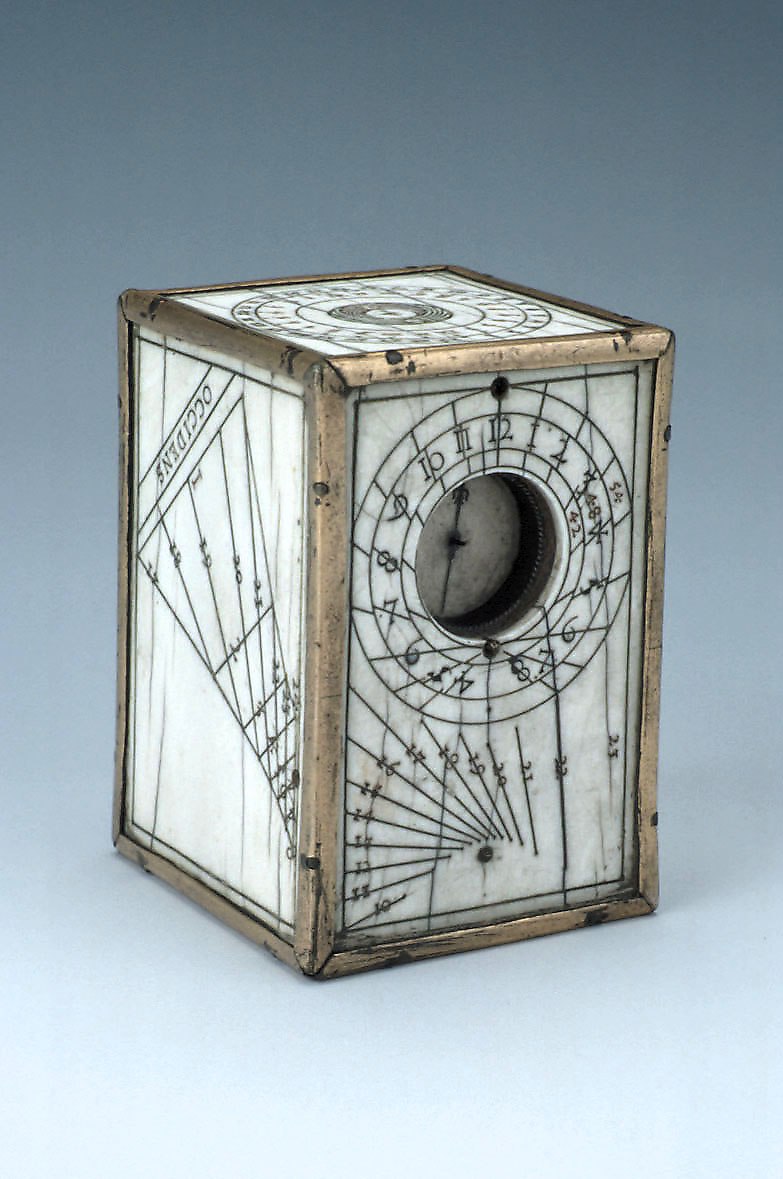
The sundial is designed as a rectangular parallelepiped, utilizing ivory as the primary material for its panels, which are framed by gilt brass edging. The compact dimensions of 82 x 58 x 54 mm reflect the portability required for such scientific instruments during the late 16th century. The maker, Hans Tucher of Nuremberg, applied precise engraving to all six faces to maximize the instrument's utility across different light conditions and timekeeping standards.
The faces contain integrated sundials and a lunar volvelle, demonstrating a multifunctional approach to horology. Each face is stamped with identifying labels or instructions, such as 'OCCIDENS' for the west-facing dial and 'ORIENS' for the east-facing dial. The design incorporates both standard and Italian hour systems, providing versatility for the user. Although the object remains in a structurally recognizable state, evidence of its historical usage and the passage of time is present in the missing components, specifically the compass assembly and the lunar volvelle plate.
Evidence for this section
- “The six faces of the polyhedral dial are stamped and engraved as follows.”
- “This ivory polyhedral dial is an unusual product from his workshop.”