
Skip to content
The Encyclopedia of Horology

Tool · Nuremberg polyhedral dial

Polyhedral Dial

Partially verified

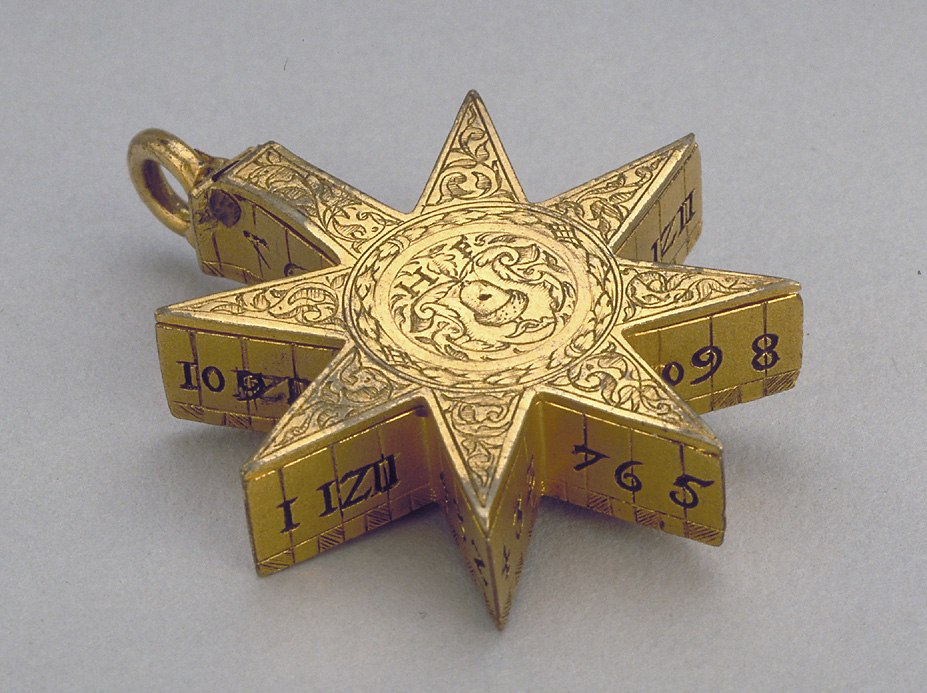
This polyhedral dial is constructed from gilt brass and takes the form of an eight-pointed star. Measuring 59 x 10 mm, the object functions as a sundial by indicating common hours from 1 to 12 across its multiple facets. It features a fixed suspension ring, a hinged strut for setting latitude, and an internal latitude scale ranging from 30 to 55. The exterior lid surface displays foliage decoration and the initials 'H F' alongside an acorn mark, which is attributed to the Nuremberg maker Hans Felt. The instrument contains an internal compartment, originally housing a pivoted compass, though the needle, ring, and glass components are currently missing. The underside of the box and the compass cover are engraved with foliage and a helmed head respectively. The piece was donated by A.W. Franks in 1857 and is held within the British Museum collection.

Polyhedral dial in the form of an eight-pointed star, showing the top lid with engraved foliage, the initials 'H F', and an acorn.
Polyhedral dial in the form of an eight-pointed star, showing the top lid with engraved foliage, the initials 'H F', and an acorn. — British Museum, London. Rights pending — permission not yet requested. Original source

Catalogue identity

Source
www.mhs.ox.ac.uk
Category
Tool · Nuremberg polyhedral dial
Maker / attribution
Hans Felt
Reference
Not recorded
Catalogue / lot identifier
MLA 1857, 8-4.35
Source-reported date
circa 1550
Source-reported place
Nuremberg

Source-reported attribution and specifications are not independent authentication. A listing does not establish present ownership, current display, availability or permission to reproduce.

Object description

Construction and Design

The object is a polyhedral dial configured as an eight-pointed star. The device is manufactured from gilt brass and is sized at approximately 59 mm by 10 mm. The design incorporates a fixed suspension ring intended for external use, allowing the instrument to be suspended and oriented relative to the sun.

The lid's external surface features engraved foliage ornamentation centered around the initials 'H F' and an acorn motif. These markings have been identified as a signature, with research suggesting an attribution to the Nuremberg-based maker Hans Felt. The internal plate provides a latitude scale labeled 'ELVFACI POLI', which is marked from 30 to 55 and divided into single-degree increments.

Evidence for this section
  • “This polyhedral dial , in the form of an eight-pointed star”
  • “The initials 'H F' and an acorn appear on the top of the box”
  • “The inside of the lid has an unequal scale of latitudes from 30 to 55”

Functionality and Internal Components

The instrument measures time by displaying hours on the lateral facets of the star points. These hours are engraved as a sequence of numbers from 1 to 12, with the markings including half-hour divisions. A specific face includes a modification where an engraving error was corrected during production.

To enable precise timekeeping, the dial utilizes a hinged strut to adjust for latitude. The box interior, which features further foliage engraving, contains a compartment for a compass. At the time of inspection, the compass assembly, including the needle, ring, and protective glass, is absent from the box.

Evidence for this section
  • “The external part of the box is the dial indicating common hours from 1 to 12 on the different sides”
  • “The box contains a small pivoted compass (needle, ring and glass missing) which is now detached.”
  • “on this face an error has been corrected by the maker”

Provenance and History

This sundial is part of the collection of the British Museum in London. It was acquired by the museum following a gift from A.W. Franks in 1857. It has been documented within the museum's registry and specialized scientific instrument surveys.

Academic analysis of the instrument, including its attribution, has been recorded in the works of F. A. B. Ward, specifically in the 1981 catalog of European scientific instruments held by the Department of Medieval and Later Antiquities.

Evidence for this section
  • “Registration no. MLA 1857, 8-4.35”
  • “The instrument was presented by A.W. Franks, Esq., in 1857”
  • “described in F. A. B. Ward, A Catalogue of European Scientific Instruments”

Open research questions

  • What specific archival evidence confirms the identification of the maker as Hans Felt?
  • At what point in the object's history were the internal compass components lost?

Source evidence

Recorded claims and source quotations for Polyhedral Dial
FieldSource-reported valueSource quotation
MakerHans Felt“Zinner suggests that 'H F' may stand for the Nuremberg maker Hans Felt.”
MaterialGilt brass“Gilt brass”
Dimensions59 x 10 mm“59 x 10 mm”
Inventory numberMLA 1857, 8-4.35“Registration no. MLA 1857, 8-4.35”
ProvenancePresented by A.W. Franks“The instrument was presented by A.W. Franks, Esq., in 1857”
OriginNuremberg“circa 1550; Nuremberg”

Visible details

  • Eight-pointed star geometric form
  • Gilt brass construction
  • Engraved foliage and signature on lid
  • Internal latitude scale inscription 'ELVFACI POLI'

Research qualifications

  • Compass needle, ring, and glass are missing
  • Attribution to Hans Felt is suggested by Zinner based on initials

Photograph identity and source facts were screened before import; rights clearance remains pending.

Consulted source

Polyhedral Dial

Reviewed 2026-10-26 · Record 3bfeaefc5e

Terms in this record

Glossary explanations for terms named in this object’s record.