
Skip to content
The Encyclopedia of Horology

Tool · Nuremberg polyhedral dial

Polyhedral Dial by Paul Reinmann

Partially verified

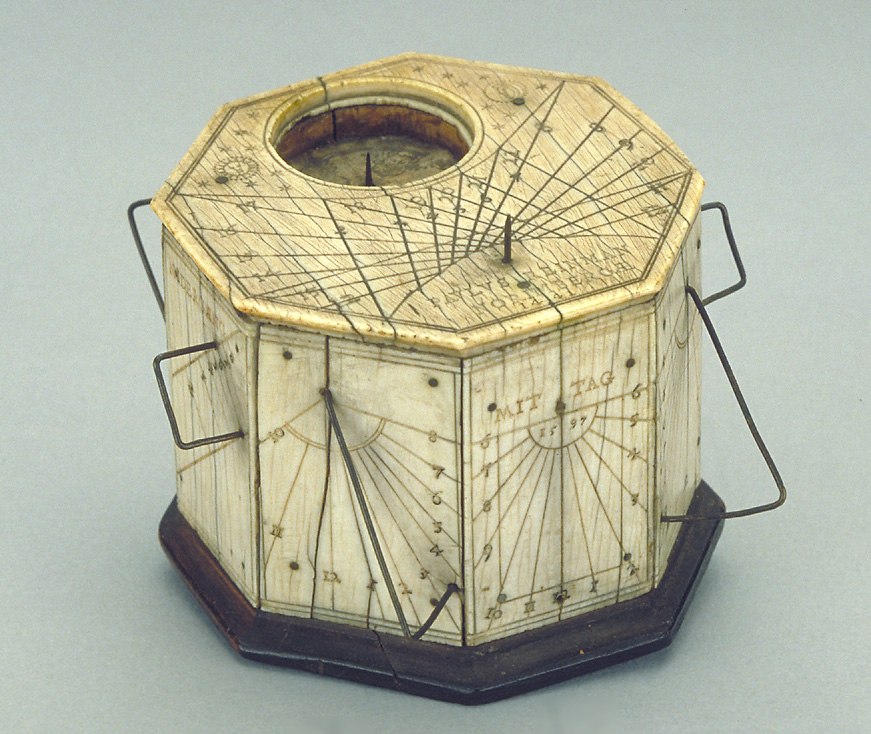
This polyhedral dial, originating from Nuremberg and dated 1597, is constructed from an octagonal wood block covered with ivory layers. Measuring 70 x 72 x 64 mm, it incorporates multiple timekeeping systems including pin gnomon and wire gnomon dials. The top face features a compass, though the glass, needle, and ring are missing, accompanied by sun and moon effigies. The instrument rests on bun feet, one of which is now absent. The instrument was bequeathed by Octavius Morgan to the British Museum. The seven vertical faces exhibit various wire dials indicating common hours, while additional inscriptions such as "MITTAG", "AVFGANG", "MITTERNACHT", and "NI{E}DERGANG" define specific solar time parameters. The maker’s mark, representing a crown, is punched twice on the fifth face.

A view of the polyhedral ivory sundial showing the top compass, wire gnomons, and the date 1597 on the 'MITTAG' face.
A view of the polyhedral ivory sundial showing the top compass, wire gnomons, and the date 1597 on the 'MITTAG' face. — British Museum, London. Rights pending — permission not yet requested. Original source

Catalogue identity

Source
www.mhs.ox.ac.uk
Category
Tool · Nuremberg polyhedral dial
Maker / attribution
Paul Reinmann
Reference
Not recorded
Catalogue / lot identifier
MLA 1888, 12-1.284
Source-reported date
1597
Source-reported place
Nuremberg

Source-reported attribution and specifications are not independent authentication. A listing does not establish present ownership, current display, availability or permission to reproduce.

Object description

Design and Construction

The dial is constructed from an octagonal block of wood, which is entirely encased in layers of carved ivory. It serves as a polyhedral timekeeping instrument, utilizing both pin gnomon dials and wire gnomon dials across its various surfaces. The structure is supported by bun feet, although the piece is currently noted as missing one of these feet.

The top face of the instrument features an integrated compass. This section is decorated with carvings of four putti, as well as sun and moon effigies. However, the original function of the compass is compromised as the glass, needle, and internal ring are no longer present. Below the compass is a pin gnomon dial that displays Italian hours from 12 to 22 and Babylonian hours from 1 to 12.

Evidence for this section
  • “This polyhedral dial is made from an octagonal block of wood, covered with layers of ivory.”
  • “The top of the dial has a compass (glass, needle and ring missing) decorated with four putti.”
  • “The dial rests on four bun feet, one of which is missing.”

Signatures, Marks and Dating

The object bears a signature identifying the maker as Paul Reinmann of Nuremberg. There are two distinct dates present on the instrument.

A second date, 1597, appears on one of the octagonal faces and is considered consistent with the overall style of the instrument. The maker's mark, depicted as a crown, is punched twice onto the fifth face of the dial.

Evidence for this section
  • “Signed by Paul Reinmann”
  • “The date 1441 on the top is probably a later addition, since the style of the numerals is characteristic of a later date.”
  • “The maker's mark (a crown) is punched twice on this face.”

Dial Configuration and Inscriptions

The seven vertical faces of the octagon are equipped with wire gnomon dials, with the exception of the first face, which is missing its wire. These dials are designed to track common hours across different segments of the day. Various faces include descriptive inscriptions such as 'MITTAG' (midday), 'AVFGANG' (sunrise), 'MITTERNACHT' (midnight), and 'NI{E}DERGANG' (sunset).

The fifth face utilizes a pin gnomon dial rather than wire. Each face is calibrated differently to track specific hour ranges, with some indicating common hours from 3 to 8, others from 4 to 12 to 2, or from 10 to 12 and 1 to 8. These various configurations demonstrate the instrument's capacity for measuring time through diverse solar methods.

Evidence for this section
  • “It has a pin gnomon dial on the top and on one of the faces, and unusual wire dials on the other seven faces.”
  • “The first of the octagonal faces is missing its wire. It marks common hours from 6 to 12 to 6, and is inscribed 'MITTAG', with the date 1597.”
  • “the fifth face has a pin gnomon dial indicating common hours from 4 to 8 twice, and is inscribed 'MITTERNACHT'.”

Open research questions

  • What is the historical significance of the crown maker's mark in relation to other instruments by Paul Reinmann?
  • Is there further evidence in the British Museum records to support the identification of the 1441 inscription as a later addition?

Source evidence

Recorded claims and source quotations for Polyhedral Dial by Paul Reinmann
FieldSource-reported valueSource quotation
MakerPaul Reinmann“Signed by Paul Reinmann”
Date1597“Dated 1597; Nuremberg”
MaterialsIvory and wood“Ivory and wood; 70 x 72 x 64 mm”
Dimensions70 x 72 x 64 mm“70 x 72 x 64 mm”
Inventory NumberMLA 1888, 12-1.284“Registration no. MLA 1888, 12-1.284”
Maker's MarkCrown symbol“The maker's mark (a crown) is punched twice on this face.”
ProvenanceOctavius Morgan“The instrument was bequeathed by Octavius Morgan”

Visible details

  • Ivory-covered octagonal wooden body
  • Multiple wire gnomon dials across faces
  • Compass area on top currently lacks internal components
  • Maker's mark of a crown punched on the fifth face

Research qualifications

  • Date 1441 is noted as likely a later addition
  • Compass components missing

Photograph identity and source facts were screened before import; rights clearance remains pending.

Consulted source

Polyhedral Dial

Reviewed 2026-10-26 · Record 9d47f40ddd

Terms in this record

Glossary explanations for terms named in this object’s record.