
Skip to content
The Encyclopedia of Horology

Tool · Nuremberg polyhedral dial

Polyhedral Dial by Hans Tucher

Partially verified

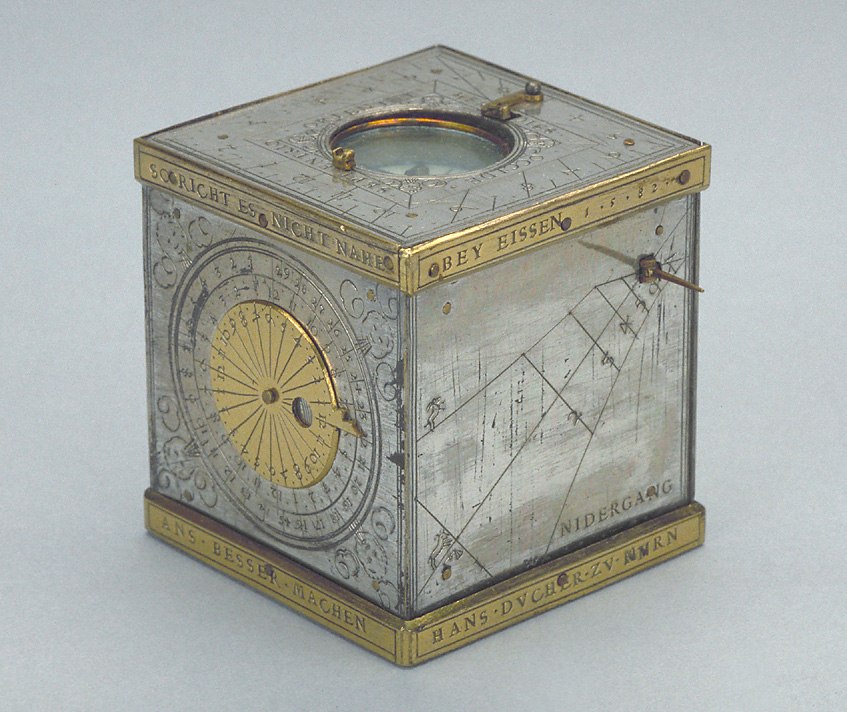
This 1582 polyhedral dial, attributed to maker Hans Tucher of Nuremberg, measures 58 x 58 x 62 mm. The instrument consists of a central wooden block covered in silver and brass plates. The top plate’s original triangular gnomon is missing. The four side faces are equipped with folding pin gnomons and include a lunar volvelle for time conversion and dials for indicating sunset, sunrise, and daylight hours, alongside zodiacal symbols. The object is encased with gilt metal rims bearing two distinct German inscriptions providing advice on usage and a personal remark from the maker. The instrument is currently held in the British Museum collection, having been acquired in 1857.

Polyhedral dial by Hans Tucher, 1582, showing the side faces and top plate with the compass and lunar volvelle.
Polyhedral dial by Hans Tucher, 1582, showing the side faces and top plate with the compass and lunar volvelle. — British Museum, London. Rights pending — permission not yet requested. Original source

Catalogue identity

Source
www.mhs.ox.ac.uk
Category
Tool · Nuremberg polyhedral dial
Maker / attribution
Hans Tucher
Reference
Not recorded
Catalogue / lot identifier
MLA 1857, 5-23.2
Source-reported date
1582
Source-reported place
Nuremberg

Source-reported attribution and specifications are not independent authentication. A listing does not establish present ownership, current display, availability or permission to reproduce.

Object description

Construction and Design

The object is a polyhedral sundial measuring 58 x 58 x 62 mm, constructed from a wooden block. This core is finished with silver and brass plates. The top face holds an ivory compass at its center, with the cardinal points abbreviated, and engraved with blowing putti. Although the central gnomon on this top plate is now missing, the plate includes hour lines divided to half-hour and quarter-hour increments.

The four sides of the cube provide various temporal functions using folding pin gnomons. One face contains a pierced gilt lunar volvelle for converting solar and lunar times. The remaining three faces feature specific dials: one for sunset ('NIDERGANG') with zodiacal symbols, one for sunrise ('AVFFGANG'), and one showing daylight duration. Each face is framed by gilt metal rims containing the object's inscriptions.

Evidence for this section
  • “This cuboid dial is made of silver and brass plates on a wooden block.”
  • “The first of the four side faces of the cube has a silver plate, on which is a pierced gilt lunar volvelle with rotating arm for converting lunar and solar times.”
  • “On gilt metal rims on the tops and bottoms of the cube sides are two inscriptions.”

Signatures and Inscriptions

The dial is signed by Hans Tucher of Nuremberg, with the maker's mark consisting of a punched hunting horn located near the ivory compass. The piece bears two distinct German inscriptions on the gilt metal rims. The first warns the user that the compass and dial should not be used in the proximity of iron to ensure accurate readings.

The second inscription includes the maker's name and a proverbial phrase, translated as 'don't laugh at things unless you can do better'.

Evidence for this section
  • “Signed by Hans Tucher”
  • “the maker's mark (a hunting horn) punched.”
  • “The second inscription reads 'DER SPO[Vumlaut]TER SOL NICHS VERACHTEN DEN ER KANS BESSER MACHEN ('don't laugh at things unless you can do better') HANS DVCHER ZV NVRN{BERG}'.”

Provenance and Documentation

The polyhedral dial is part of the collection of the British Museum under registration number MLA 1857, 5-23.2. The object was acquired in 1857.

The reference catalogue specifically notes the instrument's dimensions and its functional reliance on the presence of the gnomons, some of which remain as folding pins on the side faces of the cube.

Evidence for this section
  • “The instrument was purchased in 1857 and is described in F. A. B. Ward, A Catalogue of European Scientific Instruments in the Department of Medieval and Later Antiquities of the British Museum (London, 1981), p. 32, no.65.”
  • “Registration no. MLA 1857, 5-23.2”

Open research questions

  • What is the metallurgical composition of the gilt rims and internal components beyond the mentioned silver and brass?
  • Are there extant examples of Tucher's work that still retain the triangular gnomons missing from this specimen?

Source evidence

Recorded claims and source quotations for Polyhedral Dial by Hans Tucher
FieldSource-reported valueSource quotation
MakerHans Tucher“Signed by Hans Tucher”
Date1582“Dated 1582”
Dimensions58 x 58 x 62 mm“58 x 58 x 62 mm”
MaterialsBrass, wood, silver, ivory“This cuboid dial is made of silver and brass plates on a wooden block. The silver top plate has at its centre an ivory compass”
Maker's MarkHunting horn“the maker's mark (a hunting horn) punched”
CollectionBritish Museum“British Museum, London”
Inscription 1Regarding compass usage and iron“'WEN DAS SONNEN STO[Vumlaut] CKLEIN RECHT SOL WEISEN SO RICHT ES NICHT NAHE BEY EISSEN 1582'”
Inscription 2Personal remark by Hans Tucher“'DER SPO[Vumlaut]TER SOL NICHS VERACHTEN DEN ER KANS BESSER MACHEN ('don't laugh at things unless you can do better') HANS DVCHER ZV NVRN{BERG}'”

Visible details

  • Ivory compass inset on the top plate
  • Folding pin gnomons on side faces
  • Lunar volvelle for time conversion
  • Two inscriptions on gilt metal rims

Research qualifications

  • The gnomon on the top dial is missing
  • Original purpose of the triangular gnomon is assumed by the source

Photograph identity and source facts were screened before import; rights clearance remains pending.

Consulted source

Polyhedral Dial

Reviewed 2026-10-26 · Record 6b1146cc95

Terms in this record

Glossary explanations for terms named in this object’s record.