
Skip to content
The Encyclopedia of Horology

Movement · Repeating pocket watch movement

Pocket Watch Mechanism by Barraud

Partially verified

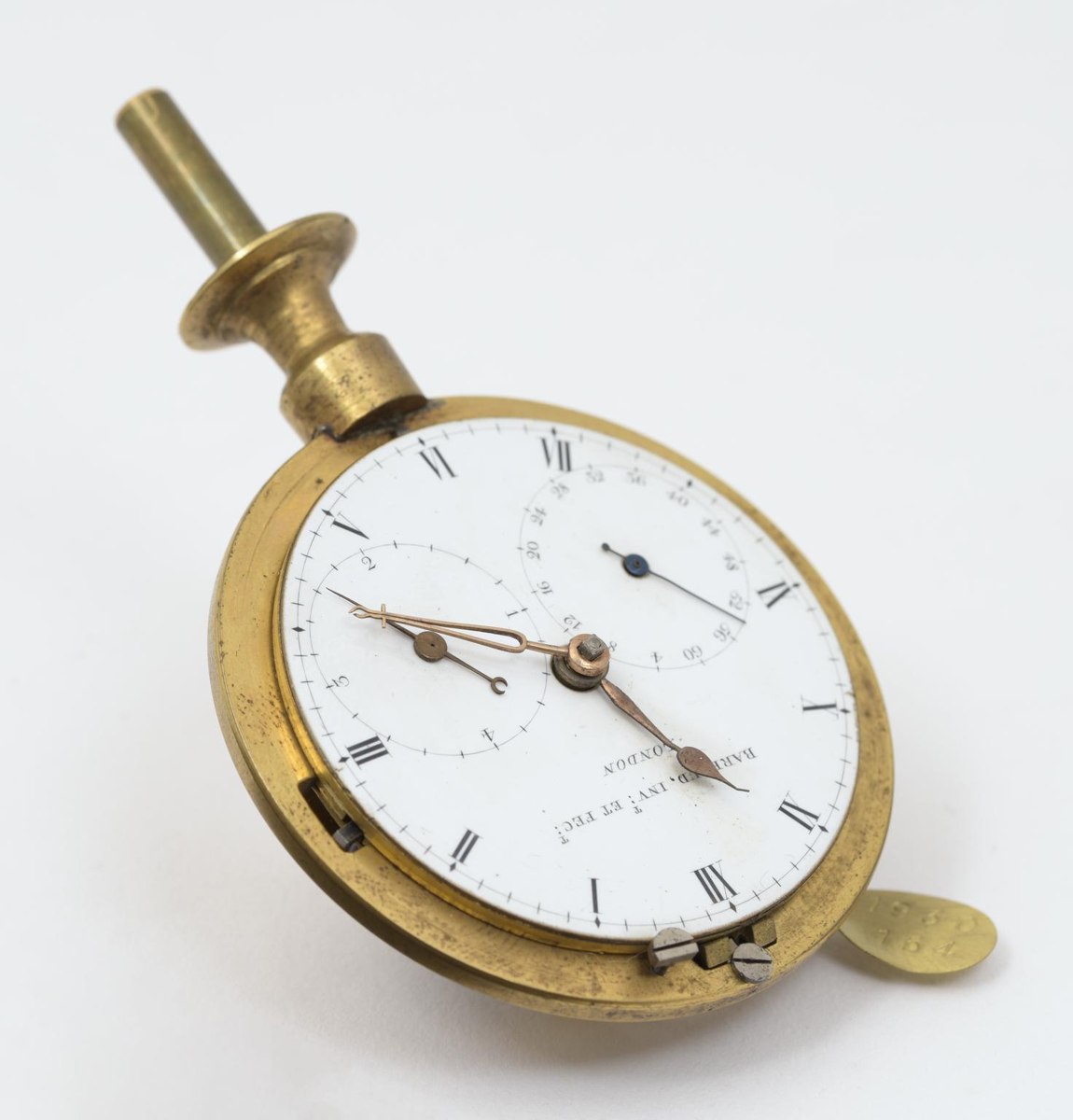
This repeating pocket watch movement was produced in London between 1780 and 1810 by the Barraud family. Preserved in the Science Museum Group collection under object number 1930-154, the mechanism incorporates enamel, brass, and steel components. The circular brass chassis holds a white enamel dial featuring Roman numerals for the hours along the rim, complemented by two subsidiary dials. A substantial turned brass pendant tube projects from the top rim, while the lower perimeter retains screws and a collection tag bearing the accession number.

Dial and brass frame of the Barraud repeating pocket watch movement
Dial and brass frame of the Barraud repeating pocket watch movement — The Board of Trustees of the Science Museum. Rights pending — permission not yet requested. Original source

Catalogue identity

Source
collection.sciencemuseumgroup.org.uk
Category
Movement · Repeating pocket watch movement
Maker / attribution
Barraud family
Reference
Not recorded
Catalogue / lot identifier
1930-154
Source-reported date
1780-1810
Country
United Kingdom

Source-reported attribution and specifications are not independent authentication. A listing does not establish present ownership, current display, availability or permission to reproduce.

Object description

Object Classification and Museum Identity

This artifact represents a repeating pocket watch movement preserved under object number 1930-154. Recorded by the Science Museum Group under the category of Time Measurement and type 'pocket watch', the movement is credited to Mr. H. W. Ravenshaw. The museum records its maker as the Barraud family, dating production to 1780-1810 in London.

The complete object measures 18 mm in depth, 51 mm in width, and 80 mm in height, with an overall recorded weight of 0.08 kg. Listed materials comprise enamel, brass (copper, zinc alloy), and steel (metal). As catalogued, the artifact consists of the movement assembly and dial rather than a complete, cased watch.

Evidence for this section
  • “Object Number: 1930-154”
  • “Category: Time Measurement”
  • “type: pocket watch”
  • “credit: Mr. H. W. Ravenshaw”
  • “Made: 1780-1810 in London”
  • “maker: Barraud family”
  • “Measurements: overall: 18 mm x 51 mm x 80 mm, .08kg”
  • “Materials: enamel , brass (copper, zinc alloy) and steel (metal)”

Dial Display and Inscriptions

The assembly features a circular white enamel dial fitted with central gold-toned hands along with two subsidiary scales. Black Roman numeral hour markers ring the perimeter, and a blued steel hand is visible on the upper subsidiary dial.

Visible on the dial face near the lower section are the inscriptions 'BARRAUD, INV. ET FEC.' and 'LONDON'. The underlying gearing and specific complications related to these displays are not visible from the dial-facing viewpoint.

Evidence for this section
  • “White enamel dial with black Roman numeral hour markers and two subsidiary scales.”
  • “Central gold-toned hands with a blued steel hand visible on the upper subsidiary dial.”
  • “Dial inscription reads 'BARRAUD, INV. ET FEC.' and 'LONDON' near the lower section.”

Mechanical Mount and Visible Frame

The dial is mounted within a brass chassis that houses the movement. An elongated brass pendant stem featuring a flared collar extends directly outward from the top of the brass frame.

Attached near the bottom edge of the assembly is an oval brass tag stamped with the accession number '1930 154'. Screws remain positioned along the perimeter, though internal components such as the repeating striking train, escapement, and balance are not visible from this angle.

Evidence for this section
  • “Elongated brass pendant stem with a flared collar extending from the top of the brass frame.”
  • “An oval brass tag bearing the accession number '1930 154' is attached near the bottom edge.”
  • “Repeating movement by Barraud, London, 1780-1810”

Open research questions

  • What specific repeating configuration (e.g., quarter or minute repeating) is utilized by the movement?
  • What functions are indicated by the upper and lower subsidiary dials?
  • Does the reverse plate or cock bear workshop numbering or individual signatures beyond the dial inscription?

Source evidence

Recorded claims and source quotations for Pocket Watch Mechanism by Barraud
FieldSource-reported valueSource quotation
Object Number1930-154“Object Number: 1930-154”
MakerBarraud family“maker: Barraud family”
Date and Origin1780-1810 in London“Made: 1780-1810 in London”
Type DescriptionRepeating movement“Repeating movement by Barraud, London, 1780-1810”
MaterialsEnamel, brass (copper, zinc alloy) and steel (metal)“Materials: enamel , brass (copper, zinc alloy) and steel (metal)”
Measurements18 mm x 51 mm x 80 mm, .08kg“Measurements: overall: 18 mm x 51 mm x 80 mm, .08kg”
Acquisition CreditMr. H. W. Ravenshaw“credit: Mr. H. W. Ravenshaw”
Museum CategoryTime Measurement“Category: Time Measurement”
Typepocket watch“type: pocket watch”

Visible details

  • White enamel dial with black Roman numeral hour markers and two subsidiary scales.
  • Central gold-toned hands with a blued steel hand visible on the upper subsidiary dial.
  • Dial inscription reads 'BARRAUD, INV. ET FEC.' and 'LONDON' near the lower section.
  • Elongated brass pendant stem with a flared collar extending from the top of the brass frame.
  • An oval brass tag bearing the accession number '1930 154' is attached near the bottom edge.

Research qualifications

  • The outer watch case is not present; only the movement and dial structure are preserved.
  • The internal gearing, escapement, and repeating train are not visible from the dial side.

Photograph identity and source facts were screened before import; rights clearance remains pending.

Consulted source

Pocket Watch Mechanism by Barraud, 1780-1810 | Science Museum Group Collection

Reviewed 2026-10-21 · Record e3b78a4242

Terms in this record

Glossary explanations for terms named in this object’s record.