
Skip to content
The Encyclopedia of Horology

Clock · Pendulum clock

Pendulum Clock Replica

Partially verified

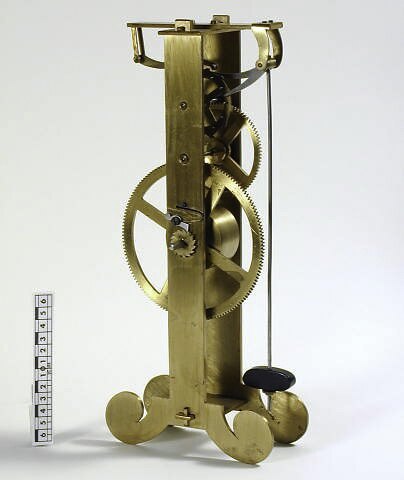
This object is a replica of a pendulum clock design attributed to Galileo Galilei. The original design concept originated shortly before the death of Galileo in 1642, with subsequent construction attempts historically associated with his son, Vincenzio, in 1649. The replica was commissioned in 1959 and constructed by A. E. Coke in Scoresby, Victoria. The model is based on historical drawings produced after Galileo's death and on models constructed during the 19th century. The clock is defined by its exposed mechanism, which is mounted between two vertical brass plates. It features a mainspring contained within a brass drum that powers a large cog wheel to drive the gear train. The timekeeping mechanism utilizes a pendulum connected to an escapement system, described as having a combination of verge and anchor components, intended to control the rate of the clock.

The Galileo pendulum clock replica featuring exposed brass gearing and a pendulum with a dark bob.
The Galileo pendulum clock replica featuring exposed brass gearing and a pendulum with a dark bob. — Museums Victoria. Rights pending — permission not yet requested. Original source

Catalogue identity

Source
collections.museumsvictoria.com.au
Category
Clock · Pendulum clock
Maker / attribution
A. E. Coke
Reference
Not recorded
Catalogue / lot identifier
ST 29858
Source-reported date
1959
Source-reported place
Australia

Source-reported attribution and specifications are not independent authentication. A listing does not establish present ownership, current display, availability or permission to reproduce.

Object description

Mechanical Construction

The clock is constructed as an open framework with the mechanical components mounted between two parallel vertical brass strips. The power source consists of a mainspring housed within a brass drum, which drives the primary cog wheel of the gear train.

The regulation of the movement is achieved through a pendulum system. This pendulum is linked to the gear train via a specific escapement assembly. According to the descriptive records provided for this item, this escapement incorporates features of both a verge and an anchor mechanism.

Evidence for this section
  • “Mechanism held between two brass strips, mainspring in brass drum turns large cog wheel that drives gears.”
  • “The pendulum connects via an escapement that is part verge and part anchor.”

Design Provenance

The object functions as a replica based on the design concepts attributed to Galileo Galilei. These designs were produced shortly before his death in 1642. Historical records associated with the design suggest that his son, Vincenzio, attempted to construct the mechanism in 1649.

The current replica is based on archival drawings that were generated following the death of Galileo, as well as 19th-century models that attempted to interpret the original specifications. The commission for this specific physical model was fulfilled in 1959 by A. E. Coke in Victoria, Australia.

Evidence for this section
  • “Model of a pendulum clock designed by Galileo (1564-1642) shortly before his death and partly constructed by his son Vincenzio in 1649.”
  • “Replica based on drawings made after Galileo's death and subsequent models constructed in the 19th century.”

Historical Context

The design represents an early attempt at utilizing a pendulum to regulate timekeeping accuracy. Galileo utilized a pendulum for his own astronomical observations, which preceded the development of practical pendulum clocks in the mid-17th century.

The development of the first practical pendulum clock is credited to Christiaan Huygens in 1657, placing the original Galileo concept as a precursor to these later advancements in horological technology.

Evidence for this section
  • “Galileo was the first to suggest using a pendulum to more accurately control the rate of a clock.”
  • “The first practical pendulum clock was designed by Huygens in 1657.”

Open research questions

  • Which 19th-century models specifically informed the construction of this replica?
  • Does the mechanism currently function as a working clock or is it a non-operational display piece?

Source evidence

Recorded claims and source quotations for Pendulum Clock Replica
FieldSource-reported valueSource quotation
MakerA. E. Coke“Maker, name: A. E. Coke, date: 1959”
DesignerGalileo Galilei“Designer, name: Galileo Galilei, date: 1642”
Construction date1959“This model made by A.E. Coke, Scoresby, Victoria, 1959.”
Registration numberST 29858“Registration number: ST 29858”
Dimensions15 cm x 7 cm x 34 cm“Overall Dimensions, dimensions: 15 cm (Length), 7 cm (Width), 34 cm (Height)”
Mechanism materialsBrass“Mechanism held between two brass strips, mainspring in brass drum”

Visible details

  • Vertical brass plate frame construction
  • Exposed mainspring in a brass drum
  • Pendulum with a dark, weighted bob
  • Support base with curved, decorative feet

Research qualifications

  • Exact historical accuracy of the original Galileo drawings referenced is not specified
  • The escapement is described as a hybrid of verge and anchor, which may not represent any single historical standard

Photograph identity and source facts were screened before import; rights clearance remains pending.

Consulted source

Pendulum Clock Replica - Galileo, 1642

Reviewed 2026-10-26 · Record c0cebbf315

Terms in this record

Glossary explanations for terms named in this object’s record.