
Skip to content
The Encyclopedia of Horology

Clock · Pendulum clock

Louis XVI bronze lion clock by Causard

Partially verified

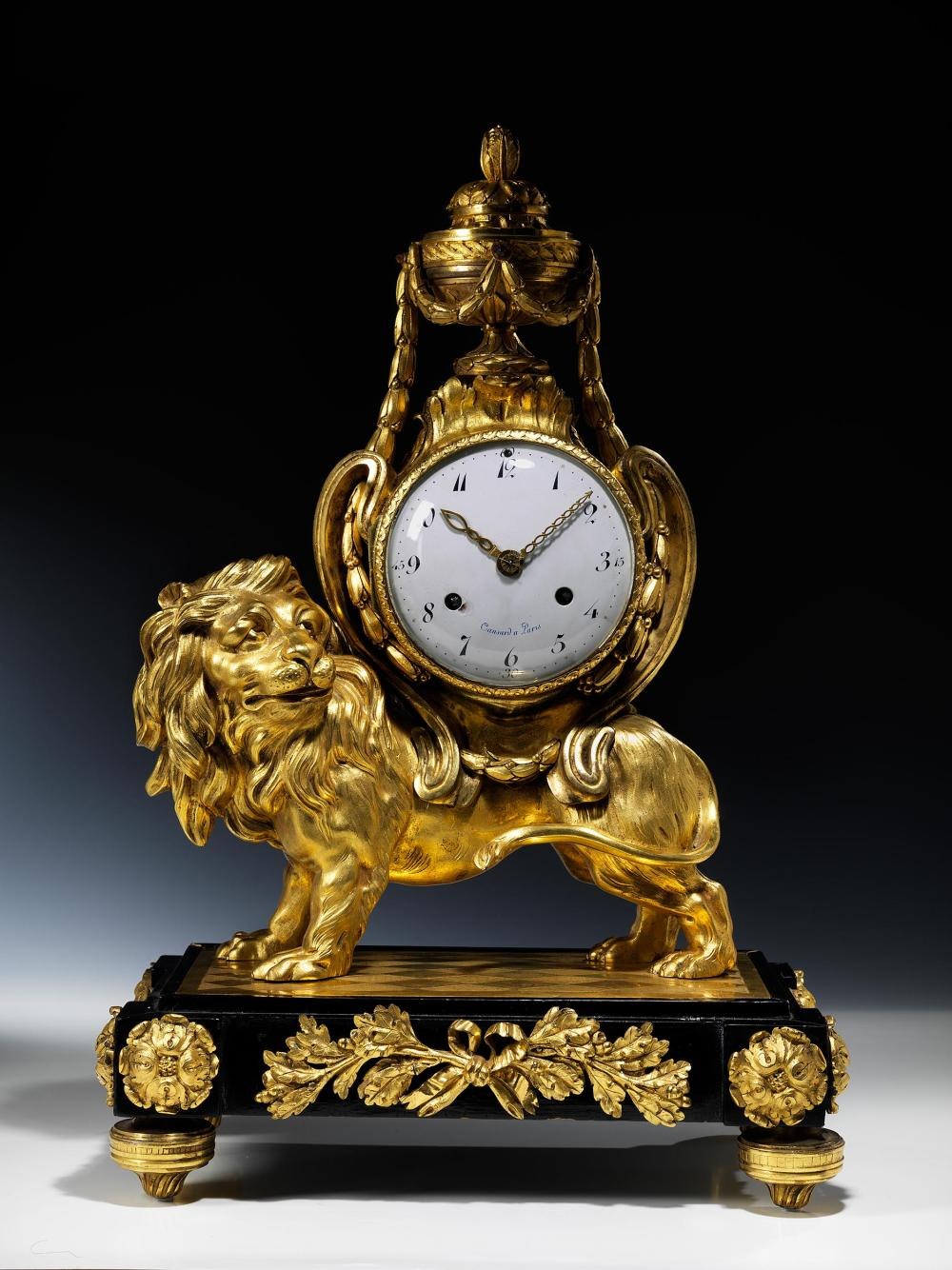
This Louis XVI bronze pendulum clock, dating to approximately 1770–1780, features a sculptural lion figure serving as the primary mount for a vase-shaped clock housing. The piece is inscribed "Causard à Paris," identifying the work of Georges Causard (1738–1780). The movement provides quarter-hour striking on a bell. The clock is set upon a rectangular ebony base, which is finished with fire-gilded ormolu mounts, including a central oak leaf bundle secured by ribbons and decorative floral motifs at the corners. The top surface of the base incorporates a gold-toned lozenge-patterned inlay. The white enamel dial displays Arabic numerals and baton indices, with gold openwork hands. Measuring 59 cm in height, the clock displays a thematic combination of animal statuary and classical vessel form.

Full view of the Louis XVI bronze pendulum clock showing the lion figure base and the vase-shaped clock housing.
Full view of the Louis XVI bronze pendulum clock showing the lion figure base and the vase-shaped clock housing. — Hampel Fine Art Auctions (via Invaluable). Rights pending — permission not yet requested. Original source

Catalogue identity

Source
www.invaluable.com
Category
Clock · Pendulum clock
Maker / attribution
Georges Causard
Reference
Not recorded
Catalogue / lot identifier
58
Source-reported date
ca. 1770 - 1780
Source-reported place
France

Source-reported attribution and specifications are not independent authentication. A listing does not establish present ownership, current display, availability or permission to reproduce.

Object description

Case and Base Construction

The clock is built upon a rectangular, stepped base finished in ebony. This base is supported by chased ormolu feet. The exterior of the plinth is decorated with fire-gilded ormolu mounts, including leaf-filled tondos at each corner and a central oak leaf garland tied with Louis XVI-style ribbons. The upper surface of the plinth is surfaced with an engraved gold-colored lozenge-patterned ground.

Mounted atop the plinth is a sculpture of a standing lion. The lion is depicted looking backward, with the clock movement enclosed within a vase-shaped housing mounted upon its back. The housing is adorned with festoons of laurel leaves, integrating the timepiece into the sculptural form.

Evidence for this section
  • “Auf ziselierten Ormolufüßen ein rechteckiger gestufter Sockel in Ebenholz mit mächtigen applizierten fein ziselierten und feuervergoldeten Beschlägen.”
  • “Darauf die vollplastisch aufgefasste Figur eines zurückblickend stehenden männlichen Löwen mit geschultertem Uhrengehäuse in Vasenform mit Lorbeerblattfestons.”

Dial and Movement

The time is indicated on a white enamel dial featuring Arabic numerals for the hours and minutes, supplemented by baton indices. The dial is equipped with gold-toned, openwork hands for the hour and minute indicators. Winding holes for the movement are located on the dial face, positioned above the four and eight o'clock markers.

The movement is capable of striking the hours and quarters on a bell.

Evidence for this section
  • “Weiß emailliert mit arabischen Stunden und Minuten sowie Stabindizes, Aufzugslöchlein über der 4 und der 8”
  • “Funktionen: Viertelstundenschlag auf Glocke zur Viertel-, halben und vollen Stunde.”

Signatures and Attribution

The clock bears the inscription "Causard à Paris" on the dial. This is attributed to the clockmaker Georges Causard, who lived from 1738 to 1780. According to the auction records, he attained master status in 1770.

The dating of the object to between 1770 and 1780 aligns with the period of Georges Causard's mastership in Paris. Reference to G. H. Baillie’s "Watchmakers & Clockmakers of the World" is cited in the documentation regarding the maker.

Evidence for this section
  • “Bezeichnet „Causard à Paris“ für Georges Causard (1738 Audeloncourt - 1780 Paris, Meister ab 1770).”
  • “Literatur: Vgl. G. H. Baillie, Watchmakers & Clockmakers of the World, London 1947, S. 54.”

Open research questions

  • What is the specific composition of the internal movement beyond the strike mechanism?
  • Are there any maker's marks or stamps on the bronze casting or the movement plates consistent with Georges Causard's production?

Source evidence

Recorded claims and source quotations for Louis XVI bronze lion clock by Causard
FieldSource-reported valueSource quotation
Height59 cm“Höhe: 59 cm.”
MakerGeorges Causard“Bezeichnet „Causard à Paris“ für Georges Causard”
FunctionsQuarter-hour striking“Funktionen: Viertelstundenschlag auf Glocke zur Viertel-, halben und vollen Stunde.”
Case materialsEbony, bronze, and ormolu“Sockel in Ebenholz mit mächtigen applizierten fein ziselierten und feuervergoldeten Beschlägen.”
Dial detailsWhite enamel with Arabic numerals and baton indices“Weiß emailliert mit arabischen Stunden und Minuten sowie Stabindizes”
Lot Number58“Lot 58”
Dateca. 1770-1780“Paris, um 1770 - 1780.”

Visible details

  • Lion figurine is depicted standing and looking backward
  • Dial features winding holes located above the 4 and 8 markers
  • Base is constructed with an ebony finish and ormolu feet
  • Hands are designed with pierced ormolu or gold-colored metalwork

Research qualifications

  • Movement internal condition not described
  • Authenticity of the signature and attribution to Georges Causard is provided by the auction house

Photograph identity and source facts were screened before import; rights clearance remains pending.

Consulted source

Louis XVI-Bronzependule mit Löwenfigur

Reviewed 2026-10-26 · Record 2f4c5723d5

Terms in this record

Glossary explanations for terms named in this object’s record.