
Skip to content
The Encyclopedia of Horology

Tool · Nuremberg diptych dial

Paul Reinmann Diptych Dial

Partially verified

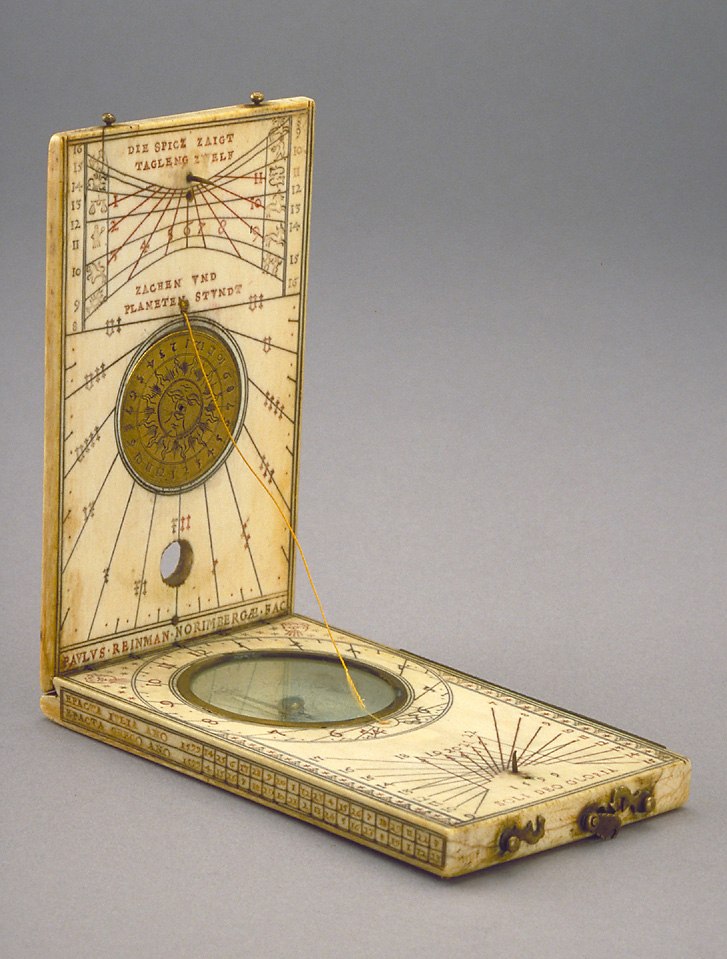
This diptych dial, created in 1599 in Nuremberg by Paul Reinmann, is constructed from ivory and brass with dimensions measuring 113 x 65 x 14 mm. The instrument features red and black filled stamped inscriptions and brass clasps for securing the closed or open positions. The object incorporates a range of timekeeping and astronomical elements including a lunar volvelle with wind rose, vertical and horizontal string gnomon dials, an equatorial dial, and multiple pin gnomon dials. The outer surface of the lower leaf provides a latitude list of 40 European cities. The base displays the maker's crown mark stamped twice. The construction utilizes both ivory surfaces and inlaid brass components, such as the equatorial dial, to facilitate complex astronomical calculations and time measurement. Its overall design includes various mottos and Latin inscriptions, while the internal layout coordinates multiple horological functions within a single portable instrument.

Paul Reinmann Diptych Dial, 1599, featuring internal pin gnomon dials and equatorial brass dial.
Paul Reinmann Diptych Dial, 1599, featuring internal pin gnomon dials and equatorial brass dial. — British Museum, London. Rights pending — permission not yet requested. Original source

Catalogue identity

Source
www.mhs.ox.ac.uk
Category
Tool · Nuremberg diptych dial
Maker / attribution
Paul Reinmann
Reference
Not recorded
Catalogue / lot identifier
MLA 1862,8-9.4
Source-reported date
1599
Source-reported place
Germany

Source-reported attribution and specifications are not independent authentication. A listing does not establish present ownership, current display, availability or permission to reproduce.

Object description

Construction and Design

The diptych dial is a portable instrument formed from two hinged leaves made of ivory and brass. It measures 113 x 65 x 14 mm and features red and black-filled stamped inscriptions throughout its surfaces. Two brass clasps on the side secure the dial in a closed position, with one clasp designed to hold the leaves open when in use. The outer surface of the upper leaf contains a lunar volvelle with an integrated wind rose, while the lower leaf's outer surface is dedicated to a latitude list of 40 European cities.

The interior surfaces accommodate several horological systems. The upper leaf includes a pin gnomon dial for unequal hours featuring zodiacal signs and a string gnomon dial. An equatorial pin gnomon dial sits centrally on a gilt brass disc. The lower leaf contains a horizontal string gnomon dial surrounding a central compass, along with a secondary pin gnomon dial displaying Italian and Babylonian hours. Decoration includes geometrical patterns, stars, and blowing faces in the corners.

Evidence for this section
  • “The stamped inscriptions on this ivory dial are filled with red and black colours.”
  • “Two brass clasps allow the dial to be closed, one clasp attached to the opposite side holds the dial in the open position while being used.”
  • “The outer surface of the lower leaf is inscribed with a latitude list of 40 European places in two columns”

Astronomical and Timekeeping Functions

The object functions as a multi-purpose scientific instrument, capable of calculating lunar and solar time. The lunar volvelle, composed of a movable brass disc with a sun effigy, allows for the conversion of lunar into solar time. It features a 24-hour scale, moon phase aperture, and lunar age indicator. The accompanying wind rose displays 32 directions in abbreviated German.

Further time measurement is provided by multiple pin and string gnomon dials. The pin gnomon dials display Italian, Babylonian, and unequal hours, with specific scales inscribed on the internal ivory faces. The horizontal string gnomon dial on the lower leaf is marked in 1/2 and 1/4 hour divisions. Epact tables for both the Julian and Gregorian calendars are present on the outer edge, enabling the user to adjust the instrument for calendar variations.

Evidence for this section
  • “The lunar volvelle, for converting lunar into solar time, consists of a movable brass disc with an index and a 24 hour dial”
  • “The inner surface of the lower leaf consists of a horizontal string gnomon dial, numbered 4 to 12 to 8 and divided to 1/2 and 1/4 hours.”
  • “On the opposite edge are epact tables for the Julian and Gregorian calendars”

Signatures and Provenance

The instrument is signed by Paul Reinmann, a known Nuremberg maker. His name and title, 'PAVLUS REINMAN NORIMBERGAE FAC', are found inscribed on the inner surface of the upper leaf. The maker’s mark, representing a crown, is stamped twice on the base of the object. Several inscriptions, including mottos such as 'SOLI DEO GLORIA', are present on the ivory surfaces.

The dial was purchased in 1862 and is currently held by the British Museum under the inventory number MLA 1862,8-9.4. It is documented in the publication A Catalogue of European Scientific Instruments in the Department of Medieval and Later Antiquities of the British Museum by F. A. B. Ward, which provides further context for its identification and historical placement.

Evidence for this section
  • “The signature of the maker, 'PAVLUS REINMAN NORIMBERGAE FAC', is inscribed at the bottom.”
  • “On the base is the maker's mark, a crown, stamped twice.”
  • “The instrument was purchased in 1862 and is described and illustrated in F. A. B. Ward, A Catalogue of European Scientific Instruments in the Department of Medieval and Later Antiquities of the British Museum”

Open research questions

  • What is the specific mechanical mechanism of the pivoted arm on the front edge of the lower leaf?
  • What is the full extent of the information contained within the erased compass deviation marks?

Source evidence

Recorded claims and source quotations for Paul Reinmann Diptych Dial
FieldSource-reported valueSource quotation
MakerPaul Reinmann“Signed by Paul Reinmann”
Date1599“Dated 1599”
Place of manufactureNuremberg“Nuremberg”
MaterialIvory and brass“Ivory and brass”
Dimensions113 x 65 x 14 mm“113 x 65 x 14 mm”
Inventory numberMLA 1862,8-9.4“Registration no. MLA 1862,8-9.4”
InscriptionPAVLUS REINMAN NORIMBERGAE FAC“'PAVLUS REINMAN NORIMBERGAE FAC', is inscribed at the bottom.”

Visible details

  • Maker's crown mark stamped twice on the base
  • Brass clasps on the outer edges for closure and support
  • Latitude table listing 40 European locations on the lower leaf outer surface
  • Red and black color-filled stamped inscriptions

Research qualifications

  • The string gnomon for the string gnomon dial is broken
  • Pin gnomons for the pin gnomon dials are missing
  • A strut for setting the latitude is missing

Photograph identity and source facts were screened before import; rights clearance remains pending.

Consulted source

Diptych Dial

Reviewed 2026-10-26 · Record f592f59947

Terms in this record

Glossary explanations for terms named in this object’s record.