
Skip to content
The Encyclopedia of Horology

Tool · Latin-inscribed astrolabe

Paper Astrolabe by Hans Herghamer

Partially verified

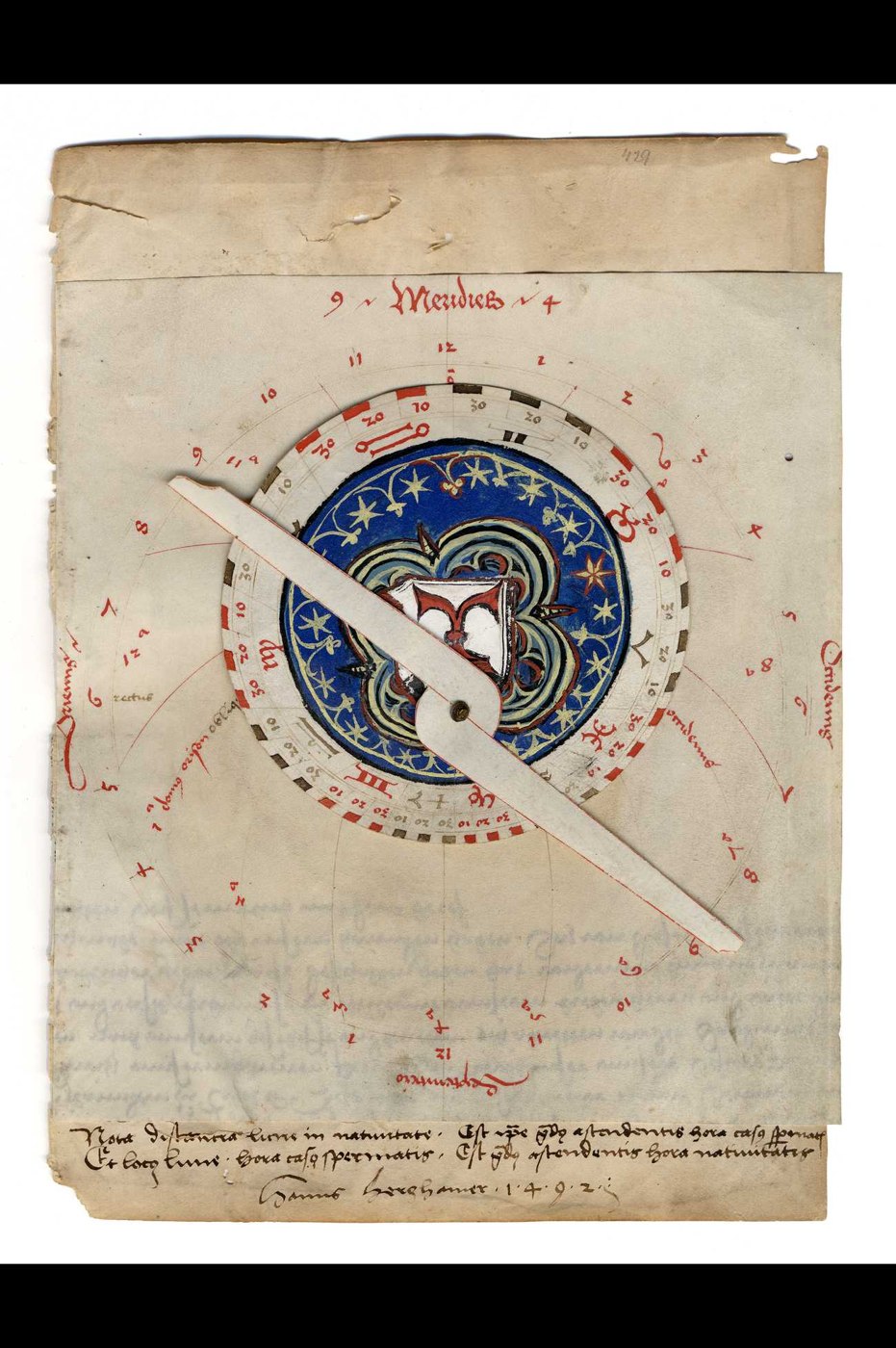
This astrolabe, dated 1492 and signed by Hans Herghamer, is constructed from ephemeral materials, consisting of vellum pasted onto a paper base with a matching paper rule. Unlike traditional metal astrolabes, it features a paper volvelle representing the ecliptic circle rather than a conventional rete, centered by a colorful armorial design. The instrument was historically bound into a contemporary printed book, specifically a 1488 copy of Johannes Angelus’s 'Astrolabium', which facilitated its survival. The mater and limb are inscribed in red ink with cardinal directions and two miscellaneous astrological inscriptions regarding the moon's position in relation to birth and conception. The Museum acquired the object in 1954 after it was removed from its original book binding by a dealer.

Front view of the paper astrolabe showing the volvelle, rule, and armorial center.
Front view of the paper astrolabe showing the volvelle, rule, and armorial center. — History of Science Museum, University of Oxford. Rights pending — permission not yet requested. Original source

Catalogue identity

Source
www.mhs.ox.ac.uk
Category
Tool · Latin-inscribed astrolabe
Maker / attribution
Hans Herghamer
Reference
Not recorded
Catalogue / lot identifier
91897
Source-reported date
1492
Source-reported place
Germany

Source-reported attribution and specifications are not independent authentication. A listing does not establish present ownership, current display, availability or permission to reproduce.

Object description

Construction and Design

The instrument is primarily constructed from paper and vellum, reflecting a practice of utilizing ephemeral materials for scientific instruments intended for personal study. The mater is a piece of vellum pasted onto a larger paper sheet, with the limb featuring an equal hours scale numbered 1 to 12. Directions are marked in red ink around the limb, using Latin terminology such as Meridies, Occidens, Septentrio, and Oriens.

The rete is replaced by a paper volvelle that displays only the ecliptic circle. At its center is an armorial motif surrounded by a star-adorned blue field. A simple, double-ended, counter-changed paper rule is attached at the center with a pin, allowing for movement over the horoscopic houses inscribed on the womb beneath.

Evidence for this section
  • “The mater is a piece of vellum that has been pasted to a piece of paper.”
  • “The rule is also of paper. And instead of a conventional rete there is a paper volvelle consisting of the ecliptic circle only”

Signatures and Inscriptions

The astrolabe bears the signature 'Hans Herghamer' and the date 1492. In addition to the maker's identification, the limb contains two miscellaneous inscriptions in red ink that relate to astrological calculations regarding the moon's position at the time of birth and conception. These inscriptions reflect the personal, scholarly use for which the device was created.

The womb contains horoscopic houses numbered with superscript 'a', written in a cursive script. The meridian and horizon lines are also labeled in Latin, providing the necessary references for the user to perform astrological or time-keeping functions compatible with the manuscript books of the period.

Evidence for this section
  • “The maker, who signs 'Hanns Herghamer' (the modern German surname Herkamer), is an otherwise unknown amateur or scholar”
  • “with a maker's signature marked as Hans Herghamer 1492.”

Provenance and Historical Context

This astrolabe was formerly part of a 1488 copy of Johannes Angelus's 'Astrolabium'. It had been placed between the front board and the flyleaf of the book's contemporary leather binding, which contributed to its survival. The book was formerly in the library of Prince Liechtenstein before being sold by a London dealer, Dr. Ernst Weil.

The Museum of the History of Science acquired the object through an exchange with Ernst Weil in 1954 after it had been separated from the volume. It remains a representative example of instruments that were once bound into manuscript tomes, though they are now rarely found in institutional collections of scientific instruments.

Evidence for this section
  • “This one survived because it had been stuck into a contemporary printed book (Johannes Angelus, Astrolabium , 1488).”
  • “The book (sold separately by Dr Weil, a London dealer) was from the library of Prince Liechtenstein”

Open research questions

  • What is the specific heraldic significance of the coat of arms depicted on the volvelle?
  • To what extent did the inclusion of this instrument in the 'Astrolabium' book influence the specific astronomical layout of the volvelle?

Source evidence

Recorded claims and source quotations for Paper Astrolabe by Hans Herghamer
FieldSource-reported valueSource quotation
MakerHans Herghamer“The maker, who signs 'Hanns Herghamer' (the modern German surname Herkamer), is an otherwise unknown amateur or scholar”
Date1492“Date 1492”
PlaceGermany“Place Germany”
MaterialPaper and vellum“It is made of a piece of vellum attached to a slightly larger piece of paper.”
Inventory Number91897“Inventory no. 91897”
ProvenanceAcquired by exchange from Ernst Weil in 1954“Acquired by exchange from Ernst Weil in 1954”
Discovery ContextRemoved from a copy of Johannes Angelus, Astrolabium, 1488“This one survived because it had been stuck into a contemporary printed book (Johannes Angelus, Astrolabium , 1488).”
Inscription ContentAstrological notes on moon position and conception“Nota distantia lune in nativitate. Est ipse gradus ascendentis hora casus spermatis”

Visible details

  • Volvelle features a blue field with stars and a central armorial crest
  • Rule is double-ended and counter-changed
  • Inscriptions on the limb are written in red ink
  • The instrument is formed from layers of vellum and paper

Research qualifications

  • Maker is described as an otherwise unknown amateur or scholar
  • The significance of the specific armorial motif is not further detailed

Photograph identity and source facts were screened before import; rights clearance remains pending.

Consulted source

Astrolabe, inventory 91897 (Germany, 1492)

Reviewed 2026-10-26 · Record 5a6d420545

Terms in this record

Glossary explanations for terms named in this object’s record.