
Skip to content
The Encyclopedia of Horology

Tool · Nuremberg diptych dial

Oval Diptych Dial by Hans Tucher

Partially verified

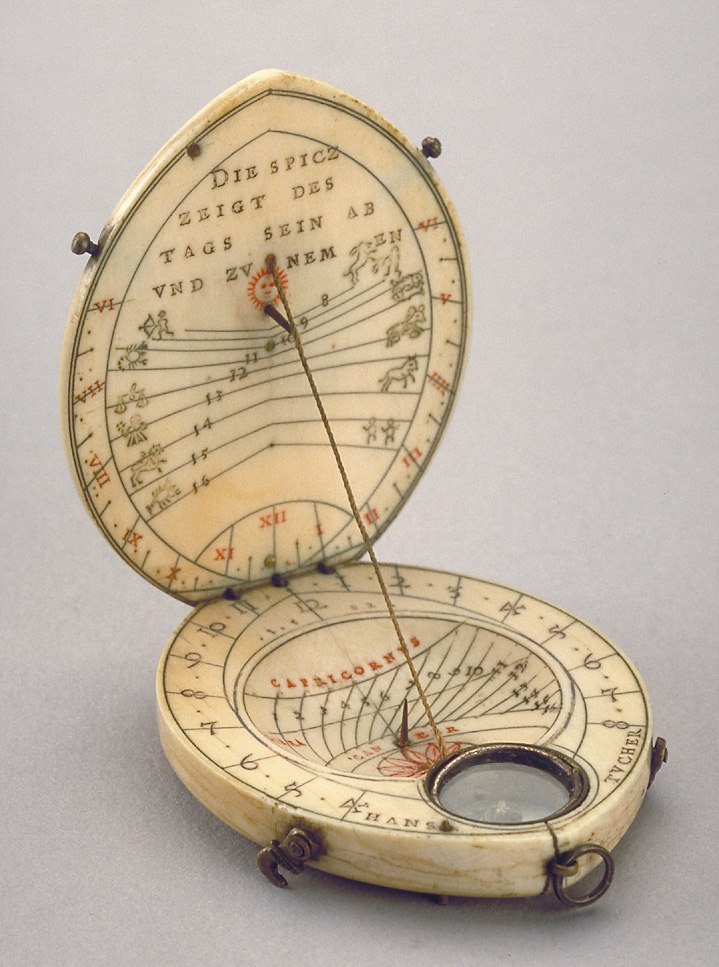
This oval diptych dial, constructed from ivory and brass, measures 65 x 53 x 13 mm and dates to 1582. It was signed by Hans Tucher in Nuremberg. The instrument features a suspension ring for potential use as personal jewellery. The dial incorporates a lunar volvelle, a vertical string gnomon dial, a horizontal string gnomon dial, and pin gnomon dials for measuring day length and Babylonian hours. The ivory surfaces feature stamped inscriptions filled with red, blue, brown, and black colors. The internal components include an inset compass with a deviation of approximately 15 degrees East, near which the maker's mark—an upright crowned snake—is stamped. The exterior of the lower leaf features a gilt brass plaque with helmet and scrollwork decoration and a German inscription regarding compass function near iron. It is currently held in the British Museum collection.

An open oval ivory and brass diptych dial showing the string gnomon, zodiacal markings, compass, and brass clasps.
An open oval ivory and brass diptych dial showing the string gnomon, zodiacal markings, compass, and brass clasps. — © British Museum, London. Rights pending — permission not yet requested. Original source

Catalogue identity

Source
www.mhs.ox.ac.uk
Category
Tool · Nuremberg diptych dial
Maker / attribution
Hans Tucher
Reference
MLA 1867,7-5.26
Catalogue / lot identifier
MLA 1867,7-5.26
Source-reported date
1582
Source-reported place
Nuremberg

Source-reported attribution and specifications are not independent authentication. A listing does not establish present ownership, current display, availability or permission to reproduce.

Object description

Construction and Form

The object is an oval-shaped diptych dial made of ivory and brass, measuring 65 by 53 by 13 millimeters. Unlike rectangular diptych dials, this instrument utilizes an oval geometry and features an inset brass suspension ring, which allowed the owner to carry the object on a chain.

The dial is held together by two brass clasps and includes a third clasp on the opposite side, designed to maintain the open position during use. The stamped inscriptions across the ivory surfaces are filled with red, blue, brown, and black colors to enhance legibility.

Evidence for this section
  • “This oval instrument is a unusual example of the normally rectangular diptych dial.”
  • “An inset brass suspension ring allowed the owner to wear on a chain around the neck.”
  • “The stamped inscriptions are is filled with red, blue, brown and black colours.”

Timekeeping Features

The instrument includes several integrated timekeeping features. The upper leaf contains a lunar volvelle for lunar-to-solar time conversion, consisting of two circles and a movable brass disc. The inner surface features a vertical string gnomon dial and a pin gnomon dial indicating day length according to zodiacal symbols.

The lower leaf contains a horizontal string gnomon dial and a scaphe pin gnomon dial for Babylonian hours. The lower scaphe is decorated with a stylized flower. An inset compass is situated on the lower leaf, bearing the maker's signature and the maker's mark, an upright crowned snake, stamped in the well.

Evidence for this section
  • “The outer surface of the upper leaf contains a lunar volvelle for converting lunar into solar time.”
  • “The inner surface of the upper leaf is marked for a vertical string gnomon dial”
  • “To both sides of an inset compass with a deviation of circa 15? E is the signature of the maker 'HANS TVCHER'.”

Exterior Decoration and Inscriptions

The outer surface of the lower leaf features a gilt brass oval plaque decorated with helmet and scrollwork. The plaque is surrounded by an inscription commonly found on Tucher family dials: 'DER CAMPAST KAN NICHT RECHT WEISEN NAHET BEY EISSEN'.

This inscription serves as a warning regarding the influence of iron on the compass accuracy. The instrument was formerly part of the collection of A.W. Franks and is catalogued in the British Museum.

Evidence for this section
  • “The outer surface of the lower leaf has a gilt brass oval plaque decorated with a helmet and scrollwork.”
  • “Surrounding the plaque is the inscription to be found on several dials made by the Tucher family: 'DER CAMPAST KAN NICHT RECHT WEISEN NAHET BEY EISSEN'.”

Open research questions

  • What is the specific distinction between Hans Tucher II and Hans Tucher III in the context of Nuremberg instrument makers?
  • To what degree do modern environmental factors affect the accuracy of the original 15-degree East compass deviation?

Source evidence

Recorded claims and source quotations for Oval Diptych Dial by Hans Tucher
FieldSource-reported valueSource quotation
MakerHans Tucher“Signed by Hans Tucher”
Date1582“Dated 1582; Nuremberg”
MaterialIvory and brass“Ivory and brass; 65 x 53 x 13 mm”
LocationNuremberg“Dated 1582; Nuremberg”
Inventory NumberMLA 1867,7-5.26“Registration no. MLA 1867,7-5.26”
Dimensions65 x 53 x 13 mm“65 x 53 x 13 mm”
Compass deviationcirca 15? E“an inset compass with a deviation of circa 15? E”

Visible details

  • Oval shape distinct from standard rectangular diptych dials
  • Inset brass suspension ring for chain attachment
  • Compass with approximately 15 degree East deviation
  • Upright crowned snake maker's mark within the compass well

Research qualifications

  • Uncertainty regarding whether the maker is Hans Tucher II or Hans Tucher III
  • Exact function of the compass relative to iron interference indicated by the exterior inscription

Photograph identity and source facts were screened before import; rights clearance remains pending.

Consulted source

Diptych Dial

Reviewed 2026-10-26 · Record 5df8aafb21

Terms in this record

Glossary explanations for terms named in this object’s record.