
Skip to content
The Encyclopedia of Horology

Tool · Nuremberg diptych dial

Nuremberg Diptych Dial

Partially verified

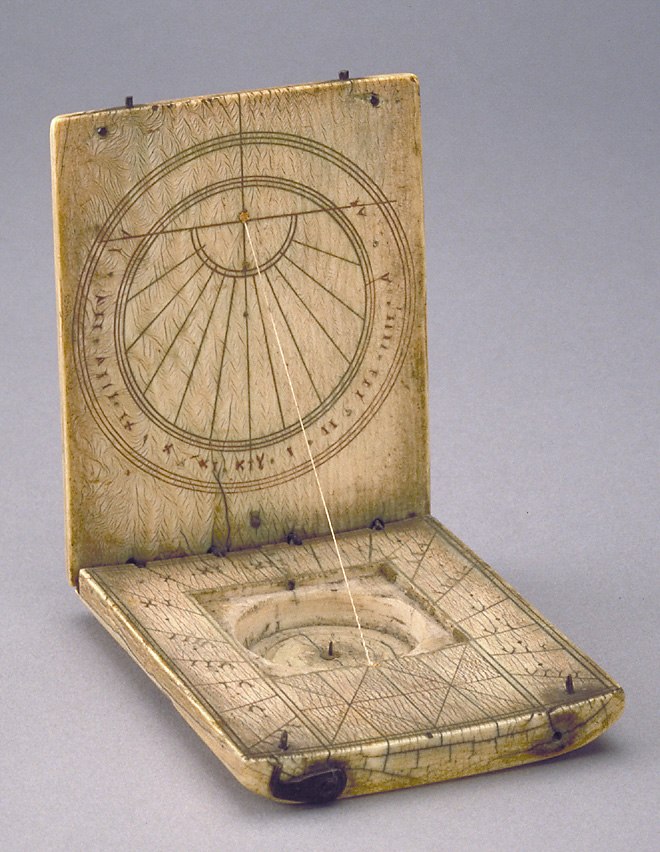
This unsigned diptych sundial is attributed to Nuremberg and dates to the late 15th century. It is constructed from ivory featuring a distinct herring-bone grain, measuring 95 by 75 by 15 mm. The instrument consists of two leaves hinged together. The upper leaf displays a relief carving of St. John the Baptist on its exterior and a vertical string gnomon dial on its interior, calibrated for approximately 48 degrees latitude. The lower leaf has a plain exterior and an interior featuring a horizontal string gnomon dial with a central empty compass well and a geometrical pattern at the base. The dial's engravings are highlighted with red and black color. It is recognized as potentially one of the earliest surviving instruments of its type, based on comparisons with similar early dials. The object is currently held by the British Museum, having been presented by A.W. Franks in 1877.

Nuremberg diptych sundial showing the internal dials and the empty compass well.
Nuremberg diptych sundial showing the internal dials and the empty compass well. — British Museum, London. Rights pending — permission not yet requested. Original source

Catalogue identity

Source
www.mhs.ox.ac.uk
Category
Tool · Nuremberg diptych dial
Maker / attribution
Not established
Reference
MLA 1877,5-21.23
Catalogue / lot identifier
MLA 1877,5-21.23
Source-reported date
Late 15th century
Source-reported place
Germany

Source-reported attribution and specifications are not independent authentication. A listing does not establish present ownership, current display, availability or permission to reproduce.

Object description

Construction and Design

The diptych sundial is constructed from ivory characterized by an unusual herring-bone grain pattern. It consists of an upper and lower leaf joined by hinges. The external surface of the upper leaf features a relief carving of St. John the Baptist, while the exterior of the lower leaf is plain. The engravings throughout the instrument are filled with red and black color, providing visual definition to the hour scales and geometric motifs.

The interior of the upper leaf contains a vertical string gnomon dial with hours numbered anticlockwise from VI to XII to VI. The interior of the lower leaf features a horizontal string gnomon dial, with hours numbered IIII to XII to VIII. At the center of the lower leaf lies an empty compass well, and the lower portion is decorated with a simple geometrical pattern. The overall dimensions of the instrument are 95 by 75 by 15 mm.

Evidence for this section
  • “This very simple instrument made from an unusual herring-bone grained ivory”
  • “The outer surface of the upper leaf is laid out as a relief carving of St. John the Baptist.”
  • “The engravings on this ivory dial with a very unusual herring-bone grain are filled with red and black colour.”

Horological Function

The instrument is a dual-dial sundial designed for operation at a latitude of approximately 48 degrees, corresponding to Nuremberg. The vertical and horizontal string gnomon dials allow for time-telling by referencing the position of the sun. The presence of an empty compass well suggests the original integration of a magnetic compass for orientation, although it is no longer present.

Though the instrument lacks an original date, researchers have attributed it to the late 15th century. This dating is derived from comparative analysis with other early dials of this period, and it is considered to be among the earliest known surviving examples of such ivory diptych dials.

Evidence for this section
  • “This instrument is undated, but by comparison with other early dials it appears to have been made in the late 15th century”
  • “laid out for circa 48?, the latitude of Nuremberg”
  • “In the centre is an empty compass well.”

Provenance and Documentation

The dial was acquired by the British Museum in 1877 following a donation by A.W. Franks. It is recorded under the inventory number MLA 1877,5-21.23. The instrument has been documented in established academic literature concerning scientific instruments.

It appears in F. A. B. Ward’s catalogue of European Scientific Instruments in the Department of Medieval and Later Antiquities at the British Museum (1981) and is referenced in P. Gouk's study of Nuremberg ivory sundials (1988). These records confirm its history and scholarly association with the British Museum collection.

Evidence for this section
  • “The instrument was presented by A.W. Franks in 1877 and is described and illustrated in F. A. B. Ward”
  • “See also P. Gouk, The Ivory Sundials of Nuremberg, 1500-1700 (Cambridge, 1988), pp. 28 ff.”

Open research questions

  • What specific type of pigment was used for the red and black coloring?
  • What is the nature of the geometrical pattern located at the base of the lower leaf?

Source evidence

Recorded claims and source quotations for Nuremberg Diptych Dial
FieldSource-reported valueSource quotation
MakerUnsigned“Unsigned”
DateLate 15th century“Late 15th century”
Dimensions95 x 75 x 15 mm“95 x 75 x 15 mm”
ProvenanceA.W. Franks, 1877“The instrument was presented by A.W. Franks in 1877”
LocationBritish Museum, London“British Museum, London”
LatitudeApproximately 48 degrees“laid out for circa 48?, the latitude of Nuremberg”

Visible details

  • Ivory with a herring-bone grain pattern
  • Red and black pigment in engraved lines
  • Empty compass well at center of lower leaf
  • Relief carving of St. John the Baptist on outer leaf

Research qualifications

  • Dating based on comparison with other early dials rather than an explicit inscription
  • Exact original function of the empty compass well not stated

Photograph identity and source facts were screened before import; rights clearance remains pending.

Consulted source

Diptych Dial

Reviewed 2026-10-26 · Record ae56859f4c

Terms in this record

Glossary explanations for terms named in this object’s record.