
Skip to content
The Encyclopedia of Horology

Tool · Italian nocturnal and sundial

Nocturnal and Sundial by Antonius Geminus

Partially verified

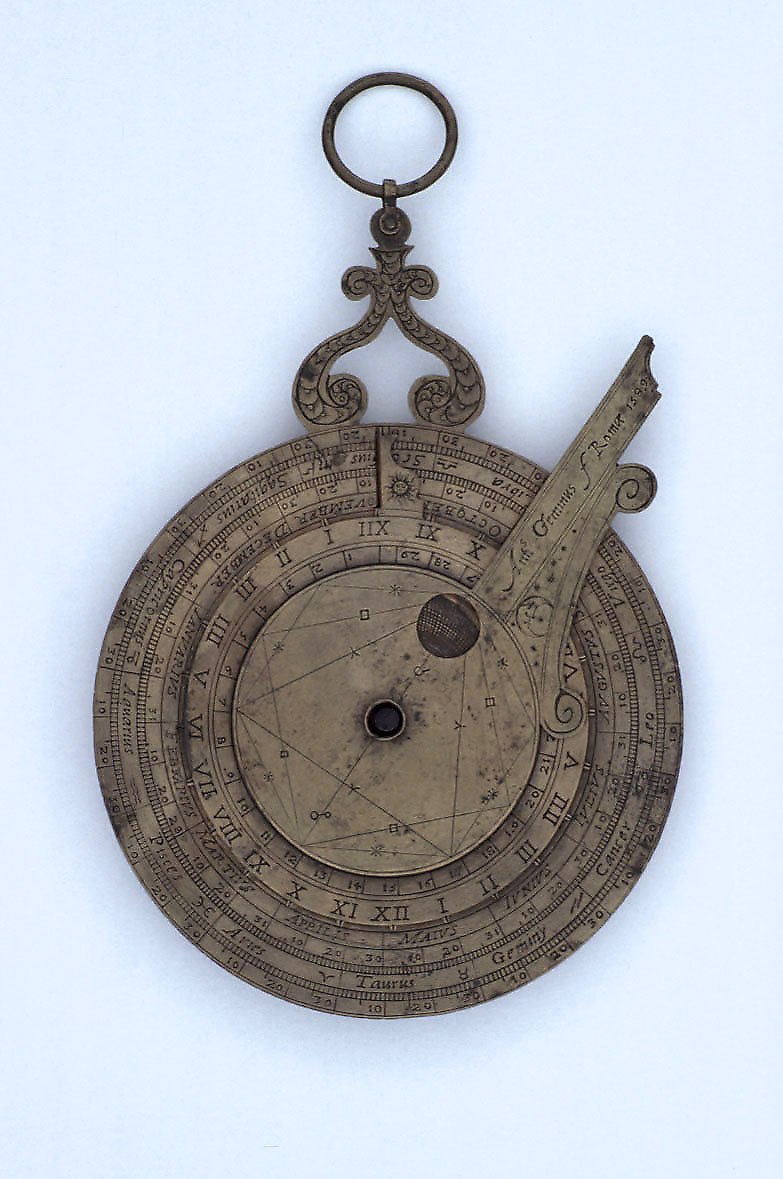
This brass nocturnal and altitude sundial, measuring 110 mm in diameter, is signed by Antonius Geminus and dated 1589. The instrument is designed to indicate time by day or night. The nocturnal side features a base plate with a zodiacal calendar, including constellations, month names in Latin, and day scales. It includes a moving plate with a nocturnal hour scale and a lunar volvelle, as well as a second plate depicting planetary aspects with a lunar phase aperture. An index arm, signed with the maker's name, allows for nocturnal observations. The reverse side functions as an 'organum Ptolemai' form of altitude sundial. This side includes a latitude scale, a rotating central disc featuring a Rojas-type projection with zodiacal symbols and curved hour lines, and a pivoting alidade. The instrument is equipped with a pierced, decorated handle and a suspension ring.

Nocturnal and altitude sundial by Antonius Geminus, 1589, showing the nocturnal side with index arm and scales.
Nocturnal and altitude sundial by Antonius Geminus, 1589, showing the nocturnal side with index arm and scales. — Museum of the History of Science, Oxford. Rights pending — permission not yet requested. Original source

Catalogue identity

Source
www.mhs.ox.ac.uk
Category
Tool · Italian nocturnal and sundial
Maker / attribution
Antonius Geminus
Reference
Not recorded
Catalogue / lot identifier
42143
Source-reported date
1589
Source-reported place
Rome

Source-reported attribution and specifications are not independent authentication. A listing does not establish present ownership, current display, availability or permission to reproduce.

Object description

Construction and Nocturnal Side

The nocturnal side of the instrument consists of a base plate inscribed with a zodiacal calendar and month names. The zodiacal scales are divided and subdivided to facilitate precise readings, with the first point of Aries designated at 21 March.

A series of moveable plates allows the user to calculate the time and lunar position. One plate provides an hour scale for nocturnal use, while a second plate contains a diagram of planetary aspects and a lunar phase aperture. An index arm featuring an engraved moon and stars facilitates observation, and the piece is finished with a decorated handle and suspension ring.

Evidence for this section
  • “The nocturnal side has a zodiacal calendar on the base plate”
  • “The first moving plate has an hour scale for the nocturnal”
  • “A second moveable plate has a diagram of planetary aspects, an aperture to reveal the lunar phase, and an index arm”

Sundial and Reverse Side

The reverse side incorporates an altitude sundial known as the 'organum Ptolemai'. This side features a latitude scale ranging from 0 to 90 degrees. A rotating disc is set against this scale, featuring a central Rojas-type projection that displays right ascension lines, zodiac symbols, and curved hour lines for before and after midday.

A pivoting alidade and rule are mounted at the center, incorporating a specific scale between the vanes. The edge of this plate is engraved with the names of the eight Mediterranean winds. Additionally, a solar declination scale is present on the edge of the base plate, with graduations arranged in parallel to the equator.

Evidence for this section
  • “The reverse side has the 'organum Ptolemai' form of altitude sundial”
  • “The base plate has a latitude scale 0 to 90 degrees to 0”
  • “The edge of the rotating plate is marked for the 8 Mediterranean winds”

Provenance and Documentation

The object is part of the collection at the Museum of the History of Science in Oxford, recorded under inventory number 42143. Its design links to similar instruments produced by Michiel Coignet in Antwerp during the same period, suggesting a connection to broader European traditions of practical mathematics as documented in the writings of Oronce Fine.

The instrument acts as a dual-purpose device for calculating time globally. The source notes that its specific design for the altitude sundial matches configurations historically described as a 'horologium generale'.

Evidence for this section
  • “Holding museum: Museum of the History of Science, Oxford”
  • “The combination for this purpose of a nocturnal and an unusual type of altitude sundial is the same as that on the instrument made in Antwerp by Michiel Coignet at a similar period.”
  • “Oronce Fine calls it 'horologium generale'.”

Open research questions

  • What is the specific intended purpose of the solar declination scale if not for a larger radius projection?
  • How does the accuracy of this specific Rojas-type projection compare to contemporary Flemish instruments?

Source evidence

Recorded claims and source quotations for Nocturnal and Sundial by Antonius Geminus
FieldSource-reported valueSource quotation
MakerAntonius Geminus“Signed by Antonius Geminus”
Date1589“Dated 1589; Rome”
MaterialBrass“Brass; 110 mm in diameter”
Dimensions110 mm diameter“110 mm in diameter”
Inventory Number42143“Inventory number 42143”
Maker SignatureAnts Geminus f: Rom 1589“The arm is signed: 'Ants Geminus f: Rom?. 1589'.”

Visible details

  • Signed 'Ants Geminus f: Rom 1589' on the index arm
  • Pierced and decorated suspension handle
  • Mediterranean wind names engraved on the rotating plate edge
  • Includes an aperture for lunar phase indication

Research qualifications

  • Plumb-line for the sundial is missing
  • Solar declination scale usage remains interpretive

Photograph identity and source facts were screened before import; rights clearance remains pending.

Consulted source

Nocturnal And Sundial

Reviewed 2026-10-26 · Record e642671425

Terms in this record

Glossary explanations for terms named in this object’s record.