
Skip to content
The Encyclopedia of Horology

Tool · Italian nocturnal and sundial

Nocturnal and Sundial

Partially verified

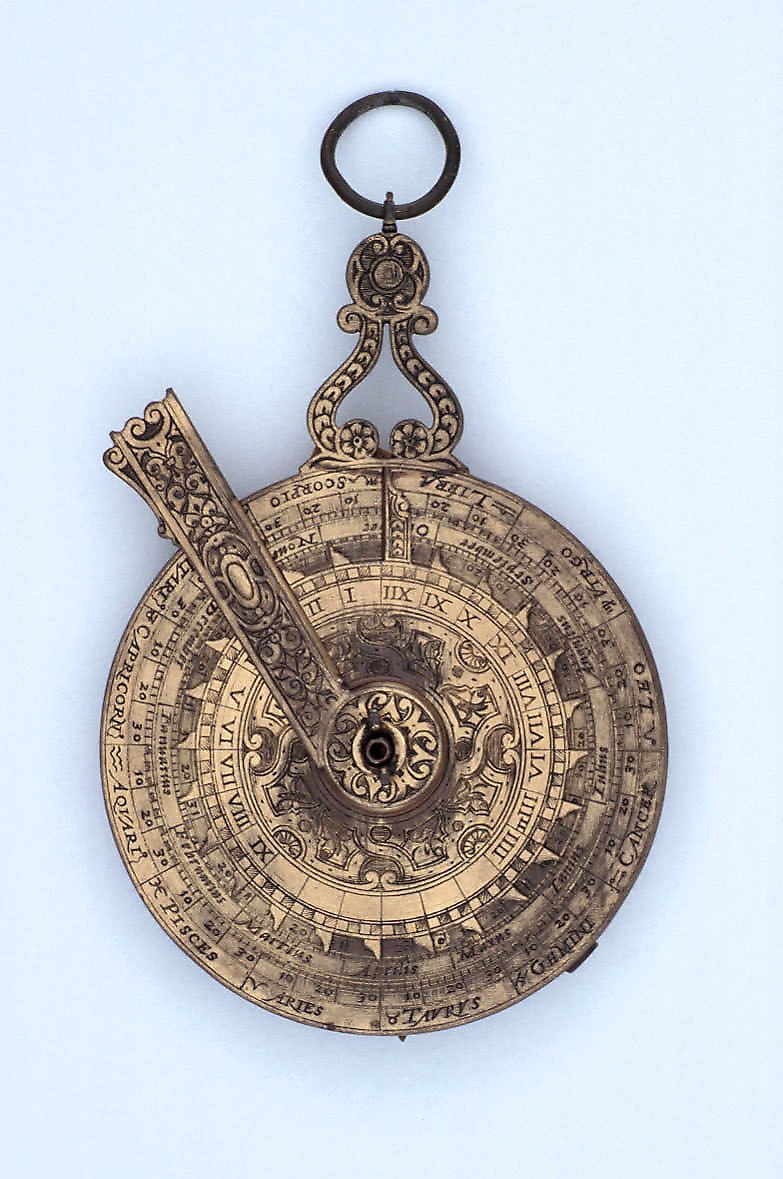
This unsigned gilt copper nocturnal and sundial, dating to 1578 and manufactured in Rome, measures 83 mm in diameter. The instrument features a base plate with a shaped, pierced handle and a suspension ring. The sundial face contains a base plate with a raised edge for latitude adjustment and a reversible circular plate featuring a Rojas projection for an altitude sundial. This projection includes a pierced and decorated trigonus with sights and a plumb-rule. The reverse of the disc comprises a double shadow square and a degree scale for altitude measurement, accompanied by foliate decoration. The nocturnal face displays a zodiacal calendar with constellation names and symbols alongside a month scale. An index arm, scrollwork, and foliate decoration adorn the center of the hour disc. The entire assembly is joined by a threaded tube and a wing nut, allowing the instrument to be disassembled for specific functional uses.

The nocturnal face of the instrument featuring a zodiacal calendar, month scales, and an index arm with foliate decoration.
The nocturnal face of the instrument featuring a zodiacal calendar, month scales, and an index arm with foliate decoration. — Museum of the History of Science, Oxford. Rights pending — permission not yet requested. Original source

Catalogue identity

Source
www.mhs.ox.ac.uk
Category
Tool · Italian nocturnal and sundial
Maker / attribution
Not established
Reference
Not recorded
Catalogue / lot identifier
48140
Source-reported date
1578
Source-reported place
Rome

Source-reported attribution and specifications are not independent authentication. A listing does not establish present ownership, current display, availability or permission to reproduce.

Object description

Sundial Construction and Components

The sundial face incorporates a base plate with a raised edge for latitude adjustment, calibrated from 90 to 0 to 90 degrees. Within this perimeter sits a reversible circular plate designed with a Rojas projection, specifically for the organum Ptolemai form of altitude sundial. The projection features meridian and polar markers alongside zodiacal scales labeled 'Austratia Signa' and 'Borealia Signa'.

The instrument is further equipped with a pierced and decorated 'trigonis' that includes integral sights and a plumb-rule. This component is essential for the instrument's disassembly and re-assembly process. The entire assembly is held together using a central threaded tube and a wing nut, which secures the trigonus to the base plate.

Evidence for this section
  • “On the sundial face, the base plate has a raised edge with a degree scale for latitude adjustment”
  • “one side of which has the Rojas projection for the 'organum Ptolemai' form of altitude sundial”
  • “The whole assembly is held together by a threaded tube attached to the trigonus and a wing nut.”

Reverse Face and Nocturnal Features

The reverse side of the reversible disc features a double shadow square, which is divided and subdivided for shadow calculations, labeled as 'Umb: Recta', 'Umbra Versa', and 'Vm: Recta'. The upper portion of this side contains an additional degree scale for measuring solar and stellar altitudes, inscribed with the production location and date.

The nocturnal component features a zodiacal calendar with constellation names and symbols, each accompanied by a 30-degree scale. A month scale is also provided, divided into 10-day and 1-day intervals. The hour disc uses Roman numerals to indicate time, and the central area is decorated with scrollwork and foliate patterns.

Evidence for this section
  • “The reverse of this disc has a double shadow square divided 0 to 12 to 0 to 12 to 0”
  • “The nocturnal face has a zodiacal calendar, with the constellation names and symbols”
  • “The hour disc is divided to 1 hour, subdivided to 1/4, the hours 4 to 12 to 9 numbered by Roman numerals”

Attribution and Design

The instrument is unsigned and is associated with a 1578 origin in Rome. The use of gilt copper in this specific configuration is noted as unusual for the period, with the Museum of the History of Science linking the technique to the output of Erasmus Habermel.

The design emphasizes ingenuity, specifically regarding the reversible plate which features a raised rim. The scales located on the reverse of the plate are intended for use with the trigonus sights, allowing the object to function as a versatile mathematical tool.

Evidence for this section
  • “Unsigned”
  • “The use in this nocturnal and sundial of gilt copper is unusual for the period, except for the work of Erasmus Habermel”
  • “Another unexpected feature is the reversible plate on the sundial face, which has been given a raised rim to accommodate it.”

Open research questions

  • Does the instrument show signs of wear consistent with field use in the 16th century?
  • Are there stylistic signatures on the foliate decoration that confirm the association with Erasmus Habermel?

Source evidence

Recorded claims and source quotations for Nocturnal and Sundial
FieldSource-reported valueSource quotation
Inventory number48140“Inventory number: 48140”
Date1578“Dated 1578”
MaterialGilt copper“Gilt copper”
Diameter83 mm“83 mm in diameter”
Inscriptions on discROM?. ao. 1578“marked 'Ad Solis & stellaru<m> altitudines dimetiendas. ROM?. ao. 1578'”

Visible details

  • Instrument is constructed of gilt copper
  • Base plate includes a shaped, pierced handle
  • Hour disc features scrollwork and foliate ornamentation
  • Assembly utilizes a threaded tube and wing nut

Research qualifications

  • Maker is unsigned, though construction relates to the work of Erasmus Habermel
  • Exact functional interaction between scales and trigonus remains a theoretical utility

Photograph identity and source facts were screened before import; rights clearance remains pending.

Consulted source

Nocturnal And Sundial

Reviewed 2026-10-26 · Record d073bff295

Terms in this record

Glossary explanations for terms named in this object’s record.