
Skip to content
The Encyclopedia of Horology

Clock · Pendulum bracket clock

Neoclassical pendulum bracket clock

Partially verified

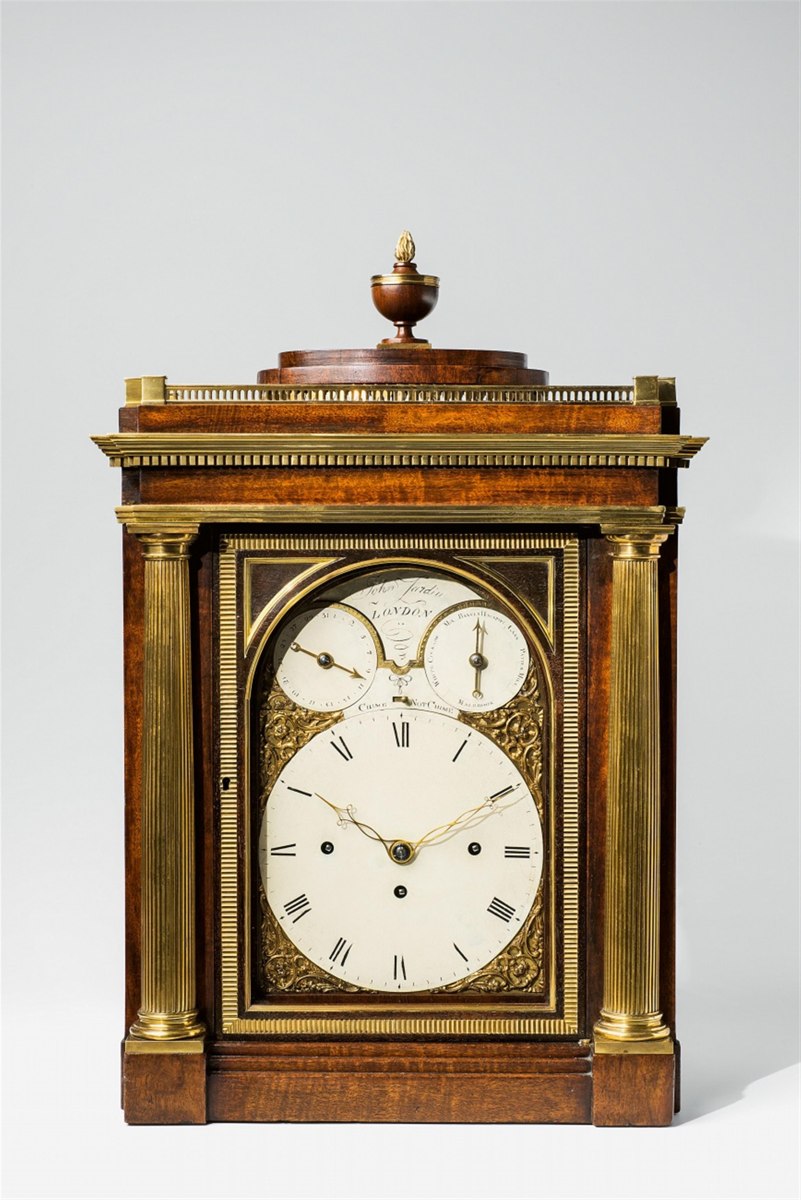
This Neoclassical pendulum bracket clock features a rectangular mahogany case with architectural details, including two fluted gilt-brass pilasters flanking an arched opening, a dentil-moulded cornice, and a stepped plinth surmounted by a turned urn finial. Catalogued with a movement by John Jardin, London, and a case attributed to David Roentgen of Neuwied circa 1780, it incorporates mechanisms to change the date and melodies, as well as a strike-silent lever, operating a 14-hour musical striking train on 12 bells. The main white enamel dial with Roman numerals sits below two upper subsidiary dials and an engraved signature plate.

Neoclassical pendulum bracket clock with movement by John Jardin and case attributed to David Roentgen, ca. 1780.
Neoclassical pendulum bracket clock with movement by John Jardin and case attributed to David Roentgen, ca. 1780. — Lempertz. Rights pending — permission not yet requested. Original source

Catalogue identity

Source
www.lempertz.com
Category
Clock · Pendulum bracket clock
Maker / attribution
Movement: John Jardin; Case attributed to David Roentgen
Reference
Not recorded
Catalogue / lot identifier
1671
Source-reported date
ca. 1780
Country
Germany / United Kingdom

Source-reported attribution and specifications are not independent authentication. A listing does not establish present ownership, current display, availability or permission to reproduce.

Object description

Case Construction and Design

The clock is housed in a rectangular mahogany case featuring four glazed windows with an arched front. Decorative elements include two fluted pilasters on the front, a staggered architrave, a pierced gallery, and a base for an urn.

The case is attributed to the David Roentgen manufactory in Neuwied, dating to approximately 1780. The design exhibits stylistic parallels to other items of furniture and clocks produced by the studio, specifically the portal motif featuring two pilasters framing an arc, which appears on a desk in Wilhelmshöhe palace near Kassel and in comparable pieces held by the Metropolitan Museum and the Hermitage.

Evidence for this section
  • “Rectangular case with four glazed windows, the front arched. Two fluted pilasters to the front, the staggered architrave surmounted by a pierced gallery and a base for an urn.”
  • “The case attributed to David Roentgen, Neuwied, ca. 1780”
  • “The portal motif with two pilasters framing an arc can be found in a desk in Wilhelmshöhe palace near Kassel and a clock in the Metropolitan Museum in New York.”

Dial and Mechanism

The clock features a white enamel dial with an engraved signature on the bezel reading 'John Jardin London'. The movement includes mechanisms for changing the date and melodies, and a function to switch off the striking.

The clock performs 14-hour musical striking on 12 bells. It is recorded that the enamel dial has been restored.

Evidence for this section
  • “Engraved signature "John Jardin London" to the bezel.”
  • “With mechanisms to change the date and melodies, and switch off the striking. 14-hour musical striking to 12 bells.”
  • “The enamel restored.”

Historical Context and Provenance

The object contains a movement by John Jardin. The source notes that it was previously not known that the Roentgen studio produced cases for English clock movements.

The provenance includes a Rhenish collection, with the clock previously sold at Lempertz auction 902, lot 652, on May 18, 2007.

Evidence for this section
  • “It was previously not known that the studio also made cases for English clock movements.”
  • “Provenance Rhenish collection, sold in Lempertz auction 902, lot 652, 18th May 2007.”

Open research questions

  • What specific archival or physical evidence within the movement plates confirms the work of John Jardin beyond the bezel engraving?
  • How does the internal musical train mechanism physically align with the 14-hour operation specification mentioned in the catalogue?
  • What specific manufacturing markers in the case support the attribution to the Roentgen studio beyond stylistic similarity?

Source evidence

Recorded claims and source quotations for Neoclassical pendulum bracket clock
FieldSource-reported valueSource quotation
Movement MakerJohn Jardin, London“the movement John Jardin, London.”
Case AttributionDavid Roentgen, Neuwied, ca. 1780“The case attributed to David Roentgen, Neuwied, ca. 1780”
DimensionsH 61.5, W 42, D 27.5 cm“H 61.5, W 42, D 27.5 cm.”
MaterialsMahogany, glass, brass, white enamel dial, cast metal“Mahogany, glass, brass, white enamel dial, cast metal.”
Musical Striking14-hour musical striking to 12 bells“14-hour musical striking to 12 bells.”
Signature InscriptionJohn Jardin London“Engraved signature "John Jardin London" to the bezel.”
DimensionsH 61.5, W 42, D 27.5 cm“H 61.5, W 42, D 27.5 cm.”
MaterialsMahogany, glass, brass, white enamel dial, cast metal“Mahogany, glass, brass, white enamel dial, cast metal.”

Visible details

  • Fluted brass-finished classical pilasters flank the arched front aperture.
  • White enamel main chapter dial displays Roman numerals with three winding apertures.
  • Two subsidiary dials flank an engraved central signature plate reading 'John Jardin LONDON' in the arch.
  • The mahogany case is crowned by a pierced metal gallery and a turned urn finial set on a circular stepped plinth.

Research qualifications

  • The catalogue notes that the enamel is restored.

Photograph identity and source facts were screened before import; rights clearance remains pending.

Consulted source

A Neoclassical pendulum bracket clock - Lot 1671

Reviewed 2026-10-25 · Record 33d0c9a323

Terms in this record

Glossary explanations for terms named in this object’s record.