
Skip to content
The Encyclopedia of Horology

Clock · Bracket clock

Musical bracket clock with calendar

Partially verified

This musical bracket clock with calendar, accessioned as 07.275a, b, is attributed to the maker Thomas Lozano, who is described as being of Spanish origin but active in London for his entire career. The clock dates to approximately 1770 or later. It is housed in a mahogany case adorned with gilded-brass mounts, featuring a silvered-brass dial. The clock incorporates a musical mechanism capable of playing a selection of twelve tunes, with features allowing both the musical and striking mechanisms to be silenced. The Metropolitan Museum of Art, which holds the object, notes that the combination of a London place-name and Spanish spelling on the dial is explained by the maker's background.

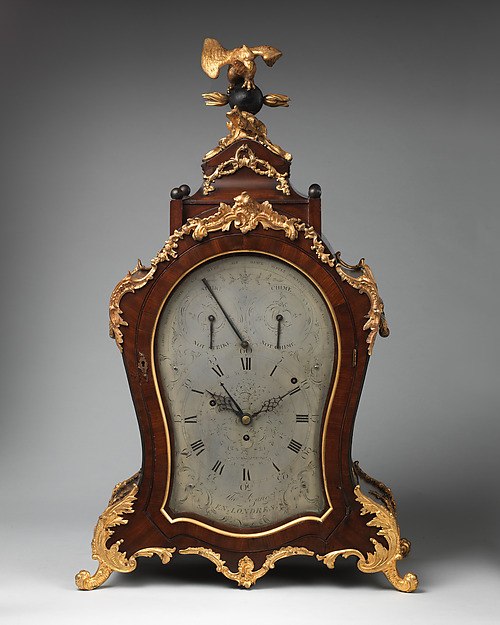
Front view of the musical bracket clock showing the dial and eagle finial.
Front view of the musical bracket clock showing the dial and eagle finial. — The Metropolitan Museum of Art — Gift of Mrs. Wm. C. Egleston, in memory of her husband, 1907. Rights pending — permission not yet requested. Original source

Catalogue identity

Source
orbiscollectibles.com
Category
Clock · Bracket clock
Maker / attribution
Thomas Lozano
Reference
Not recorded
Catalogue / lot identifier
07.275a, b
Source-reported date
ca. 1770 or later
Source-reported place
England

Source-reported attribution and specifications are not independent authentication. A listing does not establish present ownership, current display, availability or permission to reproduce.

Object description

Case and Dial Construction

The clock is housed in a mahogany case decorated with extensive gilded-brass mounts. The architectural form of the case incorporates a removable bracket and is surmounted by a gilded eagle finial. The silvered-brass dial contains primary timekeeping hands alongside dual auxiliary registers for selecting strike and chime functions, with additional indicators for tune selection.

The dial surface is inscribed with the maker's name and location, exhibiting a combination of London identification and Spanish orthography.

Evidence for this section
  • “Case and bracket: mahogany, with gilded-brass mounts”
  • “Although the clock's case, dial, and back plate all demonstrate the influence of the English rococo style, they are not typically English in their appearance.”

Movement and Musical Functionality

The movement is integrated with a musical mechanism, which is housed within the rear section of the clock case. This mechanism provides a repertory of twelve individual musical tunes. The design of the movement permits flexible usage, including the ability for the owner to silence both the musical chime and the standard striking train at will.

The striking and musical functions are controlled via the dial-mounted selector hands, which engage or disengage the respective trains.

Evidence for this section
  • “The internal movement incorporates a musical mechanism that offers a selection of twelve tunes.”
  • “Designed for flexible operation, this musical feature can be silenced at will, a characteristic shared by the clock's striking mechanism.”

Maker and Attribution

The clock is attributed to Thomas Lozano, a maker documented as having been born in Spain but who completed his training and conducted his entire professional career in London. Museum records note an active period for Lozano between 1700 and 1715, though the object is dated to circa 1770 or later, suggesting a significant temporal gap between his active years and the clock's production.

The combination of stylistic elements and the specific signature on the dial is attributed to this unique biographical background. The museum maintains the object within the department of European Sculpture and Decorative Arts, having received it as a gift in 1907.

Evidence for this section
  • “Originally from Spain, Lozano trained in his craft in London and spent the entirety of his working life there.”
  • “This background explains the combination of a London place-name and Spanish spelling displayed on the dial of this clock.”

Open research questions

  • Does archival evidence exist to confirm Thomas Lozano's production of clocks as late as 1770?
  • How does the movement construction compare to other musical clocks produced in London during the mid-to-late 18th century?

Source evidence

Recorded claims and source quotations for Musical bracket clock with calendar
FieldSource-reported valueSource quotation
MakerThomas Lozano“Thomas Lozano (active 1700–1715)”
Dateca. 1770 or later“ca. 1770 or later”
Accession Number07.275a, b“07.275a, b”
Case Materialmahogany, with gilded-brass mounts“Case and bracket: mahogany, with gilded-brass mounts”
Musical Capacity12 tunes“musical mechanism that offers a selection of twelve tunes”
Dial Materialsilvered brass“silvered brass”
ProvenanceGift of Mrs. Wm. C. Egleston, in memory of her husband, 1907“Gift of Mrs. Wm. C. Egleston, in memory of her husband, 1907”

Visible details

  • Silvered-brass dial features two selector hands for 'Strike/Not Strike' and 'Chime/Not Chime'.
  • Dial shows musical tune selection labels including 'HYMN', 'AIR', 'DANCE', 'MINUET', and 'HORNPIPE'.
  • Case is topped by a gilded-brass eagle ornament positioned on a sphere.
  • Side panels of the clock case feature pierced, gilded-brass decorative frets.

Research qualifications

  • The exact dating of 'ca. 1770 or later' remains an approximation provided by the museum.
  • The extent to which this object represents a broader category of collectible horology is unverified.

Photograph identity and source facts were screened before import; rights clearance remains pending.

Consulted source

Musical bracket clock with calendar, Thomas Lozano, ca. 1770 or later

Reviewed 2026-11-02 · Record 92ebbe1ee3

Terms in this record

Glossary explanations for terms named in this object’s record.