
Skip to content
The Encyclopedia of Horology

Clock · Carriage clock

Mid 19th Century French Quarter Repeating Carriage Clock

Partially verified

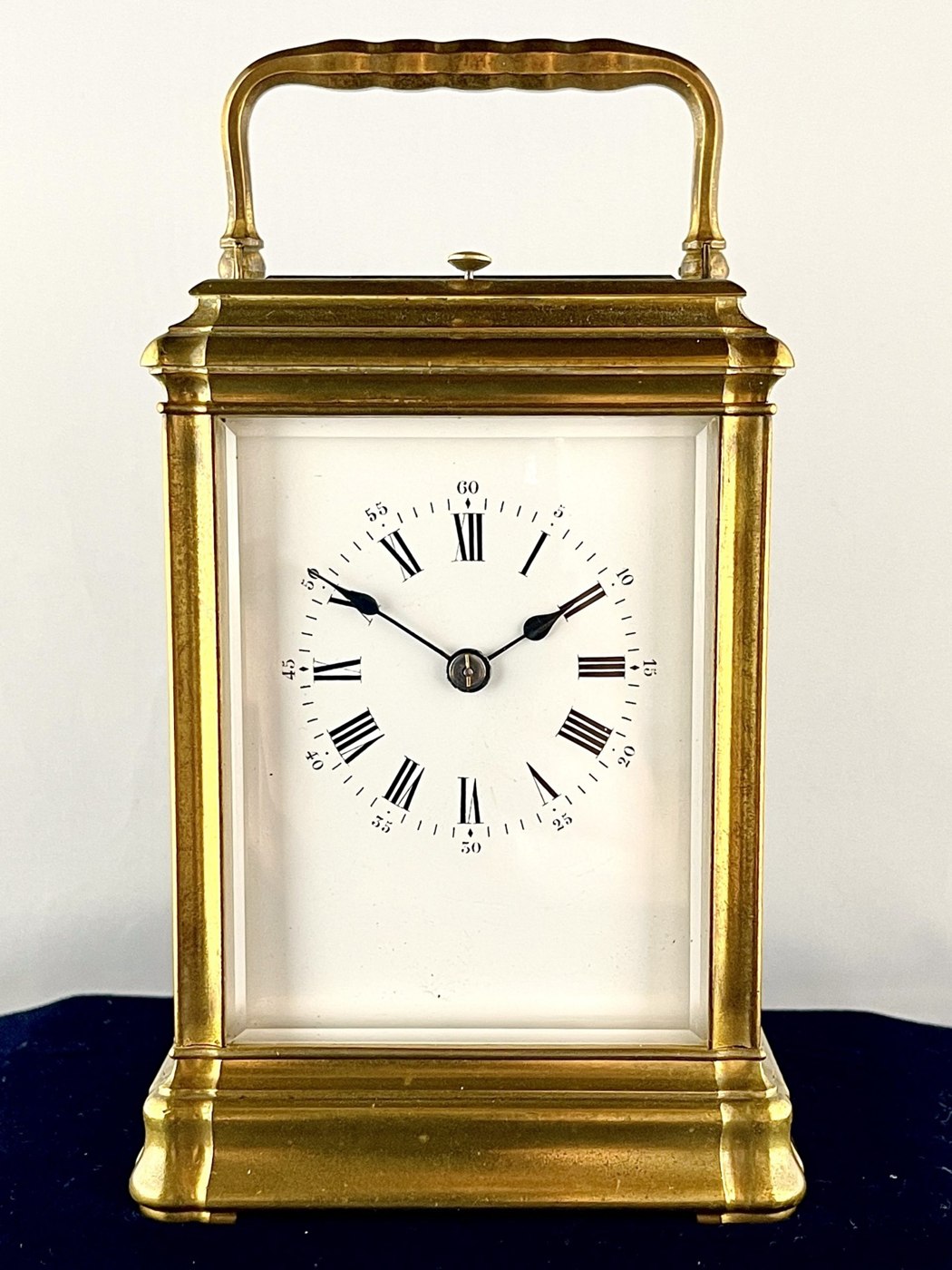
This carriage clock, dating to approximately 1870, features an eight-day movement with two train movements designed to chime hours and quarters on coiled gongs. It incorporates a quarter-repeating mechanism, with an selector lever located under the base that allows for three modes: full strike, quarter strike only, or silent. The clock is housed in a gilt-brass case in the Gorge style, equipped with a folding handle and thick, bevelled glass panels on all sides and the top, allowing for visibility of the internal components. The white enamel dial measures 2.25 inches in diameter and displays Roman numerals for the hours and Arabic numerals for the minutes at five-minute intervals. It is fitted with blued steel spade-form hands. The movement features a jewelled English lever escapement, visible through the top glass panel. The clock is supplied with a winding key.

Front view of the French Gorge-style carriage clock, showing the white enamel dial and blued steel spade hands.
Front view of the French Gorge-style carriage clock, showing the white enamel dial and blued steel spade hands. — Chequers Antiques / Zamanito. Rights pending — permission not yet requested. Original source

Catalogue identity

Source
zamanito.com
Category
Clock · Carriage clock
Maker / attribution
Not established
Reference
Not recorded
Catalogue / lot identifier
Source URL identifies the listing
Source-reported date
circa 1870
Source-reported place
France

Source-reported attribution and specifications are not independent authentication. A listing does not establish present ownership, current display, availability or permission to reproduce.

Object description

Case and Dial

The clock is housed in a gilt-brass case following the Gorge design, a style characterized by its architectural profile. It features thick, bevelled glass panels on the top and all four sides, providing a clear view into the internal movement. A folding handle is attached to the top section, which facilitates portability. The primary visual interface is a white enamel dial with a diameter of 2.25 inches.

The dial displays the time using Roman numerals for the hours and Arabic numerals at five-minute intervals for the minutes. The time is indicated by blued steel hands designed in a spade form. The overall structural integrity includes panels that are reported to be free of cracks or damage, with minor wear identified primarily on the folding handle.

Evidence for this section
  • “در قابی از جنس برنج طلاکاری‌شده (Gilt brass) به سبک مشهور «Gorge» قرار دارد”
  • “شیشه‌های پخ‌خورده ضخیم در پیرامون و بالا”
  • “صفحه مینا بدون ترک یا آسیب است”

Movement and Escapement

The clock is powered by an eight-day, two-train movement that facilitates both timekeeping and a quarter-repeating function. The striking system utilizes two coiled gongs to announce the hours and quarters. An adjustment lever located beneath the base provides the user with the ability to cycle through three modes: striking both hours and quarters, striking quarters only, or placing the clock into a silent mode.

A jewelled English lever escapement is used as the regulating system for the movement. This escapement is exposed through a glass aperture on the top of the clock, allowing for observation of the balance system and gear train operation. The source reports that the movement has been serviced and is presently in functional condition.

Evidence for this section
  • “موتور ساعت دارای کوک ۸ روزه با دو ترن حرکتی (Two-train) است”
  • “از مکانیزم تکرار (Quarter Repeating) بهره می‌برد”
  • “سیستم مهار با چنگال انگلیسی جواهرنشان (Jewelled English lever escapement) قابل مشاهده است”

Provenance and Attribution

The clock is attributed to France with a production date of circa 1870. According to the provided information, the item was manufactured specifically for the English market, though the identity of the original maker is not documented in the source.

Expert inspection has been recommended by the source regarding the matching of calibre components and the tension of internal springs. The clock is offered for sale accompanied by its original winding key, and it is reported to be in good overall condition with most of its original gilding intact.

Evidence for this section
  • “ساعت سفری (Carriage Clock) فرانسوی متعلق به اواسط قرن نوزدهم (حدود ۱۸۷۰ میلادی)”
  • “ساعت به همراه کلید کوک عرضه می‌شود”

Open research questions

  • What is the name of the original maker or retailer associated with this movement?
  • Does the serial number exist on the movement plates to allow for further identification of the manufacturer?

Source evidence

Recorded claims and source quotations for Mid 19th Century French Quarter Repeating Carriage Clock
FieldSource-reported valueSource quotation
Datecirca 1870“حدود ۱۸۷۰ میلادی”
Country of manufactureFrance“کشور سازنده: فرانسه”
Dial materialWhite enamel“صفحه ساعت از جنس مینای سفید”
Escapement typeJewelled English lever“سیستم مهار با چنگال انگلیسی جواهرنشان”
Chime configurationTwo-train movement with coiled gongs“کوک ۸ روزه با دو ترن حرکتی (Two-train) است که زنگ ساعت‌ها و ربع‌ساعت‌ها را روی دو گنگ حلزونی (Coiled gongs) می‌نوازد”
Case styleGorge“سبک مشهور «Gorge» قرار دارد”
Operating modesThree-position selector lever for chime modes“امکان انتخاب سه حالت نواختن زنگ شامل «ساعت و ربع‌ها»، «تنها ربع‌ها» و «بی‌صدا» (Silence) را فراهم می‌سازد”

Visible details

  • Spade-shaped hands in blued steel
  • Bevelled glass panels on top and sides
  • Visible jewelled English lever escapement
  • Folding carrying handle

Research qualifications

  • Manufacturer not identified
  • Attribution to the English market is based on source claims

Photograph identity and source facts were screened before import; rights clearance remains pending.

Consulted source

A Mid 19th Century Quarter Repeating Carriage Clock

Reviewed 2026-11-02 · Record e665be439f

Terms in this record

Glossary explanations for terms named in this object’s record.