
Skip to content
The Encyclopedia of Horology

Clock · Officer's carriage clock

Meuron et Comp Gilt Bronze Officer's Clock with Musical Box

Partially verified

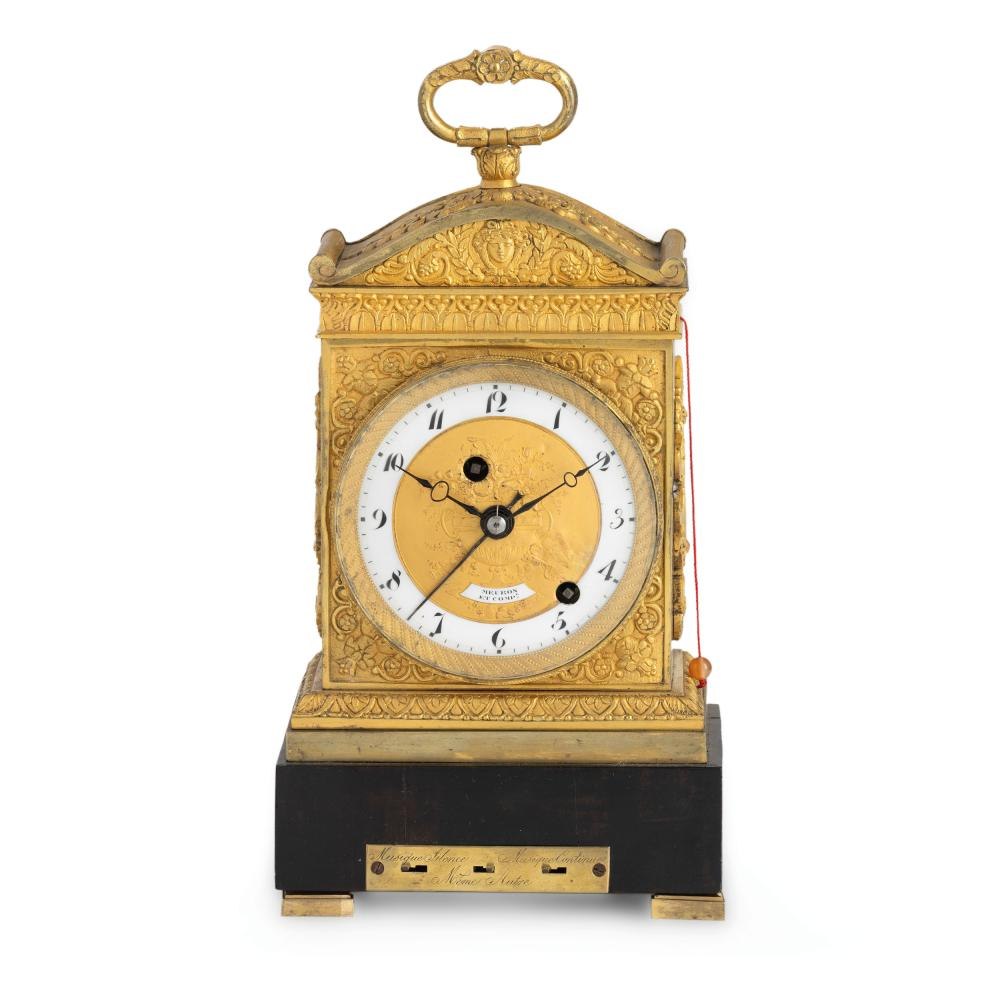
This Swiss mantel clock, attributed to Meuron et Comp circa 1780, is constructed in architectural gilt bronze. It features a dial with a white enamel band and a central embossed brass plaque signed "Meuron et Comp." The case is decorated with floral reliefs, a stylized pediment with a mascaron, and sides featuring lyres with bird protomes. The clock is set upon a restored ebonized wood base, which incorporates a large cylinder musical box capable of playing two melodies. Mechanical features include a two-day movement, a verge escapement with a balance wheel, and striking for hours and quarters on two bells. The clock is equipped with a tirage alarm and repeat function, alongside a side-mounted lever to select between Grande Sonnerie, Petite Sonnerie, or silence. It is supplied with a winding key and currently remains in functioning condition.

Front view of the Meuron et Comp clock showing the dial, gilt bronze case, and the musical control plate on the ebonized base.
Front view of the Meuron et Comp clock showing the dial, gilt bronze case, and the musical control plate on the ebonized base. — Wannenes Art Auctions (via Invaluable). Rights pending — permission not yet requested. Original source

Catalogue identity

Source
www.invaluable.com
Category
Clock · Officer's carriage clock
Maker / attribution
Meuron et Comp
Reference
Not recorded
Catalogue / lot identifier
242
Source-reported date
circa 1780
Source-reported place
Switzerland

Source-reported attribution and specifications are not independent authentication. A listing does not establish present ownership, current display, availability or permission to reproduce.

Object description

Case and Aesthetic Design

The clock is designed as a miniature architectural edifice, primarily executed in gilt bronze. The exterior is embellished with relief foliage friezes and a molded base. A stylized, mistilinear pediment surmounts the structure, centered by a mascaron motif. The design incorporates a carry handle at the apex and features flanking lyres adorned with raptor-like protomes.

The timepiece rests upon a base made of ebonized wood, which the provided records indicate has been restored. This base serves as the housing for the integrated cylinder musical box, which operates independently to provide sound at the strike of the hours. The primary visual focal point remains the dial, which combines a white enamel outer ring for the hour indicators with a central embossed brass panel.

Evidence for this section
  • “Cassa in forma architettonica ornata da fregi fogliati a rilievo”
  • “la base in legno ebanizzato (restaurata) con grande carillon a rullo a due brani”
  • “nei fianchi una cetra con protomi rapaci”

Movement and Complications

The horological core of the object is a two-day duration movement featuring a traditional verge escapement and balance wheel. The movement is complex for its scale, offering both temporal and melodic functions. It strikes the hours and quarters upon a set of two bells and includes a tirage-actuated alarm and repeating mechanism.

A distinctive feature of the clock is the selection lever located on the case side, which dictates the strike mode: Grande Sonnerie, Petite Sonnerie, or silence. Furthermore, the musical component within the base utilizes a lever system, allowing the owner to toggle the music function on or off for the hourly strikes, providing a customizable auditory experience alongside its primary function as a timekeeper.

Evidence for this section
  • “importante movimento 2 giorni di carica, scappamento a bilanciere a verga”
  • “suoneria ore/quarti su due campanelli”
  • “sul fianco della cassa è presente una leva per selezione 'Grande Sonnerie, Petite Sonnerie o il Silence'”

Signatures and Technical Inscription

The object bears the signature "Meuron et Comp" located on a cartouche positioned at the six o'clock mark on the dial. The dial itself features two winding holes positioned at approximately five and eleven o'clock. The hands are crafted from blued steel, providing contrast against the pale enamel and gilded brass surfaces.

The base assembly includes a plaque or control area that facilitates the management of the musical box. The instructions for music and silence settings are integrated into the base design, consistent with the control of the two-track melody system. The overall package is accompanied by its winding key.

Evidence for this section
  • “riportante la firma Meuron et Comp”
  • “due fori di carica a ore 11 e ore 5”
  • “dotato di dispositivo a leve che permette di impostare musica o silenzio”

Open research questions

  • What is the historical production range of musical officer clocks by Meuron et Comp?
  • Are there similar extant examples featuring the same specific side-mounted strike-selection lever configuration?

Source evidence

Recorded claims and source quotations for Meuron et Comp Gilt Bronze Officer's Clock with Musical Box
FieldSource-reported valueSource quotation
MakerMeuron et Comp“Meuron et Comp”
Datecirca 1780“1780 CIRCA”
MovementTwo-day power reserve with verge escapement“movimento 2 giorni di carica, scappamento a bilanciere a verga”
Dimensions28 cm high, 15.5 cm wide, 11 cm deep“Alt. 28 cm, larg. 15,5 cm, prof. 11 cm”
Striking featuresGrande Sonnerie, Petite Sonnerie, and silence“leva per selezione 'Grande Sonnerie, Petite Sonnerie o il Silence'”

Visible details

  • Gilt bronze architectural case with mascaron pediment
  • Enamel ring dial with Arabic numerals
  • Ebonized base with musical controls
  • Lyre motifs on the case sides

Research qualifications

  • The base is explicitly described as restored
  • Mechanism condition is reported as 'currently functioning' but specific maintenance history is not documented

Photograph identity and source facts were screened before import; rights clearance remains pending.

Terms in this record

Glossary explanations for terms named in this object’s record.