
Skip to content
The Encyclopedia of Horology

Clock · Floor clock

Metropole Clock

Partially verified

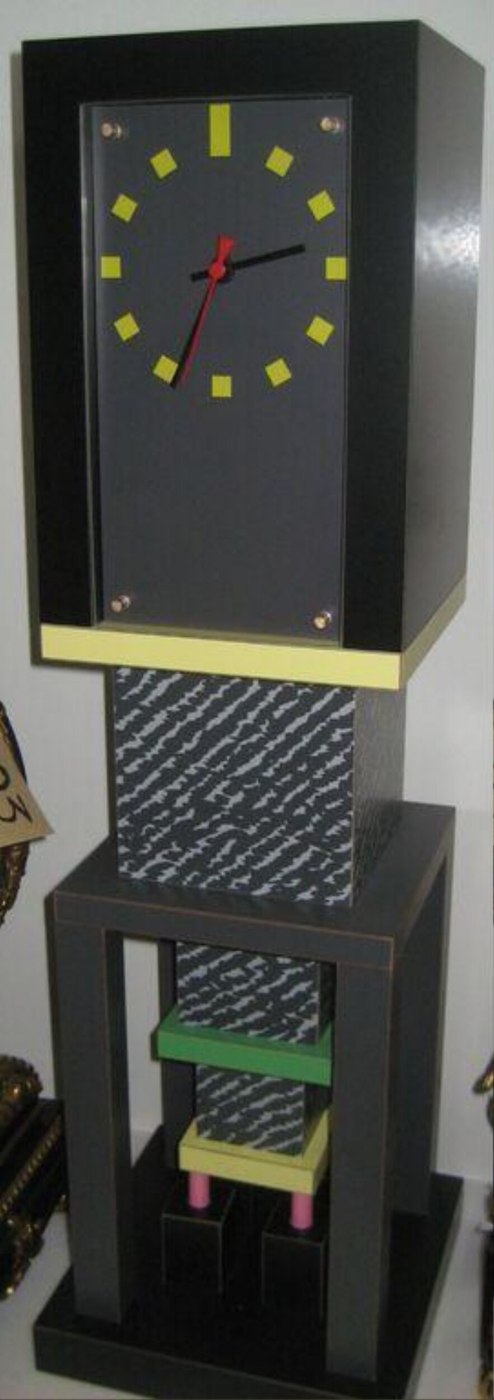
The Metropole clock is a floor-standing timepiece designed by George J. Sowden in 1982 and manufactured by Giuseppe Verdi for Memphis, Italy. Constructed from a wood frame covered in multi-coloured plastic laminates, the clock measures 31.6 inches in height. The object is characterized by its intentional anti-functionalism, as the upper housing is disproportionately large compared to the internal clock movement. This piece was designed without computer assistance and features laminates produced by Abet Laminati. The clock was acquired by the museum housed in its original wooden Memphis shipping crate.

The Metropole clock standing on a square base with a layered geometric structure.
The Metropole clock standing on a square base with a layered geometric structure. — Victoria and Albert Museum, London. Rights pending — permission not yet requested. Original source

Catalogue identity

Source
collections.vam.ac.uk
Category
Clock · Floor clock
Maker / attribution
George J. Sowden (designer); Verdi, Giuseppe (maker)
Reference
Not recorded
Catalogue / lot identifier
W.31-2010
Source-reported date
1982
Source-reported place
Italy

Source-reported attribution and specifications are not independent authentication. A listing does not establish present ownership, current display, availability or permission to reproduce.

Object description

Construction and Materials

The Metropole clock is constructed from a wooden frame finished with multi-coloured plastic laminates. The overall form is based on a vertical arrangement of geometric shapes, primarily squares and cubes. The clock mechanism is enclosed within a large rectangular box positioned at the top of the structure.

The base is a solid square block covered in black laminate. Above this, the structure consists of three smaller cubes that decrease in size towards the top. Various decorative elements, including green and yellow plates and pink cylindrical poles, serve as spacers and structural support between the lower components. The laminates were produced by Abet Laminati.

Evidence for this section
  • “Wooden clock in a plastic laminate box, based on a series of squares.”
  • “The lower cube is always of a smaller size than the upper one.”
  • “The plastic laminates were made by Abet Laminati, a laminate factory which worked often with Memphis.”

Design Philosophy

George J. Sowden designed the Metropole clock while he was a member of the Memphis design group. Sowden drafted the concept by hand rather than using computer-aided tools.

This is evident in the scale of the upper housing, which is significantly larger than necessary for the small clock movement it contains.

Evidence for this section
  • “Sowden used the ‘golden section’ – derived ratios and squares as compositional elements.”
  • “The clock was designed ‘on the kitchen table’, without the use of computer.”
  • “The upper box of the clock is unnecessarily large for the small mechanism inside.”

History and Provenance

The Metropole clock is recognized as one of Sowden's primary designs for Memphis and was documented in the book 'Hot House' by Andrea Branzi. Similar to other early products created by the Memphis collective, the name of the clock is derived from a luxury hotel.

Upon acquisition by the Victoria and Albert Museum, the clock arrived complete with its original wooden shipping crate.

Evidence for this section
  • “The 'Metropole' clock is George J. Sowden's best known design for Memphis.”
  • “Like many other early Memphis objects, the ‘Metropole’ clock was named after a luxury hotel.”
  • “The clock arrived at the Museum in its original wooden Memphis shipping crate.”

Open research questions

  • What specific type of movement is housed within the upper section?
  • Are there known production numbers for this clock beyond the museum's example?

Source evidence

Recorded claims and source quotations for Metropole Clock
FieldSource-reported valueSource quotation
MakerSowden, George J. (designer); Verdi, Giuseppe (maker)“Sowden, George J. (designer); Verdi, Giuseppe (maker)”
Accession numberW.31-2010“W.31-2010”
Height31.6 in“Height: 31.6 in”
Materialswood, multi-coloured plastic laminates, clock movement“Clock in wood, multi-coloured plastic laminates, clock movement”
InscriptionsMEMPHIS / MILANO / G. SOWDEN / 1982 / MADE IN ITALY“'MEMPHIS / MILANO / G. SOWDEN / 1982 / MADE IN ITALY'”

Visible details

  • Features a rectangular upper housing for the movement
  • Lower section composed of three nested cubes of decreasing size
  • Supported by four pink cylindrical poles
  • Includes a black square base with projecting supports

Research qualifications

  • The source attributes the design and manufacture to Italy but identifies the designer as British
  • The specific nature of the clock movement mechanism is not described in detail

Photograph identity and source facts were screened before import; rights clearance remains pending.

Consulted source

Metropole

Reviewed 2026-10-26 · Record cf1b39e430

Terms in this record

Glossary explanations for terms named in this object’s record.