
Skip to content
The Encyclopedia of Horology

Clock · Floor clock

Dutch 18th-century floor clock

Partially verified

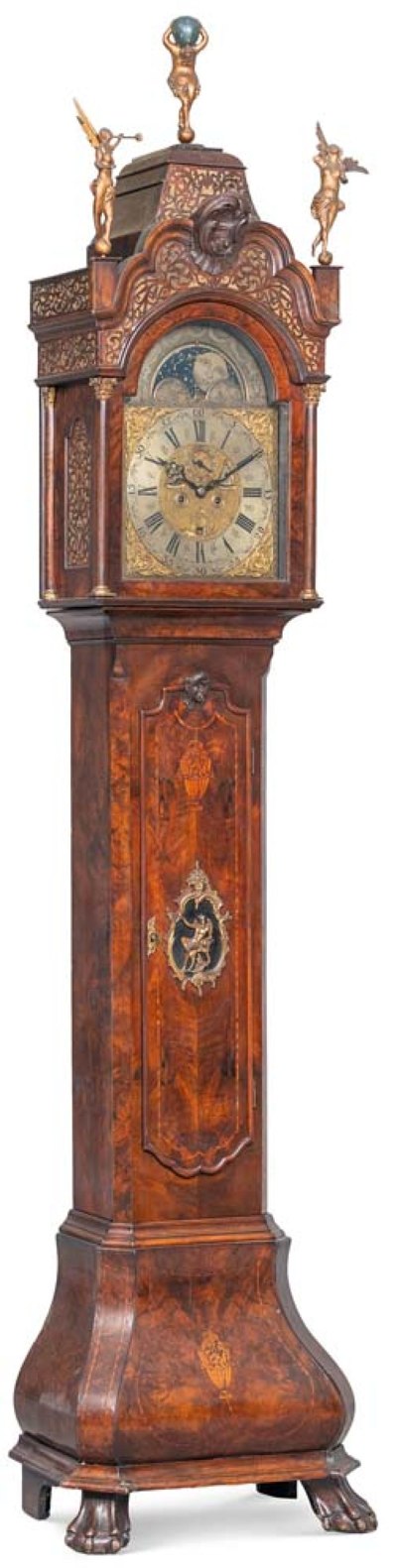
This 18th-century floor clock, attributed by the source to the maker Rutgerds v. Meus of Amsterdam, is constructed with a pine wood base finished with walnut and walnut root veneers. It features intricate inlaid and carved decorative elements. The clock stands on lion-shaped feet and includes a cast bronze figure of Kronos mounted on the door of the clock case. The pediment is adorned with a gilded wooden figure of Atlas and two trumpeting angels. The dial is made of engraved and chiseled bronze, displaying both Roman and Arabic numerals along with a sun-moon mechanism. The movement is described as double-striking. The clock is accompanied by one winding key, one clock case key, two weights, and one pendulum. The auction description notes that the object is currently functional but requires repair and is stated to be incomplete.

Full view of the 18th-century Dutch floor clock, showing the wooden case, decorative bronze and gilded figures, and the bronze dial.
Full view of the 18th-century Dutch floor clock, showing the wooden case, decorative bronze and gilded figures, and the bronze dial. — Nagyhazi Gallery and Auction House (via Invaluable). Rights pending — permission not yet requested. Original source

Catalogue identity

Source
www.invaluable.com
Category
Clock · Floor clock
Maker / attribution
Rutgerds v. Meus
Reference
Not recorded
Catalogue / lot identifier
847
Source-reported date
18th century
Source-reported place
Netherlands

Source-reported attribution and specifications are not independent authentication. A listing does not establish present ownership, current display, availability or permission to reproduce.

Object description

Case Construction and Decorative Elements

The floor clock is built upon a pine wood carcass, which serves as the base for an exterior veneer of walnut and walnut root. The casing is decorated with marquetry and carving, resting on carved feet designed in the form of lion paws. The door of the main case features an inset cast bronze figure depicting Kronos.

The top of the clock is highly decorative, featuring a carved and gilded wooden central figure of Atlas holding a globe. This central motif is flanked by two carved and gilded wooden figures of angels shown in a trumpeting pose.

Evidence for this section
  • “clock case: pine wood base covered with walnut and walnut root, inlaid and carved decoration, lion feet”
  • “cast bronze figure of Kronos on the clock case door”
  • “carved gilded wooden figure of Atlas and two trumpeting angels on top”

Dial and Timekeeping Mechanism

The clock dial is manufactured from bronze, which has been chiseled and engraved to create a textured finish. The layout of the dial includes both Roman and Arabic numerals to indicate the time. Positioned in the upper section of the dial face is a sun-moon mechanism, which serves as a complication.

The movement, as indicated in the provided documentation, is of the double-striking variety. The clock is supplied with two weights to provide power for the movement, along with a pendulum to regulate timekeeping. While the documentation notes the clock is functional, it is officially classified as incomplete and in need of repair.

Evidence for this section
  • “double-striking, sun-moon mechanism, Roman and Arabic numerals, engraved, chiseled bronze dial”
  • “functional but in need of repair, incomplete”

Provenance and Documentation

The clock is attributed to the Amsterdam-based maker Rutgerds v. Meus. The identification of the maker is established via a marking found on the object itself. The item was catalogued as Lot 847 for a sale held at the Nagyhazi Gallery and Auction House in Budapest, Hungary.

The cataloguing information provided by the gallery explicitly categorizes the object as a Dutch product originating from the 18th century. It comes with its original winding and case keys, alongside the necessary weights and pendulum for operation.

Evidence for this section
  • “Dutch, 18th century, marked: "Rutgerds v. Meus Amsterdam”
  • “Lot 847 : Floor clock”
  • “Nagyhazi Gallery and Auction House Budapest, Hungary”

Open research questions

  • What specific components are considered missing from the movement or case?
  • What are the specific technical requirements for the mentioned repairs to the double-striking mechanism?

Source evidence

Recorded claims and source quotations for Dutch 18th-century floor clock
FieldSource-reported valueSource quotation
MakerRutgerds v. Meus Amsterdam“marked: "Rutgerds v. Meus Amsterdam”
Date18th century“Dutch, 18th century”
Dimensions290 x 68 x 37 cm“290×68×37 cm”
DialEngraved, chiseled bronze“engraved, chiseled bronze dial”
MaterialsPine, walnut, walnut root, bronze, gilded wood“pine wood base covered with walnut and walnut root, inlaid and carved decoration”
Inclusions1 winding key, 1 clock case key, 2 weights, 1 pendulum“1 winding key, 1 clock case key, 2 weights, 1 pendulum”
ConditionFunctional but requires repair and is incomplete“functional but in need of repair, incomplete”

Visible details

  • Carved gilded wooden figure of Atlas at the top
  • Cast bronze figure of Kronos on the case door
  • Dial features a sun-moon mechanism
  • Base supported by carved lion feet

Research qualifications

  • Extent of missing components is unspecified
  • Specific nature of required repairs is undefined

Photograph identity and source facts were screened before import; rights clearance remains pending.

Consulted source

Floor clock

Reviewed 2026-10-26 · Record 28dff3df2c

Terms in this record

Glossary explanations for terms named in this object’s record.