
Skip to content
The Encyclopedia of Horology

Clock · Floor clock

Monumental clock with musical mechanism

Partially verified

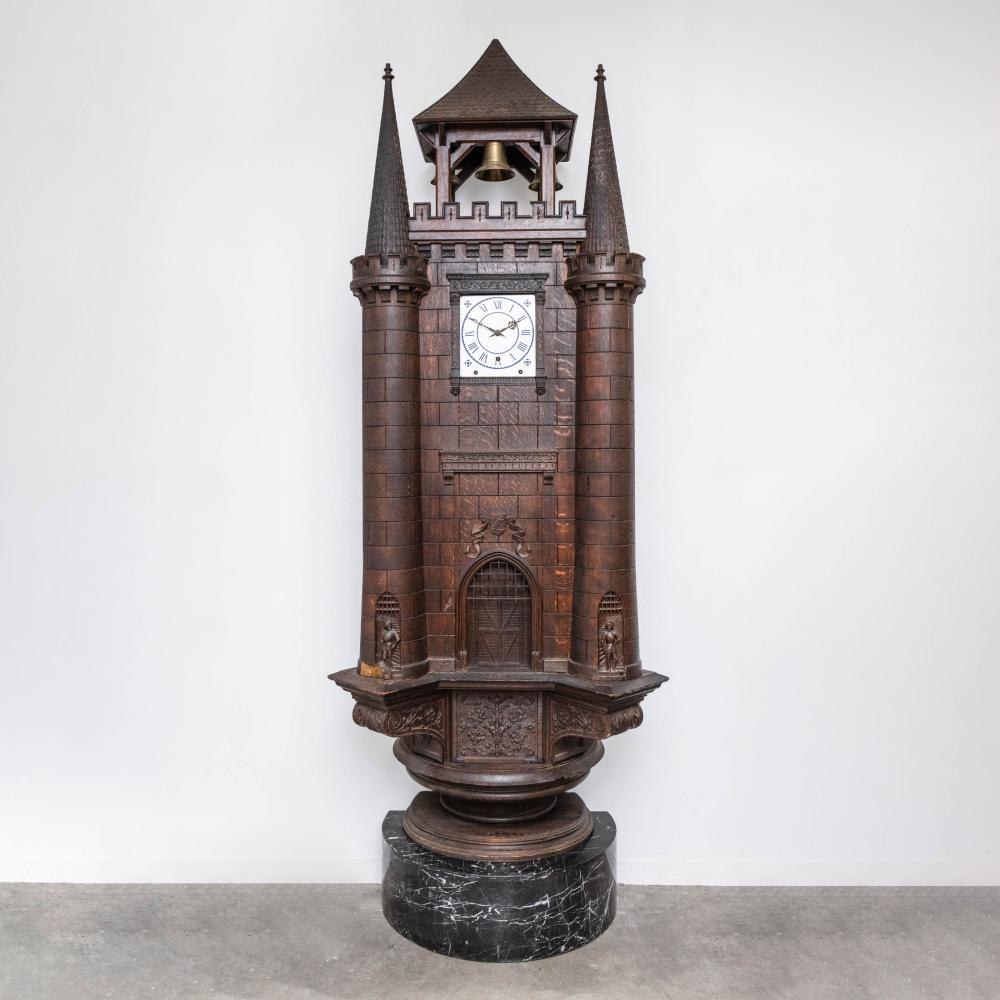
This late 19th-century monumental clock features a musical mechanism and is housed within a solid oak case. The structure is designed to represent a castle, including architectural details such as a draw gate. The clock stands at 328 x 122 x 75 cm. Its interior is signed "Ameublement - décoration G., Roswag 7-8-11- Cité-Véron Paris". According to the auction description, the clock was custom-made for a bank building located in Roeselare. The interior movement is described as having a construction similar to a comtoise structure, featuring percussion for the hours and quarters on three bells positioned at the top. The clock also incorporates a drum-based musical playing mechanism, though it is reported that the gong pipes where the hammers should strike are currently missing from the assembly.

Front view of the monumental castle-shaped clock featuring the dial and bell tower.
Front view of the monumental castle-shaped clock featuring the dial and bell tower. — Bernaerts Auctioneers (via Invaluable). Rights pending — permission not yet requested. Original source

Catalogue identity

Source
www.invaluable.com
Category
Clock · Floor clock
Maker / attribution
Ameublement - décoration G., Roswag
Reference
Not recorded
Catalogue / lot identifier
94
Source-reported date
late 19th century
Source-reported place
Belgium

Source-reported attribution and specifications are not independent authentication. A listing does not establish present ownership, current display, availability or permission to reproduce.

Object description

Case and Exterior Design

The clock is encased in a monumental structure crafted from solid oak. The exterior aesthetic is designed to resemble a castle, complete with a draw gate. The entire assembly sits atop a rounded base. The overall height, width, and depth of the piece are recorded as 328 x 122 x 75 cm.

Carved details include figures positioned near the lower section of the tower-like structure, flanking the central gateway. The case construction appears to serve both as a decorative enclosure and a housing for the substantial movement and musical components located within.

Evidence for this section
  • “Monumental case made of solid oak”
  • “depicts a castle with draw gate”
  • “328 x 122 x 75 cm”

Movement and Musical Mechanism

The internal mechanism is described as having a unique construction, built similarly to a comtoise structure. The timekeeping and striking train are arranged to sound the hours and quarters, utilizing three bells located at the top of the clock.

In addition to the standard striking, the clock includes a musical mechanism situated below the clock movement. This assembly features a drum for playing music. It is noted that the gong pipes, intended to be struck by the hammers within this musical system, are currently missing.

Evidence for this section
  • “Inside is a unique interior with construction like a comtoise structure”
  • “percussion on the hours and quarters on 3 bells at the top”
  • “Below is a drum with playing mechanism, the gong pipes, where the hammers should strike, are missing.”

Provenance and Documentation

The auction records indicate that this clock was originally commissioned as a custom piece for a bank building located in Roeselare. The interior of the oak casing bears a specific manufacturer's mark. This signature identifies the work as 'Ameublement - décoration G., Roswag', with an address listed as 7-8-11- Cité-Véron, Paris.

This internal mark serves as the primary identification for the cabinet-maker associated with the monumental case.

Evidence for this section
  • “inside signed 'Ameublement - décoration G., Roswag 7-8-11- Cité-Véron Paris'”
  • “This clock was once custom-made for a bank building in Roeselare.”

Open research questions

  • What specific type of musical mechanism is contained within the drum?
  • What was the original intended function of the gong pipes in relation to the musical drum?

Source evidence

Recorded claims and source quotations for Monumental clock with musical mechanism
FieldSource-reported valueSource quotation
Dimensions328 x 122 x 75 cm“328 x 122 x 75 cm”
SignatureInside the case signed 'Ameublement - décoration G., Roswag 7-8-11- Cité-Véron Paris'“inside signed 'Ameublement - décoration G., Roswag 7-8-11- Cité-Véron Paris'”
Case materialSolid oak“Monumental case made of solid oak”
ProvenanceBank building in Roeselare“This clock was once custom-made for a bank building in Roeselare.”
Striking trainHours and quarters on 3 bells“percussion on the hours and quarters on 3 bells at the top”
ConditionMissing gong pipes“the gong pipes, where the hammers should strike, are missing.”

Visible details

  • Solid oak case designed as a castle with draw gate
  • Dial with Roman numerals
  • Mounted on a circular marble-look base
  • Musical drum mechanism present at lower section

Research qualifications

  • Source confirms gong pipes are missing from the musical mechanism
  • The exact origin of manufacture is not explicitly stated, only the signature of the cabinet-maker 'Ameublement - décoration G., Roswag' is found inside

Photograph identity and source facts were screened before import; rights clearance remains pending.

Consulted source

A LATE 19TH CENTURY MONUMENTAL CLOCK WITH MUSICAL MECHANISM.

Reviewed 2026-10-26 · Record 176c075127

Terms in this record

Glossary explanations for terms named in this object’s record.