
Skip to content
The Encyclopedia of Horology

Tool · German mathematical compendium

Mathematical Compendium

Partially verified

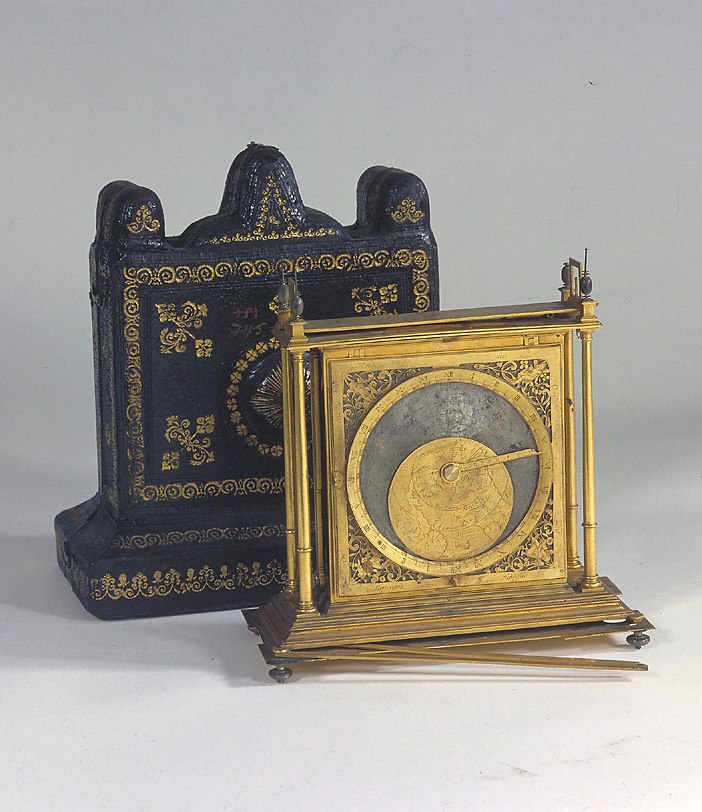
This mathematical compendium is a gilt brass and silver instrument constructed in the form of a clock, measuring 198 x 200 x 90 mm. It is signed by Hans Christoph Schissler the younger. The structure consists of a rectangular brass plinth resting on four feet, featuring four turned pillars that support a top plate adorned with silver finials. The instrument integrates numerous functional components including an astrolabe, a geographical mirror, and a compass with a calendar on its base. An alidade with sights and a vertical scale is hinged to the top plate, accompanied by a pendulum level. A hinged square plate features an hour circle with Roman numerals and intricate pierced spandrels. Additional features include a planisphere, a table of ruling planets, and a sundial with a folding pin-gnomon. It is stored within a leather case decorated with gold tooling.

Mathematical Compendium in its leather case, featuring the instrument with its front-hinged plate and astrolabe projection visible.
Mathematical Compendium in its leather case, featuring the instrument with its front-hinged plate and astrolabe projection visible. — Istituto e Museo di Storia della Scienza, Firenze. Rights pending — permission not yet requested. Original source

Catalogue identity

Source
www.mhs.ox.ac.uk
Category
Tool · German mathematical compendium
Maker / attribution
Hans Christoph Schissler jr
Reference
Not recorded
Catalogue / lot identifier
2467
Source-reported date
late 16th century
Source-reported place
Germany

Source-reported attribution and specifications are not independent authentication. A listing does not establish present ownership, current display, availability or permission to reproduce.

Object description

Structural Design and Layout

The instrument is built in the form of a clock, comprising a rectangular brass plinth supported by four feet. Four turned pillars extend upwards to support a top plate, which is decorated with silver finials. The instrument utilizes a system of hinged plates and components to provide multiple functions within a compact form factor.

A hinged square plate on the front includes an hour circle, numbered with Roman numerals, and pierced spandrels. The base incorporates a compass oriented horizontally, which features a calendar on its external surface. A leather-covered case, featuring gold decorative tooling and secured with pivoted catches, houses the instrument.

Evidence for this section
  • “The instrument is built in the form of a clock, with a rectangular brass plinth on four feet and four turned pillars rising to a top plate with four silver finials (one missing).”
  • “On the base of the instrument is a compass which can be oriented horizontally and which bears a calendar on the external surface of its base.”

Functional Components and Astrolabe

The compendium serves multiple mathematical and observational functions. It features an astrolabe, a geographical mirror, and an alidade equipped with pinhole and window sights. A plumb-line is situated between the pillars on one side, and a vertical scale, graduated in degrees, is positioned to allow for height measurements.

The instrument includes a silvered plate featuring circles for the daily path of the sun, marked for zodiac signs and hour lines. A gilt brass planisphere is engraved with continent names and five cities. The back of the hinged plate contains a circular table of ruling planets, which opens to reveal a sundial with a folding pin-gnomon and a degree scale.

Evidence for this section
  • “On its upper part are an astrolabe and a geographical mirror, on which the name Hans Christoph Schissler jr , is engraved.”
  • “Hinged at one end of the top plate is an alidade with pinhole and window sights and a hinged vertical scale at the other end graduated in degrees 0 to 40”

Signature and Historical Context

The instrument is signed by Hans Christoph Schissler the younger, who is identified in the records as the son of another instrument maker. The signature is found on the front of the hinged plate alongside the cardinal points in Latin.

Historical documentation indicates that the compendium was part of a collection brought from Germany to Italy by Prince Mattias de' Medici in 1635. The instrument is held by the Istituto e Museo di Storia della Scienza in Florence.

Evidence for this section
  • “The front of the hinged plate is marked 'Meridies', 'Septentrio', 'Oriens' and 'Occidens' and has the signature 'H C [as a monogram] Sch?ssler'.”

Open research questions

  • What is the intended function of the upper glass level that currently appears functionless?
  • Which specific components, if any, are confirmed as missing from the upper level of the instrument?

Source evidence

Recorded claims and source quotations for Mathematical Compendium
FieldSource-reported valueSource quotation
MakerHans Christoph Schissler jr“Signed by Hans Christoph Schissler jr”
Inventory number2467“Inventory number: 2467”
Dimensions198 x 200 x 90 mm“198 x 200 x 90 mm”
MaterialsGilt brass and silver“Gilt brass and silver”
OriginGerman“German”
ProvenancePrince Mattias de' Medici“The instrument belonged to the collection brought by Prince Mattias de' Medici from Germany in 1635.”

Visible details

  • Case includes gold-tooled leather decorative elements.
  • One silver finial is missing from the top plate.
  • Instrument includes a compass mounted on the base.
  • Front plate features pierced spandrels with foliate decoration.

Research qualifications

  • The upper glass level appears to have no current function and components may be missing.
  • The exact date of manufacture is broadly identified as late 16th century.

Photograph identity and source facts were screened before import; rights clearance remains pending.

Consulted source

Mathematical Compendium

Reviewed 2026-10-26 · Record f7d1717612

Terms in this record

Glossary explanations for terms named in this object’s record.