
Skip to content
The Encyclopedia of Horology

Clock · Bracket clock

Magnificent pendule with quarter-hour strike

Partially verified

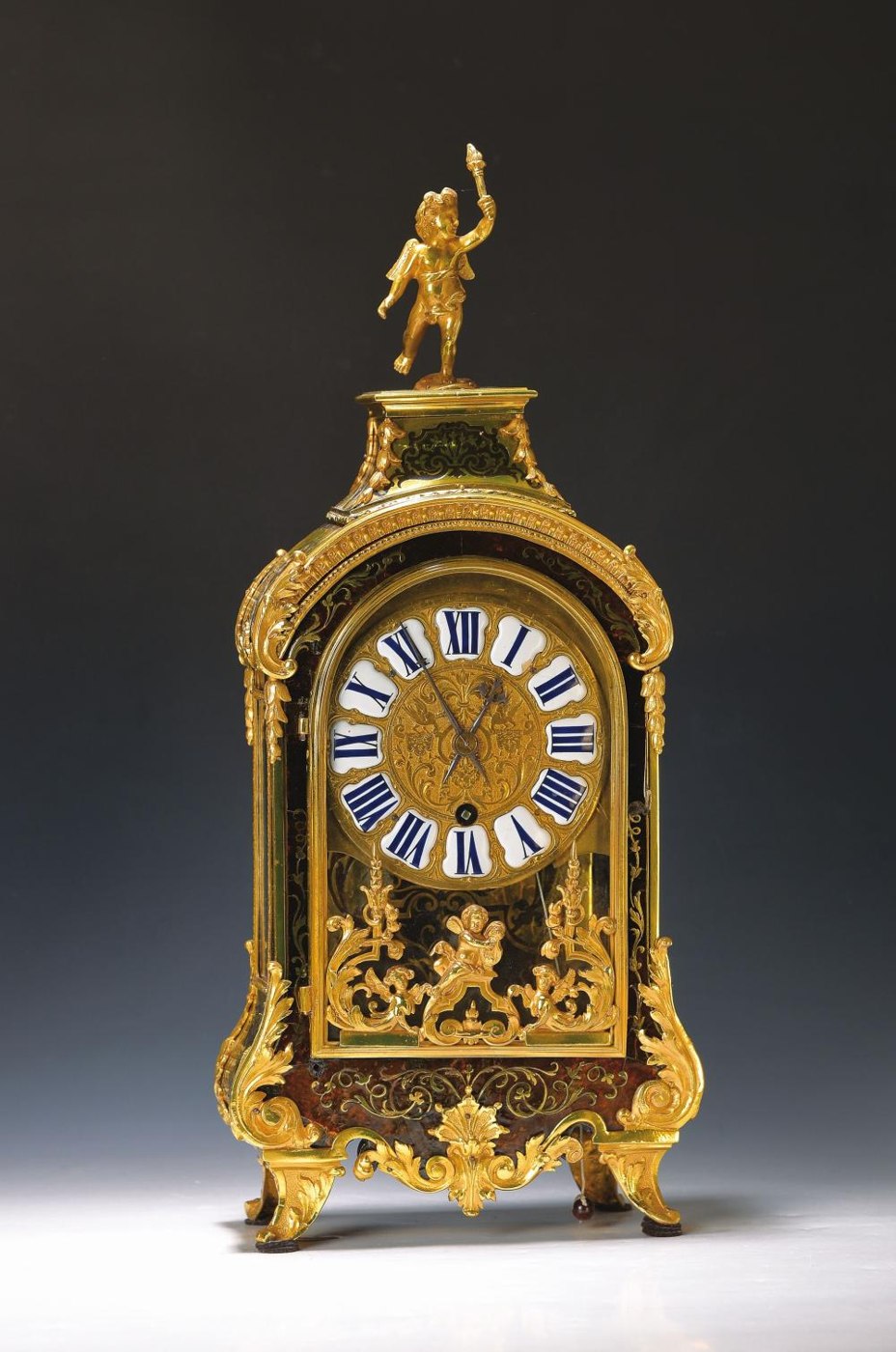
This French pendule, dating to approximately 1710, features a Boulle case design, with elements of Contre-Boulle decoration and a translucent protective varnish finish. The clock stands approximately 59 cm in height and sits on rocaille feet. The case is glazed on three sides and capped by a crowning putto figure. The dial is constructed of decorated cast brass and is fitted with individual enamel cartouches for the hour numerals. The movement is a massive brass plate design signed by the maker, Margotin a Paris, featuring a verge escapement and powered by a large barrel. It is equipped with a quarter-hour striking mechanism intended for two bells, though one striking hammer is currently missing. The clock includes a repetition mechanism operated by a cord. The auction report indicates that the striking mechanism does not function and cannot be tested.

Boulle work pendule featuring a brass dial with enamel cartouches and a crowning putto figure.
Boulle work pendule featuring a brass dial with enamel cartouches and a crowning putto figure. — Henry's Auktionshaus (via Invaluable). Rights pending — permission not yet requested. Original source

Catalogue identity

Source
www.invaluable.com
Category
Clock · Bracket clock
Maker / attribution
Margotin a Paris
Reference
Not recorded
Catalogue / lot identifier
5420
Source-reported date
circa 1710
Source-reported place
France

Source-reported attribution and specifications are not independent authentication. A listing does not establish present ownership, current display, availability or permission to reproduce.

Object description

Case and Aesthetic Construction

The clock is housed in a Boulle-style case which incorporates sections of Contre-Boulle, with the exterior surfaces covered in a translucent protective varnish. The structural form includes a semicircular upper section, an attached top, and a trapezoidally arranged base supported by rocaille feet.

The case is glazed on three sides to allow for visibility into the interior components. The rear door is decorated on the interior with Contre-Boulle work. A putto figure is mounted at the apex of the case, although this element is noted to be a secondary replacement. The front glass panel shows signs of a beginning crack.

Evidence for this section
  • “Boulle case, partly Contre-Boulle”
  • “case covered with translucent protective varnish”
  • “figure crowning putto (secondary)”
  • “vorderes Glas mitbeginnenden Sprung”

Movement and Mechanical Function

The timepiece is driven by a massive brass plate movement signed by Margotin a Paris. It utilizes a verge escapement and relies on a large mainspring barrel for power. The clock is designed to strike the quarter-hours on two bells using a configuration of three striking hammers.

One of the three striking hammers is currently missing. Furthermore, the clock includes a repetition function enabled by a cord. The auction house reports that the function of the striking train cannot be tested because the mechanism does not initiate correctly. The movement is rated in condition category 3-4.

Evidence for this section
  • “mass. Messingplatinenwerk sign.: Margotin a Paris”
  • “Antrieb über ein großes Federhaus”
  • “Spindelgang”
  • “3 Schlaghämmer (einer fehlt)”

Dial and Internal Components

The dial is composed of cast brass and features decorative surface casting. The hour markers are presented as individual enamel cartouches featuring blue Roman numerals. These are set against the intricate metalwork of the brass dial face.

Internal inspections reveal the continuation of the marquetry theme within the case, notably on the rear door. The movement is secured within the housing which, according to the provided condition report, is rated at a 2-3 level, indicating the general state of the exterior housing relative to the movement's functionality.

Evidence for this section
  • “verziertes Messingguß Zifferblatt”
  • “Emailkartuschen”
  • “hintere Türe innen mit Contre-Boulle”
  • “housing 2-3”

Open research questions

  • What is the specific history of the maker Margotin a Paris within the context of early 18th-century French clockmaking?
  • Are there original historical records that confirm the type of crowning figure originally intended for this specific model of pendule?

Source evidence

Recorded claims and source quotations for Magnificent pendule with quarter-hour strike
FieldSource-reported valueSource quotation
MakerMargotin a Paris“signed: Margotin a Paris”
Datecirca 1710“France around 1710”
Height59 cm“height approx. 59cm”
EscapementVerge“Spindelgang”
StrikeQuarter-hour“Viertelstundenschlag”
Case constructionBoulle and Contre-Boulle“Boulle case, partly Contre-Boulle”
ConditionMovement 3-4, Housing 2-3“condition of movement 3- 4, housing 2-3”

Visible details

  • The front glass has a noticeable crack
  • The crowning putto figure is identified as a secondary addition
  • The dial features enamel Roman numeral cartouches
  • The case features applied cast brass rocaille feet and ornaments

Research qualifications

  • The striking mechanism is noted as non-functional
  • The figure crowning the clock is explicitly stated to be a secondary addition

Photograph identity and source facts were screened before import; rights clearance remains pending.

Consulted source

Magnificent pendule, with a quarter-hour strike

Reviewed 2026-10-26 · Record eaef66845d

Terms in this record

Glossary explanations for terms named in this object’s record.