
Skip to content
The Encyclopedia of Horology

Clock · Religieuse-Pendule

Louis XIV Religieuse-Pendule

Partially verified

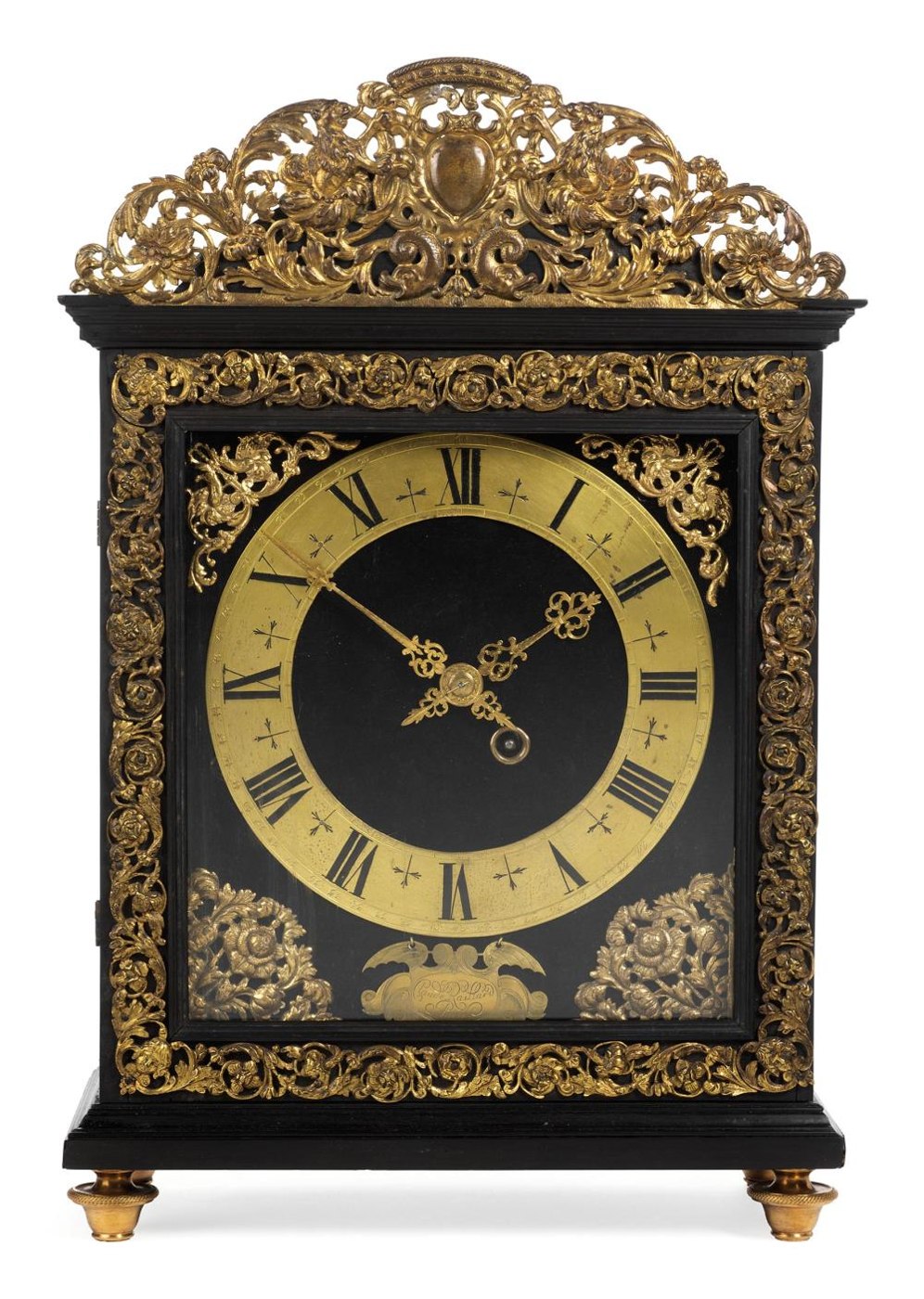
This Louis XIV period religieuse-pendule is an ebonized wooden mantle clock attributed to the Parisian clockmaker Claude Raillard, who was active during the second half of the 17th century. The clock measures 46 cm in height, 31 cm in width, and 13 cm in depth. Its aesthetic is defined by an ebonized case featuring decorative tin stringing, accented with ornate cast and gilded bronze relief elements on the front door and upper cresting. The dial consists of a gold-colored chapter ring with blackened Roman numerals and engraved Arabic numerals for minutes, mounted against a black velvet ground. It is signed on a brass plaque beneath the numeral six. The timepiece incorporates a pendulum regulated by a silk suspension and includes a locking plate mechanism for half-hourly and hourly striking on an overhead bell.

Front view of the Louis XIV religieuse-pendule showing the dial and gilded bronze decorative elements.
Front view of the Louis XIV religieuse-pendule showing the dial and gilded bronze decorative elements. — Hampel Fine Art Auctions (via Invaluable). Rights pending — permission not yet requested. Original source

Catalogue identity

Source
www.invaluable.com
Category
Clock · Religieuse-Pendule
Maker / attribution
Claude Raillard
Reference
Not recorded
Catalogue / lot identifier
80
Source-reported date
circa 1660/70
Source-reported place
France

Source-reported attribution and specifications are not independent authentication. A listing does not establish present ownership, current display, availability or permission to reproduce.

Object description

Case and Dial Construction

The case is decorated with tin stringing inlay along the sides, which contrasts with the dark wood. The front door and the elaborate cresting are adorned with cast gilded bronze reliefs, which serve both as structural mounts and decorative elements.

The dial features a chapter ring with bold Roman numerals for the hours and engraved Arabic numerals for the minute divisions. The dial and the four cast bronze corner spandrels are set against a background of black velvet, providing a stark visual contrast. The hands are fashioned in a delicate, filigree style from gilded metal. A brass plaque, positioned directly beneath the numeral six, identifies the maker through an inscription.

Evidence for this section
  • “Gehäusekasten in ebonisiertem Holz mit seitlichen Zinn-Fadeneinlagen, Fronttüre und Aufsatzdekor in gegossenem vergoldetem Bronzerelief.”
  • “Ziffernring und Eckdekor auf schwarzem Samt; geschwärzte römische Stunden und gravierte arabische Minuten, filigrane Zeiger vergoldet.”
  • “Unterhalb der VI ein Messingschild mit der Uhrmacherbezeichnung „Claude Raillard / AParis“.”

Movement and Mechanism

The movement is configured as a religieuse-pendule, utilizing a pendulum regulated by a silk suspension system. This arrangement allows for the fine adjustment of the clock's timing. The striking mechanism is operated via a locking plate system, designed to regulate the half-hourly and hourly chime sequences. These strikes are delivered on an overhead bell mounted at the top of the movement.

It is noted by the auction house that the current operational status of the movement has not been verified. No internal photographs of the movement plates or train were provided in the description, leaving the internal condition and technical specifics to be determined by further inspection.

Evidence for this section
  • “Regulier-Pendel an Fadenaufhängung, Schlossscheibe für Halb- und Stundenschlag auf der oben liegenden Glocke.”
  • “Nicht auf Funktionsfähigkeit geprüft.”

Maker and Historical Context

Claude Raillard is identified as a master clockmaker who maintained his workshop on the Rue de la Pelleterie in the Saint-Jacques-de-la-Boucherie area of Paris. Archival records confirm his professional activity between 1648 and 1718, with his death occurring approximately in 1720. His work is recognized in historical collections, such as the Planetarium Zuylenburgh in Utrecht.

The clock is documented in regional literature from 1981, providing a degree of provenance-related reference for the specific piece.

Evidence for this section
  • “Claude Raillard war Meister-Uhrmacher in Paris (Rue de la Pelleterie, Saint-Jacques-de-la-Boucherie).”
  • “In Archiven wurde er von 1648 bis 1718 erwähnt, er starb etwa um 1720.”
  • “Ein Werk seiner Hand befindet sich im Planetarium Zuylenburgh in Utrecht.”
  • “Literatur: Paris 1981, S. 130 ff.”

Open research questions

  • What is the current mechanical state of the movement and is it original to the case?
  • Are there any identifiable inventory marks on the backplate or case interior that link it to specific collections beyond the 1981 literature?

Source evidence

Recorded claims and source quotations for Louis XIV Religieuse-Pendule
FieldSource-reported valueSource quotation
MakerClaude Raillard“Claude Raillard / AParis”
Height46 cm“Höhe: 46 cm.”
Width31 cm“Breite: 31 cm.”
Depth13 cm“Tiefe: 13 cm.”
Datecirca 1660/70“Um 1660/70.”
MaterialsEbonized wood, tin, gilded bronze, velvet“Gehäusekasten in ebonisiertem Holz mit seitlichen Zinn-Fadeneinlagen, Fronttüre und Aufsatzdekor in gegossenem vergoldetem Bronzerelief.”
MechanismSilk suspension pendulum, locking plate striking“Regulier-Pendel an Fadenaufhängung, Schlossscheibe für Halb- und Stundenschlag auf der oben liegenden Glocke.”

Visible details

  • Cast gilded bronze corner spandrels
  • Filigree gilded hands
  • Clock sits on four small turned feet
  • Brass signature plaque located below the numeral VI

Research qualifications

  • Condition regarding functionality not tested
  • Exact production date speculative per circa attribution

Photograph identity and source facts were screened before import; rights clearance remains pending.

Consulted source

Louis XIV Religieuse-Pendule

Reviewed 2026-10-26 · Record 1ebe5d6c0c

Terms in this record

Glossary explanations for terms named in this object’s record.