
Skip to content
The Encyclopedia of Horology

Wristwatch · Aviation watch

Longines Lindbergh Hour Angle Ref 3210

Partially verified

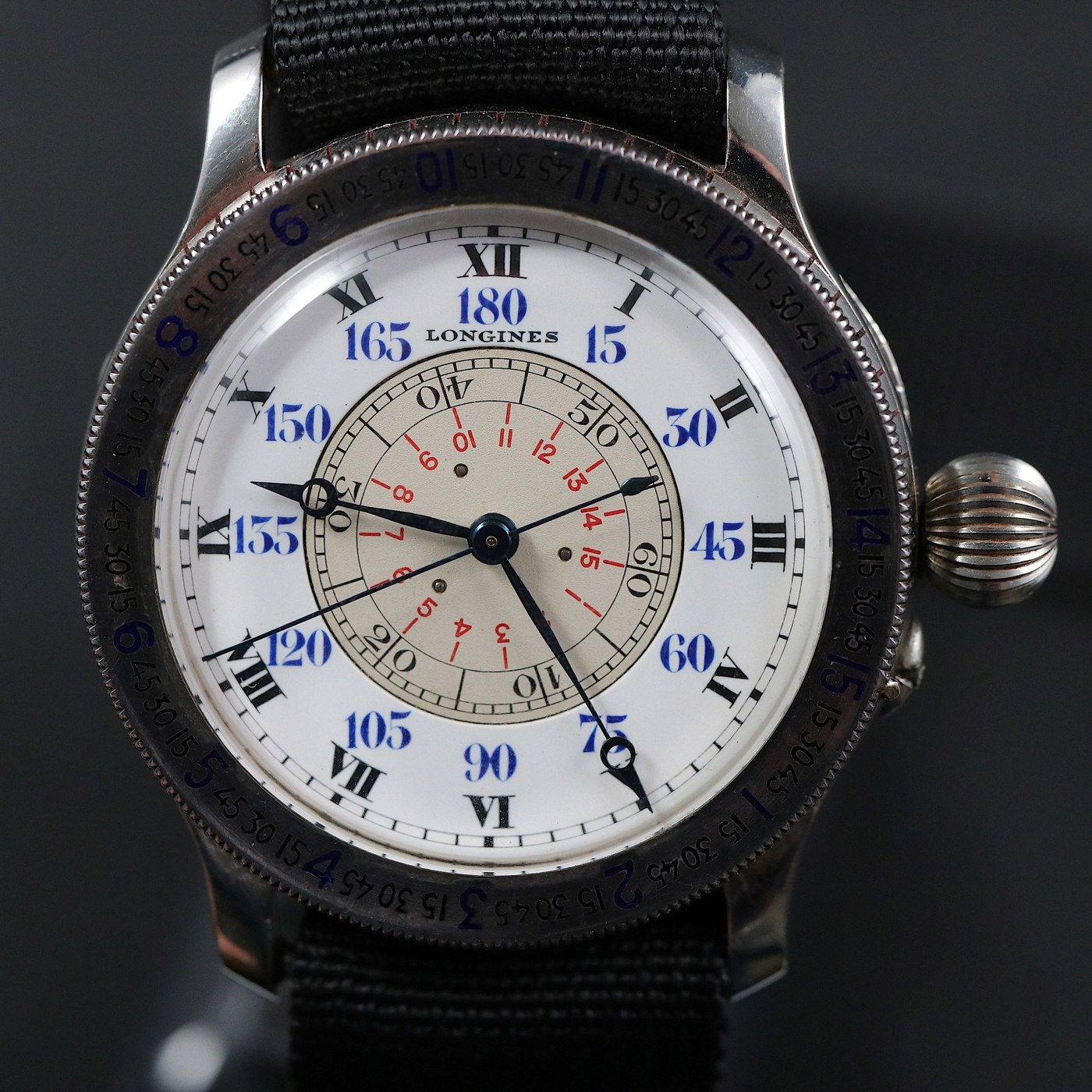
This Longines Lindbergh Hour Angle watch, referenced 3210 and dated to 1938, is an aviation timepiece designed for navigation. The watch features a 47mm stainless-steel case with an onion-style crown and a pusher at the 4 o'clock position. The dial is composed of a white enamel outer section with Roman numerals and blue Arabic numerals, and a light gray inner rotating disc that functions in conjunction with the rotating bezel to calculate hour angles. The watch is powered by a manual winding Caliber 18.69N movement with 15 jewels. Documentation provided with the watch includes an 'Extract from the Archives' dated March 3, 2026. The watch was originally invoiced on October 27, 1938, to the Longines agent in Panama, Casullo. The case interior and cuvette both feature engraved markings referencing 'Acier Staybrite' and the serial number 200342.

Frontal view of the Longines Lindbergh Hour Angle Ref 3210, showcasing the multi-layered dial with white enamel, rotating gray center disc, and graduated rotating bezel.
Frontal view of the Longines Lindbergh Hour Angle Ref 3210, showcasing the multi-layered dial with white enamel, rotating gray center disc, and graduated rotating bezel. — Laurent Fine Watches. Rights pending — permission not yet requested. Original source

Catalogue identity

Source
www.laurentfinewatches.com
Category
Wristwatch · Aviation watch
Maker / attribution
Longines
Reference
3210
Catalogue / lot identifier
Source URL identifies the listing
Source-reported date
1938
Source-reported place
Switzerland
Source-reported serial
200342

Source-reported attribution and specifications are not independent authentication. A listing does not establish present ownership, current display, availability or permission to reproduce.

Object description

Design and Dial Construction

The timepiece features a multi-layered dial designed for the calculation of latitude and longitude via the hour angle. The dial layout includes an outer white enamel ring displaying Roman numerals and blue Arabic numerals representing degrees. A central rotating disc, finished in light gray, includes a red graduated ring and is manipulated using the crown.

The watch includes a rotating silver bezel marked with black graduations intended for navigation. The time is indicated by blue-toned Breguet-style hands. The watch is equipped with an onion-style crown for winding and a pusher located at the 4 o'clock position, which is utilized for setting the time.

Evidence for this section
  • “round white enamel dial and inner light gray dial”
  • “The watch comes with a silver bezel with graduation in black for navigation purpose.”
  • “The watch comes with the classic onion crown and pusher at 4 o’clock to set-up the time.”

Movement and Mechanical Specifications

The watch is powered by a manual winding movement identified as Caliber 18.69N, which features 15 jewels. This caliber was first developed in 1908 and was frequently used in the pocket watches produced by the manufacturer. It operates at a frequency of 18,000 A/h and provides an approximate power reserve of 36 hours.

The 18.69N caliber was employed for the first three generations of the Hour-angle series. This specific movement was produced with either nickel or gilt finishes, reflecting the manufacturer's production standards for aviation timepieces during this era.

Evidence for this section
  • “Longines manual winding movement with caliber 18.69N, 15 jewels and 18,000 A/h.”
  • “The power reserve is approximately 36 hours.”
  • “The 18.69N caliber was used for the first three Hour-angle generations and available in either a nickel or gilt finish.”

Provenance and Documentation

The watch was officially invoiced on October 27, 1938, through the entity Casullo, which served as the Longines representative in Panama. The watch is accompanied by an 'Extract from the Archives' issued on March 3, 2026, verifying its production details and original sale.

The case and its associated cuvette are engraved internally with the phrase 'Acier Staybrite' and the serial number 200342, which confirms the specific manufacturing batch. The watch is currently presented with an original brown NATO strap in poor condition and an additional non-original black NATO strap.

Evidence for this section
  • “This watch was invoiced on October 27, 1938 by the company Casullo, which was at that time the Longines agent in Panama.”
  • “It is a stainless-steel case with engraved inside “Acier Staybrite – 200342”
  • “The Watch comes with the “Extract from the Archives” dated March 3, 2026.”

Open research questions

  • Does the 200342 serial number correlate exactly with known production batch records for 1938 18.69N movements?
  • What precise modifications differentiate this 'second generation' reference 3210 from the first generation of Lindbergh Hour Angle watches?

Source evidence

Recorded claims and source quotations for Longines Lindbergh Hour Angle Ref 3210
FieldSource-reported valueSource quotation
MakerLongines“BRAND: LONGINES”
Reference3210“MODEL: LINDBERGH HOUR ANGLE – REFE 3210”
Serial Number200342“It is a stainless-steel case with engraved inside “Acier Staybrite – 200342”
Date1938“10/27/1938”
Movement18.69N“The watch has a manual winding movement with caliber 18.69N and 15 jewels.”
Case MaterialStainless steel“STAINLESS STEEL WITH SILVER BEZEL”
ProvenanceCasullo, Panama“This watch was invoiced on October 27, 1938 by the company Casullo, which was at that time the Longines agent in Panama.”

Visible details

  • Onion-style winding crown at 3 o'clock
  • Rotating outer bezel with black navigation graduations
  • Blue-toned Breguet-style hands
  • Red inner ring on the central rotating disc

Research qualifications

  • The source states the watch might be the second generation
  • The current NATO strap is noted as not original to the watch

Photograph identity and source facts were screened before import; rights clearance remains pending.

Terms in this record

Glossary explanations for terms named in this object’s record.