
Skip to content
The Encyclopedia of Horology

Clock · Longcase clock

Longcase clock (Régulateur) by Robert Robin

Partially verified

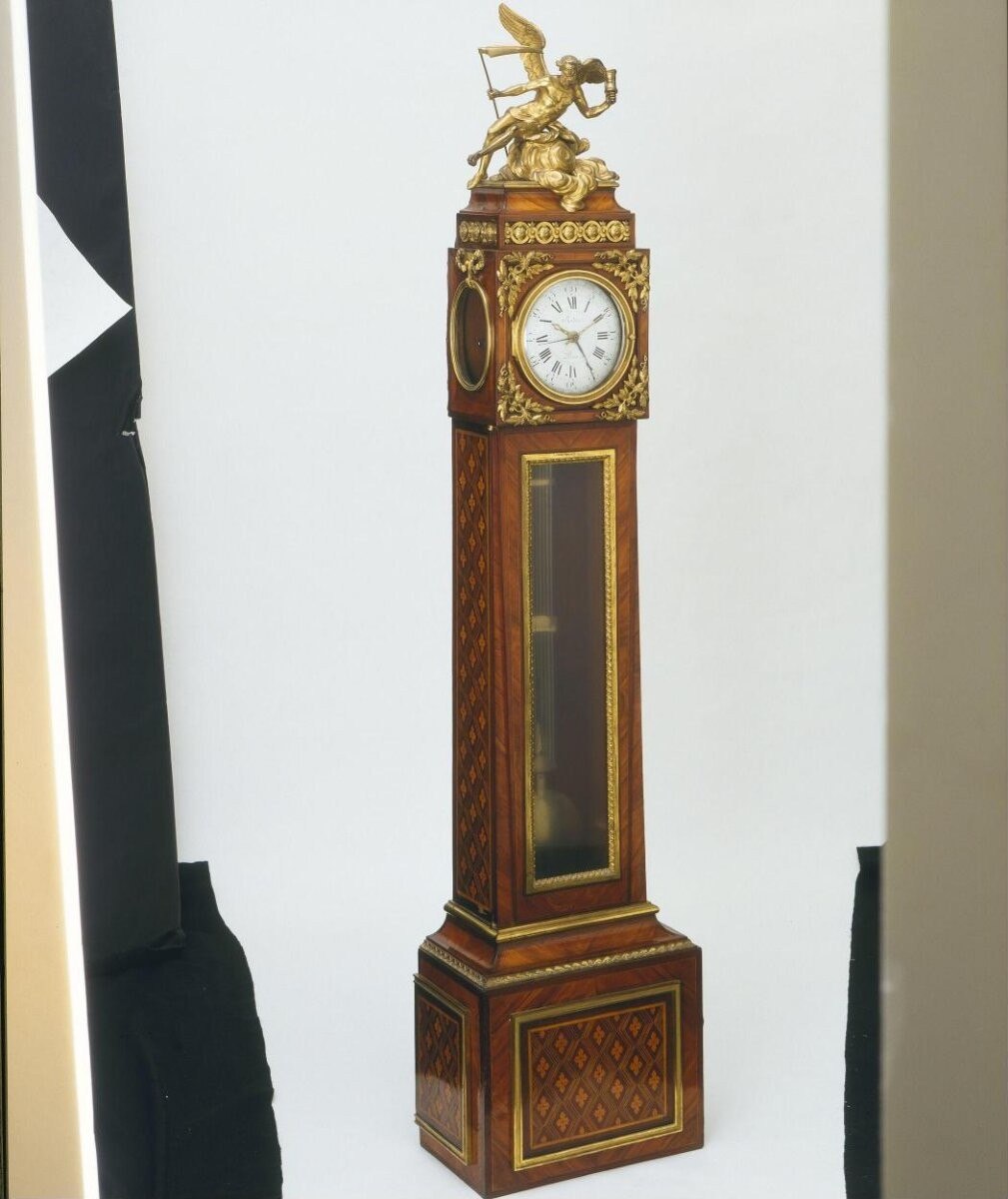
This longcase clock, or régulateur, features a movement by the Parisian maker Robert Robin and a case attributed to the cabinet-maker Balthazar Lieutaud. Produced in Paris between 1770 and 1775, the timepiece is constructed with a carcase of oak veneered in tulipwood and other woods. The exterior displays a lozenge marquetry pattern on the base panel and is finished with gilt-bronze mounts, including a figurative cresting depicting Father Time holding a scythe. The white enamel dial, signed 'Robin a Paris', is also marked by the enameller Elie Barbezat on the reverse. The object's structural components show a repair inscription dated 1817. While the clock is missing its original plinth, a replacement base was manufactured by the Victoria and Albert Museum in 2015 to facilitate its display. The case bears the stamp of Balthazar Lieutaud in four locations, reflecting the professional collaboration common among 18th-century Parisian guild-controlled trades.

Full view of the longcase clock showing the gilt-bronze figure of Father Time, the dial, and the lozenge marquetry case.
Full view of the longcase clock showing the gilt-bronze figure of Father Time, the dial, and the lozenge marquetry case. — Victoria and Albert Museum. Rights pending — permission not yet requested. Original source

Catalogue identity

Source
collections.vam.ac.uk
Category
Clock · Longcase clock
Maker / attribution
Robert Robin
Reference
Not recorded
Catalogue / lot identifier
1011:1 to 3&A -1882
Source-reported date
1770-1775
Source-reported place
France

Source-reported attribution and specifications are not independent authentication. A listing does not establish present ownership, current display, availability or permission to reproduce.

Object description

Case and Marquetry

The case of this regulator clock is constructed from an oak carcase, which is subsequently veneered in tulipwood and assorted secondary woods. The visual design centers on the use of lozenge-pattern marquetry, which is applied to the front face of the base panel, providing a geometric contrast to the verticality of the longcase form.

Ornamentation is further achieved through the application of gilt-bronze mounts. The most prominent feature is the cresting at the top of the clock, which represents Father Time holding a scythe. While the primary case dates to the 18th century, the original plinth section beneath the base is missing, necessitating the creation of a modern replacement by the museum to allow for the object's current display.

Evidence for this section
  • “the case veneered in tulipwood and other woods on a carcase of oak”
  • “the front face of the base with a panel of lozenge marquetry”
  • “the case mounted with gilt-bronze mounts, including the figure of Time, with his scythe, as a cresting.”
  • “The clock is missing its base, but a replacement base was made by the Museum in 2015, for display.”

Signatures and Marks

The horological and cabinet-making components are documented through several inscriptions and stamps. The signature 'Robin a Paris' appears on both the white enamel dial and the underlying dial plate. The enamel dial itself carries the mark of the enameller Elie Barbezat on its reverse side.

The cabinet-making provenance is evidenced by four distinct stamps of 'B. LIEUTAUD' located on the back of the clock case. These are positioned on the upright sections and the base, providing a clear indication of the cabinet-maker's involvement in the production of the exterior housing.

Evidence for this section
  • “The dial and dial plate are marked 'Robin a Paris'”
  • “the mark of the enameller Elie Barbezat.”
  • “the case is stamped four times with the stamp B.LIEUTAUD.”

Provenance and Context

This object entered the museum collection as part of the bequest of John Jones, having been acquired by him prior to 1882. The maker, Robert Robin, was a prominent clockmaker in 18th-century Paris, known for his work for the French monarchy and his technical proficiency in producing highly engineered movements.

The collaboration between the clockmaker and the cabinet-maker Balthazar Lieutaud was consistent with the strict guild regulations governing trade in Paris at the time. Cabinet-makers were responsible for the creation of clock cases, while clockmakers such as Robin focused on the mechanical internal systems.

Evidence for this section
  • “Acquired by John Jones before 1882”
  • “Robert Robin, the maker of this clock, was one of the most celebrated clockmakers in 18th-century Paris.”
  • “the different trades were tightly controlled by the guild system and Robin did not make the wooden cases of his clocks.”
  • “This case is stamped ‘B. LIEUTAUD’, the mark of the cabinetmaker Balthazar Lieutaud, who worked frequently with Robin.”

Open research questions

  • What is the exact mechanical nature of the calendar equation feature indicated in the source?
  • Can the provenance of the clock be traced further back than John Jones' 1882 acquisition?

Source evidence

Recorded claims and source quotations for Longcase clock (Régulateur) by Robert Robin
FieldSource-reported valueSource quotation
MakerRobert Robin“Robert Robin, the maker of this clock”
Cabinet-makerBalthazar Lieutaud“This case is stamped ‘B. LIEUTAUD’, the mark of the cabinetmaker Balthazar Lieutaud”
Date1770-1775“1770-1775”
EnamellerElie Barbezat“This is the mark of the enameller Elie Barbezat.”
MaterialsOak, tulipwood, gilt-bronze, steel, brass, enamel“tulipwood and other woods veneered on oak, the case set with gilt-bronze mounts”

Visible details

  • Gilt-bronze figure of Father Time with a scythe as a cresting
  • Dial and dial plate signed 'Robin a Paris'
  • Lozenge marquetry panels visible on the base and mid-section
  • Transparent glazed section allowing visibility of the pendulum

Research qualifications

  • Originality of the base which is a museum replacement
  • Attribution of the case stamping to the specific output of Balthazar Lieutaud

Photograph identity and source facts were screened before import; rights clearance remains pending.

Consulted source

Longcase clock (Régulateur)

Reviewed 2026-11-02 · Record e4f4791f7d

Terms in this record

Glossary explanations for terms named in this object’s record.