
Skip to content
The Encyclopedia of Horology

Clock · Longcase clock

Longcase Clock by Balthazar Lieutaud

Partially verified

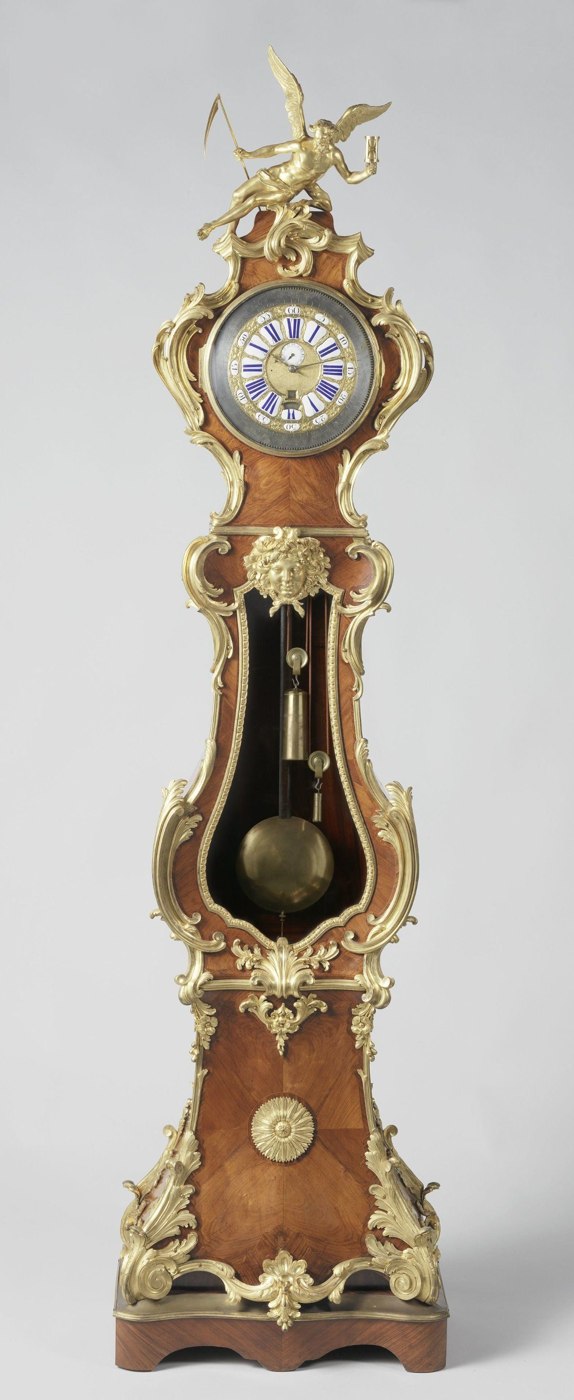
This longcase clock (regulator) is attributed to Balthazar Lieutaud of Paris, dating from approximately 1760 to 1765. The clock features a case constructed of oak and coniferous wood, veneered in rosewood and kingwood, and decorated with elaborate gilt-bronze mounts. The design incorporates a pedestal base, a lyre-shaped trunk with a glazed door for viewing the pendulum, and a hooded top section housing the movement. A gilt-bronze figure of Father Time, depicted with a scythe and hourglass, surmounts the clock. The dial incorporates enamel elements. The cabinetwork exhibits herringbone-pattern marquetry and figurative gilt-bronze applications featuring shell, volute, and floral motifs. The clock carries a 'crowned C' mark on the dial and the maker's stamp on the rear of the hood.

Full view of the longcase clock, showing the gilt-bronze figure of Father Time and the lyre-shaped trunk.
Full view of the longcase clock, showing the gilt-bronze figure of Father Time and the lyre-shaped trunk. — Rijksmuseum. Rights pending — permission not yet requested. Original source

Catalogue identity

Source
www.rijksmuseum.nl
Category
Clock · Longcase clock
Maker / attribution
Balthazar Lieutaud
Reference
Not recorded
Catalogue / lot identifier
BK-16671
Source-reported date
c. 1760 - c. 1765
Source-reported place
France

Source-reported attribution and specifications are not independent authentication. A listing does not establish present ownership, current display, availability or permission to reproduce.

Object description

Cabinetwork and Aesthetics

The clock is composed of an oak and coniferous wood core, surfaced with decorative rosewood and kingwood veneers. The structure follows a tiered design, beginning with a layered pedestal base that supports a tapering basement. Above this, a lyre-shaped trunk features a glazed door, allowing for visual inspection of the pendulum. The clock is crowned by a hooded section that houses the timekeeping movement.

The exterior is finished with herringbone marquetry and extensive gilt-bronze mounts. These metal applications, which embellish the corners and frame the case, depict shell, volute, and floral ornamentation. At the very top, a gilt-bronze figure identified as Father Time holds a scythe and an hourglass, providing the clock with a figurative decorative focus.

Evidence for this section
  • “Staande klok versierd met marqueterie op eikenhouten kern en met verguld brons.”
  • “Aan de voorkant zijn de randen in een montuur gevat, evenals de achterpoten, met schelp-, voluut- en florale motieven; bovenop een figuur van de Tijd.”

Signatures and Identifiers

The object includes several internal and external identifying marks. A 'crowned C' mark is struck in multiple locations on the dial. On the rear of the hood, the maker’s name 'B.LIEUTAUD' is stamped.

Inside the plinth and lower cabinet, additional markings are present. These include an ink-written Russian label and a circular stamp referring to customs handling, inscribed with the text 'Zollabfertigung'. These markings suggest the clock moved through specific administrative or transit points during its history.

Evidence for this section
  • “merk, op diverse plaatsen op de wijzerplaat, afgeslagen: gekroonde C”
  • “signatuur, op de achterzijde van de kap, gestempeld: ‘B.LIEUTAUD’”
  • “stempel, aan de binnenzijde van de plint en de onderkast, gestempeld: Zwarte cirkel met randschrift: Zollabfertigung [..]le Niederlage(?) S[...]”

Provenance and History

The clock was sold at the Leningrader Museen und Schlösser auction in 1929. By 1936, it was part of the collection of Dr. Fritz Mannheimer in Amsterdam and Paris. In 1940, the estate was purchased by the Dienststelle Mühlmann for the Führermuseum in Linz.

Following the end of the Second World War, the clock was subject to recuperation by the SNK in 1945. It was subsequently loaned to the museum by the DRVK in 1952, before being officially transferred to the museum collection in 1960.

Evidence for this section
  • “sale, Leningrader Museen und Schlösser (Zweiter Teil), Rudolph Lepke (Berlin), 4 (5) June 1929”
  • “war recuperation, SNK, 1945”

Open research questions

  • What is the complete text of the Russian label located inside the plinth?
  • Does the 'crowned C' mark correspond to a specific tax or guild regulation period in Paris?

Source evidence

Recorded claims and source quotations for Longcase Clock by Balthazar Lieutaud
FieldSource-reported valueSource quotation
Object numberBK-16671“Objectnummer BK-16671”
MakerBalthazar Lieutaud“vervaardiger: Balthazar Lieutaud, Parijs”
Dimensions242.5 cm height x 62 cm width x 32 cm depth“hoogte 242,5 cm x breedte 62 cm x diepte 32 cm”
MaterialsOak, conifer, rosewood, kingwood, gilt bronze, enamel“eiken-en naaldhout, belijmd met rozenhout en palissanderhout, verguld brons, email”
Maker's markB.LIEUTAUD (stamped)“signatuur, op de achterzijde van de kap, gestempeld: ‘B.LIEUTAUD’”
Dial markCrowned C“merk, op diverse plaatsen op de wijzerplaat, afgeslagen: gekroonde C”
ProvenanceFormerly in the collection of Dr. Fritz Mannheimer“collection Dr Fritz Mannheimer (1890-1939), Amsterdam and Paris, 1936”

Visible details

  • Gilt-bronze figure of Father Time atop the hood
  • Lyre-shaped central trunk with glazed viewing aperture
  • Herringbone marquetry on the lower cabinet front
  • Gilt-bronze mounts with floral and scroll motifs

Research qualifications

  • Maker attribution based on stamp on rear of hood
  • Exact nature of Russian label on the inside of the plinth is not fully detailed

Photograph identity and source facts were screened before import; rights clearance remains pending.

Consulted source

Longcase clock, c. 1760 - c. 1765

Reviewed 2026-11-02 · Record fa513b56eb

Terms in this record

Glossary explanations for terms named in this object’s record.