
Skip to content
The Encyclopedia of Horology

Clock · Longcase clock

Longcase clock by Adam Heijmuijs

Partially verified

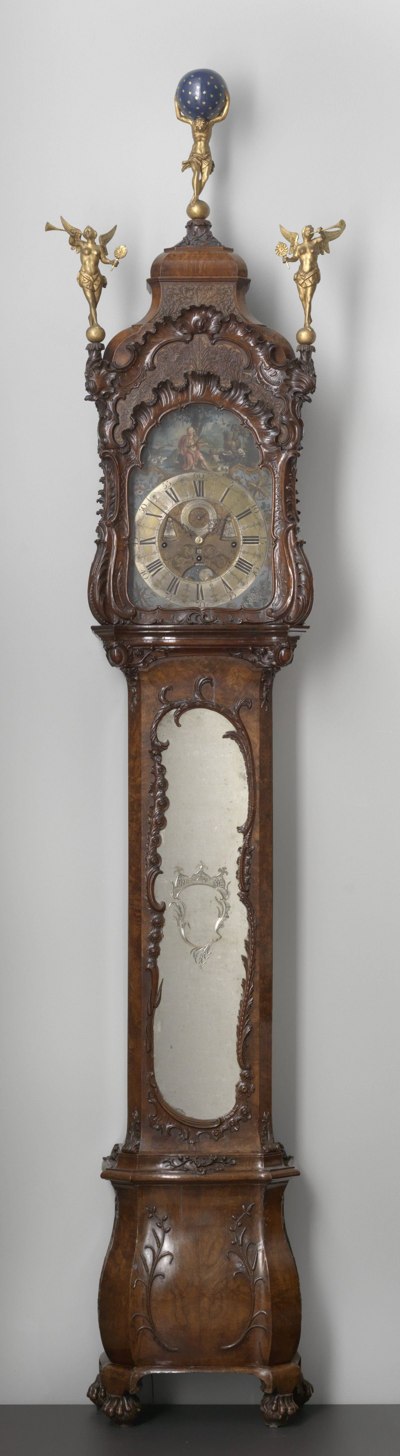
This longcase clock is a tall horological instrument attributed to the Amsterdam-based clockmaker Adam Heijmuijs, active between circa 1755 and 1765. Constructed with an oak core, the case is veneered in burr walnut and features a curved base supported by claw feet. The front panel includes a tall, arched door with an asymmetrically framed mirror featuring etched ornaments. The hood, which sits atop a curved molding, includes a glazed door and openwork carving, capped by a figure of Atlas carrying a celestial sphere, flanked by figures of angels with trumpets. The timepiece is mechanically complex, equipped with a musical mechanism capable of playing fourteen melodies. Beyond standard timekeeping, the clock provides various indications including date, day, month, moon phase, and high water tide levels. The movement dial bears the signature of Adam Heijmuijs, while the cabinet maker of the wooden housing remains anonymous.

Full view of the longcase clock showing the walnut case, mirror door, and Atlas crowning figure.
Full view of the longcase clock showing the walnut case, mirror door, and Atlas crowning figure. — Rijksmuseum. Rights pending — permission not yet requested. Original source

Catalogue identity

Source
www.rijksmuseum.nl
Category
Clock · Longcase clock
Maker / attribution
Adam Heijmuijs
Reference
Not recorded
Catalogue / lot identifier
BK-1967-144
Source-reported date
ca. 1755 - ca. 1765
Source-reported place
Netherlands

Source-reported attribution and specifications are not independent authentication. A listing does not establish present ownership, current display, availability or permission to reproduce.

Object description

Case Construction and Design

The case of the longcase clock is constructed from an oak core, which is subsequently veneered in burr walnut. The cabinet maker aimed to minimize the width of the clock while offsetting the angular, straight lines through the integration of an asymmetrically shaped mirror on the front door, which is further decorated with etched ornamentation.

The base section is curved and raised on claw feet, featuring overhanging styles. The hood is supported by a curved molding and includes a glazed door with ornate openwork saw-cut detailing. Decorative elements include trumpet-playing angels mounted on pedestals and a crowning figure of Atlas holding a celestial sphere.

Evidence for this section
  • “Staande klok van wortelnotenhout op eiken kern. Het gebogen onderstuk met overhoeks geplaatste stijlen rust op klauwpoten.”
  • “De voorzijde van de rechte kast bestaat uit een getoogde deur met spiegel met ingeslepen ornament en assymetrische omlijsting.”
  • “Op de overhoeks geplaatste stijlen voetstukken met bazuinengelen; ter bekroning atlas met hemelbol.”

Mechanism and Functions

The clock functions as both a timekeeper and a complex mechanical instrument. It incorporates a musical mechanism capable of playing fourteen distinct melodies.

The dial includes multiple indicators beyond the standard hours and minutes. These functions display the date, day, month, current moon phase, and high water tide levels, reflecting an elaborate movement design consistent with the period of production.

Evidence for this section
  • “De klok heeft een speelwerk van veertien melodieën en wijst datum, dag, maand, de stand van de maan en hoogwater aan.”

Signatures and Documentation

The clock bears the signature of the Amsterdam clockmaker Adam Heijmuijs on the dial. While the clockmaker is identified, the furniture maker responsible for the walnut and oak cabinetry is recorded as anonymous.

The object was acquired by the museum in 1967 and currently resides in the collection under the accession number BK-1967-144. It is documented as a Dutch piece dating to the mid-18th century.

Evidence for this section
  • “signatuur, wijzerplaat: ‘Adam Heijmuijs Amsterdam’”
  • “meubelmaker: anoniem, Amsterdam”
  • “aankoop 1967”

Open research questions

  • What specific musical mechanism was used for the fourteen melodies?
  • Is there further information on the specific tidal calculation method used by Heijmuijs?

Source evidence

Recorded claims and source quotations for Longcase clock by Adam Heijmuijs
FieldSource-reported valueSource quotation
MakerAdam Heijmuijs“uurwerkmaker: Adam Heijmuijs, Amsterdam”
Object numberBK-1967-144“Objectnummer BK-1967-144”
MaterialsBurr walnut, oak, glass“notenhout en eikenhout, gefineerd met wortelnotenhout, spiegelglas”
Dimensions311 cm high“hoogte 311 cm (hoogte inclusief atlas)”
ComplicationsMusical, date, day, month, moon phase, tide“De klok heeft een speelwerk van veertien melodieën en wijst datum, dag, maand, de stand van de maan en hoogwater aan.”
Signature locationDial“signatuur, wijzerplaat: ‘Adam Heijmuijs Amsterdam’”

Visible details

  • Case features a mirror with asymmetric frame
  • Atlas figure surmounts the hood
  • Dial displays moon phase and tidal information
  • Base supported by claw feet

Research qualifications

  • Maker of the walnut and oak case remains anonymous
  • Exact construction origin remains attributed to Amsterdam

Photograph identity and source facts were screened before import; rights clearance remains pending.

Consulted source

Longcase clock, c. 1755 - c. 1765

Reviewed 2026-11-02 · Record 038173b18d

Terms in this record

Glossary explanations for terms named in this object’s record.