
Skip to content
The Encyclopedia of Horology

Clock · Lighthouse clock

Lighthouse Clock

Partially verified

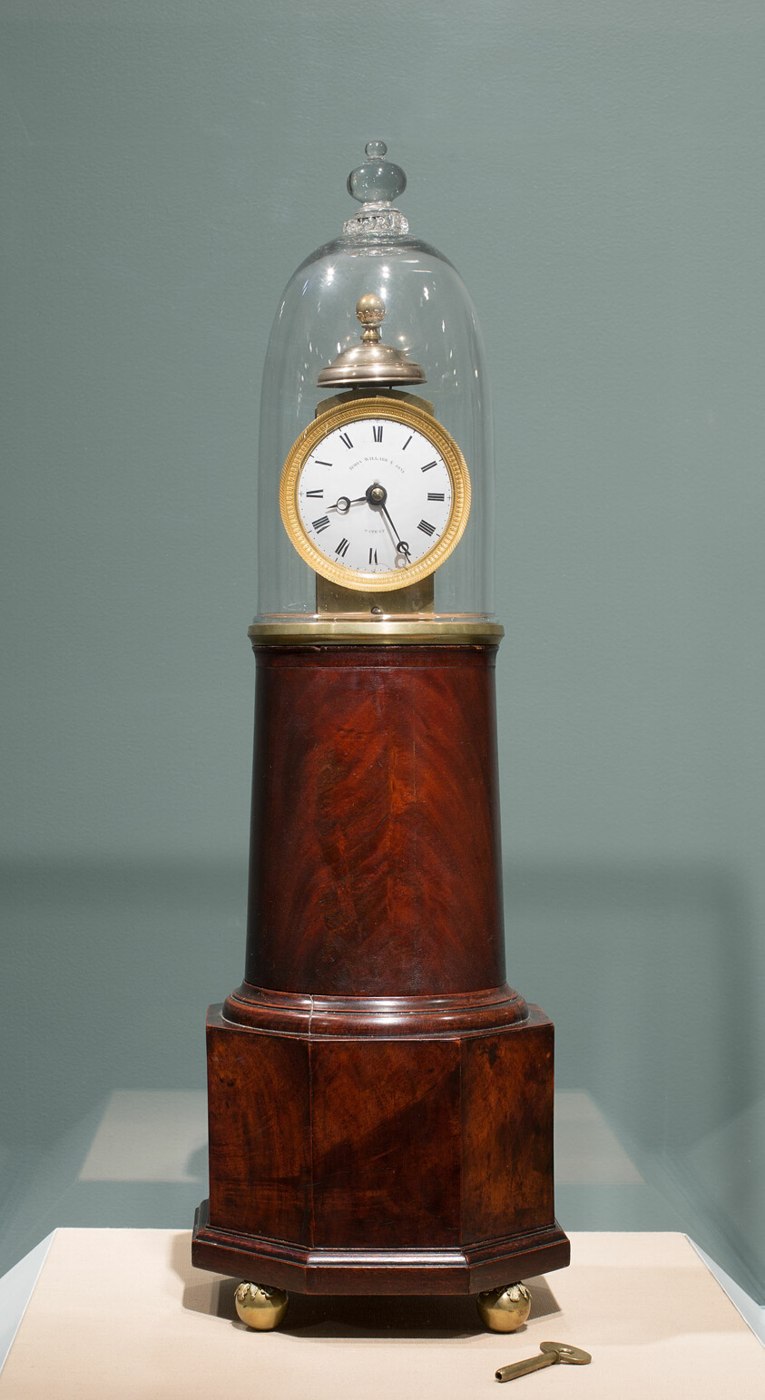
This lighthouse clock is a timepiece produced by Simon Willard and Sons in Roxbury, Massachusetts, between 1825 and 1830. The object stands 74.9 cm tall on an octagonal wooden plinth base that transitions into a tapering cylindrical column. The base is crafted from white pine and finished with mahogany veneer. The clock movement is housed beneath a clear glass dome, which serves to protect the mechanism while maintaining visibility. Within this enclosure, the circular white enamel dial features black Roman numerals and is surrounded by a gilt metal bezel. A bell finial, integrated into the top of the dial assembly, contributes to the overall form, which draws inspiration from the silhouette of a lighthouse. The piece is recorded in the collection of the Art Institute of Chicago under accession number 1997.451 and is reported to have provenance descending through the family of the maker’s brother, Aaron Willard.

Full view of the lighthouse clock showing the mahogany base and the dial housed under the glass dome.
Full view of the lighthouse clock showing the mahogany base and the dial housed under the glass dome. — Art Institute of Chicago. Rights pending — permission not yet requested. Original source

Catalogue identity

Source
orbiscollectibles.com
Category
Clock · Lighthouse clock
Maker / attribution
Simon Willard and Sons
Reference
Not recorded
Catalogue / lot identifier
1997.451
Source-reported date
1825–30
Source-reported place
United States

Source-reported attribution and specifications are not independent authentication. A listing does not establish present ownership, current display, availability or permission to reproduce.

Object description

Construction and Design

The clock is constructed from a combination of materials, specifically utilizing white pine for the underlying structural components, which are finished with a mahogany veneer. The base configuration consists of an octagonal plinth that provides stability for the upright, tapering cylindrical column. The assembly of these components creates the vertical lighthouse profile that characterizes this specific timepiece design.

The upper section of the clock is protected by a clear glass dome. This housing contains the primary timekeeping elements, including a circular white enamel dial marked with Roman numerals. The dial is framed by a gilt bezel and features a bell finial arrangement, which serves as the visual apex of the object and completes the intended lighthouse aesthetic.

Evidence for this section
  • “The design features a wooden base composed of an octagonal plinth supporting a tapering cylindrical column finished in mahogany veneer.”
  • “Inside the dome is a circular white enamel dial displaying Roman numerals, bordered by a gilt bezel and surmounted by a bell finial arrangement, echoing the form of a lighthouse.”

Historical Context and Provenance

The origin of the lighthouse clock design is linked to the broader body of work by Simon Willard, who received a patent for an alarm timepiece in 1819. These clocks were intended for use as portable domestic timepieces. The nomenclature of this specific style relates to the visual resemblance they bear to the Eddystone lighthouse located off the coast of Plymouth, England.

The record for the Art Institute of Chicago notes that this specific example is linked to the family of the maker. It is reported to have remained within the family of Simon Willard's brother, Aaron Willard, before entering the museum's collection. This historical association is a documented element of the clock's specific record.

Evidence for this section
  • “Clocks of this design became known as lighthouse clocks due to their similarity to the Eddystone lighthouse”
  • “This specific example descended in the family of Simon Willard's brother Aaron.”

Collection and Identification

This object is catalogued by the Art Institute of Chicago under the accession number 1997.451. The record is categorized as a lighthouse clock, explicitly identifying it as a production of Simon Willard and Sons from their facility in Roxbury, Massachusetts.

The technical record for the clock identifies the use of brass, gilt, and silver mounts in addition to the primary wooden construction and enamel dial. These specifications, alongside the provided dimensions, form the primary documentation for this object within the institution's collection.

Evidence for this section
  • “Museum object number 1997.451”
  • “produced by Simon Willard and Sons in Roxbury, Massachusetts.”

Open research questions

  • What specific type of movement (e.g. weight or spring-driven) is contained within the cylindrical base?
  • Are there any visible maker's marks or signatures inscribed on the dial or movement components?

Source evidence

Recorded claims and source quotations for Lighthouse Clock
FieldSource-reported valueSource quotation
MakerSimon Willard and Sons“produced by Simon Willard and Sons”
Date1825–30“dating from 1825–30”
MaterialsWhite pine, mahogany, enamel, brass, gilt, silver“constructed from white pine with mahogany veneer, enamel, brass, and gilt and silver mounts”
Dimensions74.9 x 26 cm“74.9 by 26 cm (29 1/2 by 10 1/4 inches)”
Place of manufactureRoxbury, Massachusetts“produced by Simon Willard and Sons in Roxbury, Massachusetts”
Accession number1997.451“Museum object number 1997.451”

Visible details

  • Clock stands on an octagonal plinth base
  • Dial features Roman numerals
  • Glass dome encloses the dial and bell assembly
  • Gilt metal bezel surrounds the enamel dial

Research qualifications

  • The exact internal movement mechanism is not visible in the provided photograph
  • Provenance claims regarding descent through the Aaron Willard family are provided by the record without additional supporting documentation

Photograph identity and source facts were screened before import; rights clearance remains pending.

Consulted source

Lighthouse Clock

Reviewed 2026-11-02 · Record 22135c193d

Terms in this record

Glossary explanations for terms named in this object’s record.