
Skip to content
The Encyclopedia of Horology

Clock · Lantern clock

Late 19th-Century Brass Lantern Clock

Partially verified

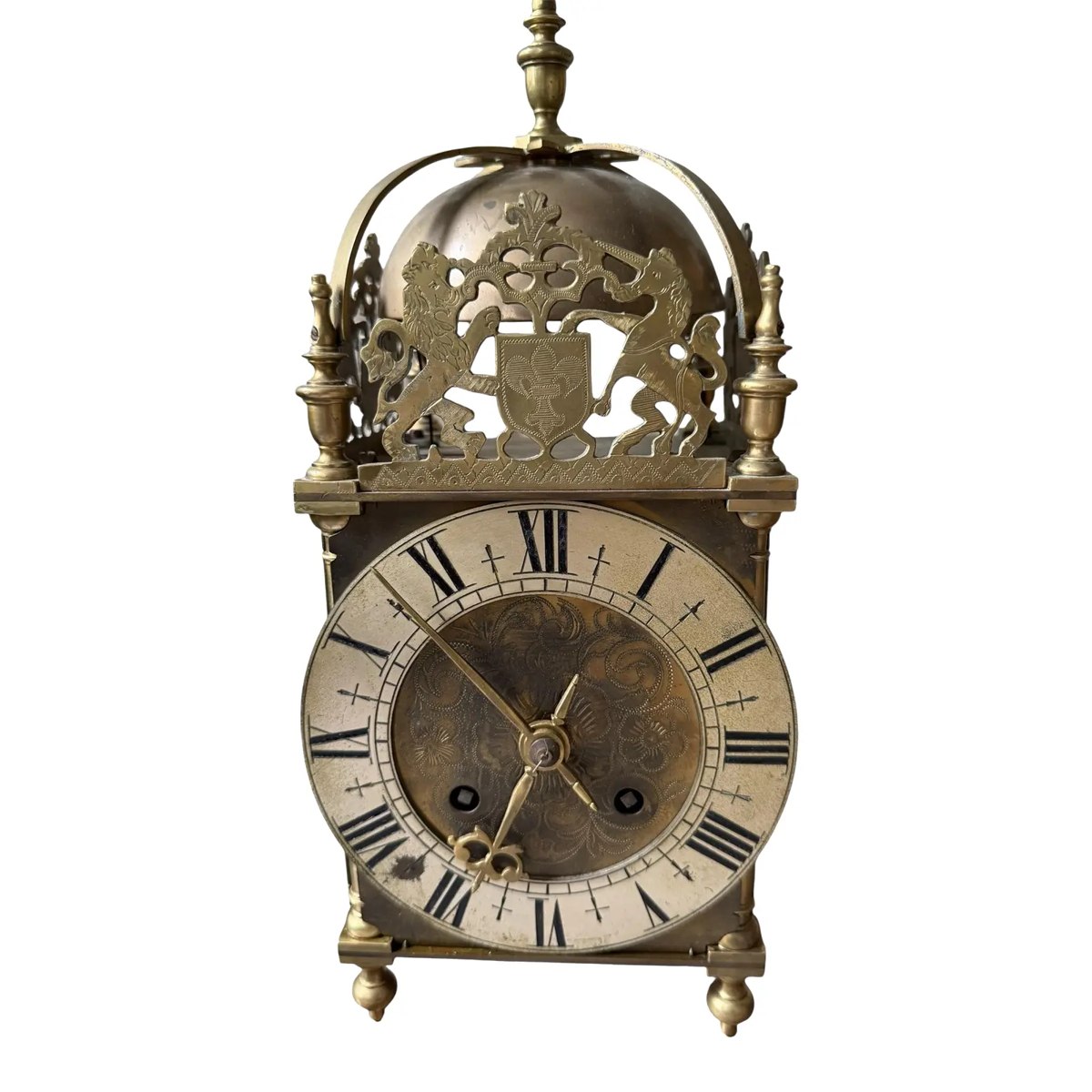
According to the seller, this brass lantern clock dates to the late 19th century and originates from the United Kingdom. Built in the traditional lantern form, the brass case is crowned with an arched bell structure, an upper finial, corner finials, and pierced fretwork featuring a lion and unicorn supporting a shield with a fleur-de-lys. The dial consists of a chapter ring marked with Roman numerals, set around an engraved brass center with two winding apertures and two hands, supported on turned ball feet.

Front view of late 19th-century brass lantern clock
Front view of late 19th-century brass lantern clock — Chairish. Rights pending — permission not yet requested. Original source

Catalogue identity

Source
www.chairish.com
Category
Clock · Lantern clock
Maker / attribution
Not established
Reference
Not recorded
Catalogue / lot identifier
29152488
Source-reported date
Late 19th Century
Country
United Kingdom

Source-reported attribution and specifications are not independent authentication. A listing does not establish present ownership, current display, availability or permission to reproduce.

Object description

Physical Configuration

The timepiece is a brass lantern clock measuring 7 inches wide, 6 inches deep, and 15 inches in height. The structure is supported by turned feet attached to the base plate.

The upper section features a domed bell assembly protected by arched brass straps. This structure is surmounted by a central turned finial, with additional turned finials positioned at the corners.

Evidence for this section
  • “7ʺW × 6ʺD × 15ʺH”
  • “Domed bell framed beneath arched brass straps and surmounted by a central turned finial and corner finials”
  • “Turned feet supporting the base plate”

Dial and Decorative Elements

The dial consists of a circular chapter ring featuring Roman numerals, surrounding an engraved brass center. Two winding holes are situated in the lower portion of the central dial.

The clock includes pierced cresting frets depicting a heraldic lion and unicorn supporting a central shield bearing a fleur-de-lys.

Evidence for this section
  • “Circular chapter ring with Roman numerals surrounding an engraved brass center”
  • “Two winding holes situated in the lower portion of the central dial”
  • “Pierced cresting frets depicting a heraldic lion and unicorn supporting a central shield bearing a fleur-de-lys”

Provenance and Status

The seller identifies the clock as originating from the United Kingdom and dating to the late 19th century.

The functional status of the clock is not recorded. The seller notes that the clock has not been tested, and internal movement details are not visible in the available documentation.

Evidence for this section
  • “Period Late 19th Century”
  • “Country of Origin United Kingdom”
  • “The clock has not been tested.”

Open research questions

  • What is the specific nature of the internal movement and escapement mechanism?
  • Does the current winding mechanism reflect original 19th-century construction?
  • What is the method of manufacture for the pierced frets and finials?

Source evidence

Recorded claims and source quotations for Late 19th-Century Brass Lantern Clock
FieldSource-reported valueSource quotation
Dimensions7ʺW × 6ʺD × 15ʺH“7ʺW × 6ʺD × 15ʺH”
MaterialsBrass Engraving“Materials Brass Engraving”
PeriodLate 19th Century“Period Late 19th Century”
Country of OriginUnited Kingdom“Country of Origin United Kingdom”
Condition NotesThe clock has not been tested.“The clock has not been tested.”
MaterialsBrass“Materials Brass Engraving”

Visible details

  • Pierced cresting frets depicting a heraldic lion and unicorn supporting a central shield bearing a fleur-de-lys
  • Domed bell framed beneath arched brass straps and surmounted by a central turned finial and corner finials
  • Circular chapter ring with Roman numerals surrounding an engraved brass center
  • Two winding holes situated in the lower portion of the central dial
  • Turned feet supporting the base plate

Research qualifications

  • The seller notes that the clock has not been tested.
  • Internal movement, escapement, and rear/side case construction are not visible in the primary image.

Photograph identity and source facts were screened before import; rights clearance remains pending.

Terms in this record

Glossary explanations for terms named in this object’s record.