
Skip to content
The Encyclopedia of Horology

Clock · Lyre mantel clock

Late 18th Century French Lyre Form Mystery Clock with Brilliant Ring Pendulum

Partially verified

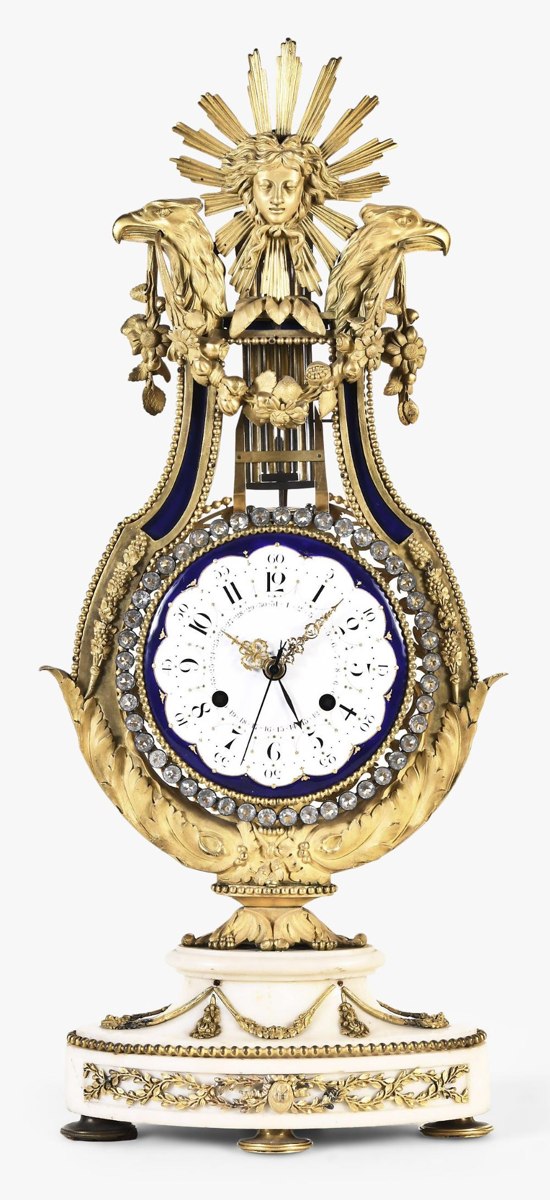
Attributed by the auctioneer to France circa 1785, this lyre form mystery mantel clock is built on an elliptical white marble base festooned with fruit-bearing garlands and an olive branch frieze. The gilt-bronze lyre case is accented with acanthus leaves, beaded borders, and cobalt blue enamel panels, surmounted by a radiant Medusa sunburst cresting flanked by outward-facing eagle heads holding floral garlands. The white enamel dial features Arabic numerals, a scalloped cobalt border, five-minute marks, and a red concentric date track. A bimetallic gridiron pendulum suspended on a knife edge terminates in a brilliant paste ring bob oscillating around the dial. The movement is reported to feature a pinwheel escapement and grand sonnerie striking.

French late 18th-century lyre form mystery mantel clock on marble base
French late 18th-century lyre form mystery mantel clock on marble base — Schmitt Horan & Co.. Rights pending — permission not yet requested. Original source

Catalogue identity

Source
www.invaluable.com
Category
Clock · Lyre mantel clock
Maker / attribution
Not established
Reference
Not recorded
Catalogue / lot identifier
457
Source-reported date
circa 1785
Country
France

Source-reported attribution and specifications are not independent authentication. A listing does not establish present ownership, current display, availability or permission to reproduce.

Object description

Case Construction and Ornamentation

The clock is constructed as a lyre-form mantel piece mounted upon an elliptical white marble base. The base features an olive branch frieze and is adorned with fruit-bearing garlands and pendants. The bronze lyre frame incorporates acanthus leaf detailing at the base and bead trim, while the upper section includes cobalt blue enamel panels.

The cresting consists of a Medusa mask flanked by addorsed eagle heads, which hold a fruit and floral garland. The condition report notes scattered verdigris, gilding loss, loose mounts with minor bends, and missing mounts on the back of the base. Additionally, the horizontal enamel panel at the top has minor loss, and the garland at the top exhibits a repaired break at the right.

Evidence for this section
  • “elliptical white marble base with olive branch frieze and festooned with fruit bearing garlands and pendants”
  • “the upper portion with cobalt blue enamel panels, and surmounted by a Medusa mask flanked by addorsed eagle heads holding a fruit and floral garland”
  • “case dirty and with scattered verdigris, losses to gilding, some mounts loose and with minor bends, back of base lacking two mounts, garland at top with repaired break at right, horizontal enamel panel at top with minor loss”

Dial and Pendulum Configuration

The white enamel dial features Arabic numerals, a scalloped cobalt blue border, five-minute markers, and a red concentric date ring. The assembly includes fancy gilt hands, a blued steel date pointer, and a sweep seconds hand. The timekeeping is regulated by a bimetallic gridiron pendulum suspended on a knife edge, terminating in a brilliant ring bob that surrounds the dial.

Condition issues noted for the dial include losses to the gilt ornament and minor losses to the enamel at the center. The hour, minute, and seconds hands are reported as replaced.

Evidence for this section
  • “arabic numeral white enamel dial with scalloped cobalt blue border, five minute markers, and concentric date ring in red”
  • “fancy gilt hands with blued steel date pointer and sweep seconds hand”
  • “bimetallic gridiron pendulum with knife edge suspension and brilliant ring bob surrounding the dial”
  • “dial with losses to gilt ornament, minor losses to enamel at center”
  • “hour, minute and seconds hands replaced”

Movement and Functionality

The timepiece utilizes a two-train, two-to-four-week movement featuring a pinwheel escapement and a grand sonnerie striking mechanism on bells. The movement is reported as dirty and in need of service.

The strike train is currently noted as not functioning automatically as the hands advance; however, the movement will strike if the hook is manually lifted from the rack. The escapement is functional but requires adjustment.

Evidence for this section
  • “two train, 2 - 4 week movement with pin wheel escapement, and grand sonnerie striking on bells”
  • “movement dirty, escapement will function, needs adjustment, does not strike as hands advance, will strike if hook is manually lifted from rack, needs service”

Open research questions

  • Does the current movement configuration and signature corroborate the attributed circa 1785 French origin?
  • Are there specific horological archives that can verify the existence of this specific lyre-form model?
  • To what extent does the extent of replaced components affect the potential historical integrity of the movement?

Source evidence

Recorded claims and source quotations for Late 18th Century French Lyre Form Mystery Clock with Brilliant Ring Pendulum
FieldSource-reported valueSource quotation
OriginFrance“France, a late 18th century lyre form mystery clock”
Datecirca 1785“circa 1785”
Dimensions27in x 10.5in x 5.25in“27in x 10.5in x 5.25in”
EscapementPin wheel escapement“two train, 2 - 4 week movement with pin wheel escapement”
Striking MechanismGrand sonnerie striking on bells“grand sonnerie striking on bells”
PendulumBimetallic gridiron with brilliant ring bob“bimetallic gridiron pendulum with knife edge suspension and brilliant ring bob surrounding the dial”
ProvenanceCollection of Victor Kochaver“From the collection of Victor Kochaver”

Visible details

  • Surmounted by a sunburst cresting with a Medusa mask and flanked by addorsed eagle heads.
  • Paste brilliant ring pendulum bob encircles the scalloped white enamel dial.
  • Elliptical white marble plinth ornamented with gilt-bronze draped swags and an olive branch frieze.
  • Cobalt blue enamel panels line the upper section of the bronze lyre uprights.

Research qualifications

  • The auction condition report states that the hour, minute, and seconds hands are replaced.
  • The report notes scattered verdigris, gilding loss, loose mounts, two missing back base mounts, a repaired top garland, and enamel loss.
  • The movement is noted as dirty and needing adjustment/service, with the strike train not functioning automatically as hands advance.

Photograph identity and source facts were screened before import; rights clearance remains pending.

Consulted source

At Auction: A late 18th century lyre form mystery clock with brilliant ring pendulum

Reviewed 2026-10-25 · Record 52a7de1a38

Terms in this record

Glossary explanations for terms named in this object’s record.