
Skip to content
The Encyclopedia of Horology

Clock · Lantern clock

Lantern Clock by Antonius Venturi

Partially verified

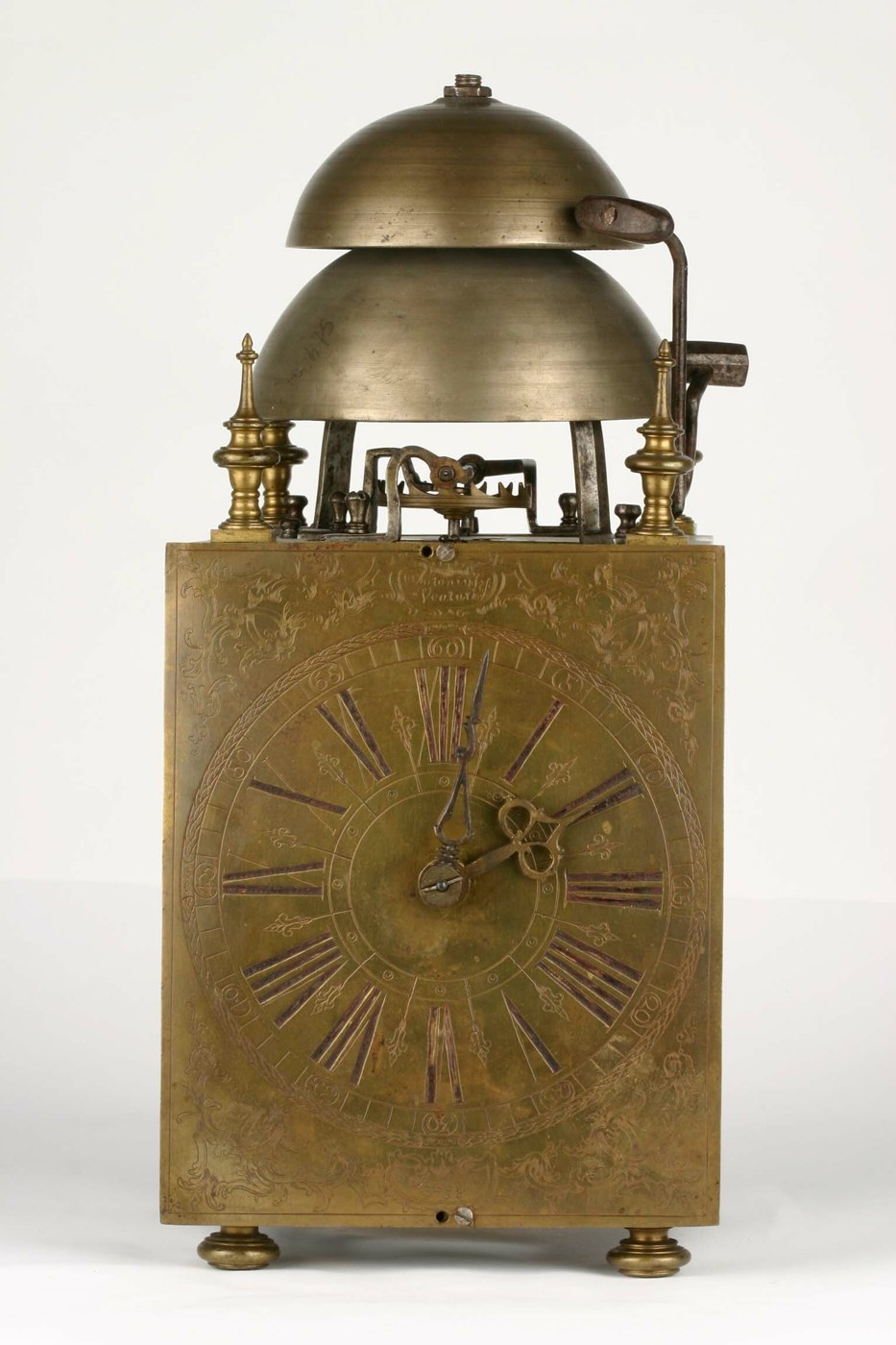
This lantern clock, or Laternenuhr, is held in the collection of the German Clock Museum (Deutsches Uhrenmuseum Furtwangen). The timepiece is signed by maker Antonius Venturi and dates to 1738. It is attributed to Bologna, Italy. The clock features a mechanical structure consistent with the lantern clock form, including a 4/4 striking mechanism, which the museum records as having a 'whirrer' or 'Surrer'. The clock measures 35.50 cm in height, 16.50 cm in width, and 19.50 cm in depth. The visual presentation includes a square metal face with engraved ornamentation surrounding the chapter ring. The clock is topped with a bell and internal striking train elements. The museum record serves as the primary source of information for the physical and technical specifications of this timepiece.

Front view of the lantern clock showing the dial, bell, and striking train top components.
Front view of the lantern clock showing the dial, bell, and striking train top components. — German Clock Museum via Europeana. Rights pending — permission not yet requested. Original source

Catalogue identity

Source
orbiscollectibles.com
Category
Clock · Lantern clock
Maker / attribution
Antonius Venturi
Reference
Not recorded
Catalogue / lot identifier
/1406/Museu_ProvidedCHO_museum_digital_31978__technical_number_
Source-reported date
1738
Source-reported place
Italy

Source-reported attribution and specifications are not independent authentication. A listing does not establish present ownership, current display, availability or permission to reproduce.

Object description

Clock Construction and Dial

The timepiece is a lantern clock with a rectangular brass dial plate. The face displays a central chapter ring featuring Roman numerals for the hours, accompanied by an outer track for minutes. The dial plate surface is decorated with engraved foliate or scrollwork patterns that fill the corners and border the central chapter ring.

The physical dimensions of the clock are 35.50 cm in height, 16.50 cm in width, and 19.50 cm in depth. The clock is mounted on four small feet and is topped by a large bell, which serves as part of the striking assembly visible from the front view.

Evidence for this section
  • “height: 35.50 cm, width: 16.50 cm, depth: 19.50 cm”
  • “Lantern clock (Lantern Clock) with 4/4 striking mechanism (whirrer [Surrer])”

Mechanism and Striking Train

The museum records identify the clock as having a 4/4 striking mechanism. This assembly includes a whirrer, referred to in the German record as a 'Surrer'.

Visible components at the top of the clock include the bell housing and parts of the striking train.

Evidence for this section
  • “Lantern clock (Lantern Clock) with 4/4 striking mechanism (whirrer [Surrer])”

Provenance and Attribution

The object is held by the German Clock Museum (Deutsches Uhrenmuseum Furtwangen). The record provided by the institution attributes the work to the maker Antonius Venturi. The production date is documented as 1738.

The geographic origin is attributed to Bologna, Italy. However, the source uses cautious language, stating the origin as 'probably' Bologna, rather than confirming it as a definite place of manufacture.

Evidence for this section
  • “Antonius Venturi, probably Bologna, 1738.”
  • “German Clock Museum”

Open research questions

  • Are there any identifiable stamps or marks on the movement plates aside from the dial signature?
  • What is the specific material composition of the dial and frame?

Source evidence

Recorded claims and source quotations for Lantern Clock by Antonius Venturi
FieldSource-reported valueSource quotation
MakerAntonius Venturi“Antonius Venturi”
LocationBologna“probably Bologna”
InstitutionGerman Clock Museum“German Clock Museum”
Height35.50 cm“height: 35.50 cm”
Width16.50 cm“width: 16.50 cm”
Depth19.50 cm“depth: 19.50 cm”
Mechanism4/4 striking mechanism“4/4 striking mechanism (whirrer [Surrer])”

Visible details

  • Engraved floral or scrollwork ornamentation on the dial plate
  • Central chapter ring with Roman numerals
  • Bell positioned at the top of the movement frame
  • Four small feet supporting the base

Research qualifications

  • The attribution to Bologna is noted by the source as 'probably' rather than certain
  • No detailed documentation of internal movement components beyond the presence of a whirrer is provided

Photograph identity and source facts were screened before import; rights clearance remains pending.

Terms in this record

Glossary explanations for terms named in this object’s record.