
Skip to content
The Encyclopedia of Horology

Clock · Desk clock

Kundo Space Timer Radio-Controlled Desk Clock

Partially verified

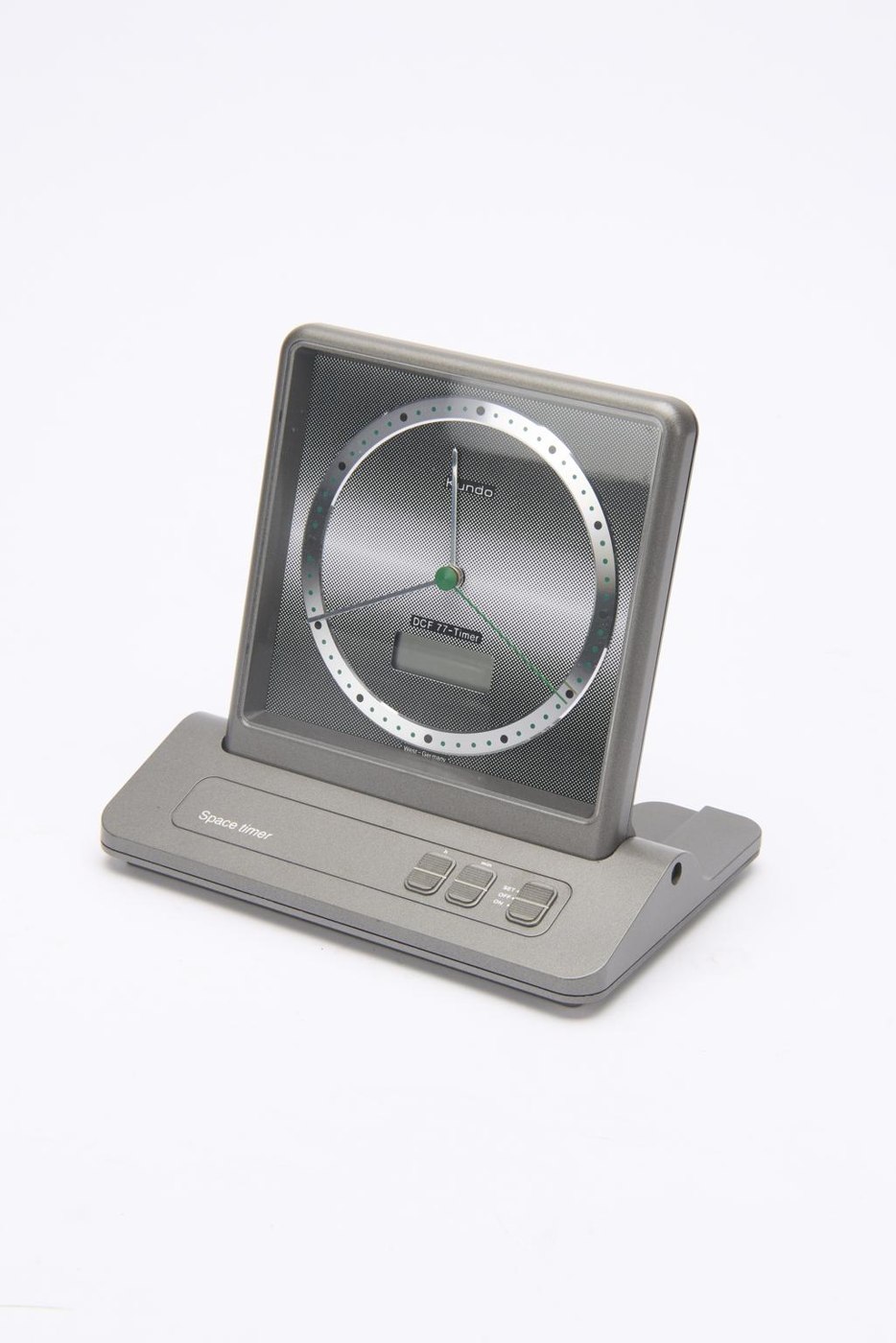
This radio-controlled quartz desk clock, known as the Kundo Space Timer, was manufactured by Kieninger und Obergfell GmbH in 1988. The clock is housed in a grey plastic casing measuring 178 mm by 190 mm by 135 mm, with a total weight of 0.4413 kg. It functions by synchronising to 77.5 kHz time signals transmitted from the DCF 77 radio transmitter located near Mainflingen, Frankfurt. Designed to indicate Mid-European time, the clock maintains an offset one hour ahead of Greenwich Mean Time. The device features an automatic reset mechanism to adjust for daylight saving time transitions. The display incorporates a circular dial design with analogue hands and a digital liquid crystal display window. It is identified by the model name Space Timer, which is printed on the front base, and marks including Kundo and DCF 77-Timer are present on the clock face.

Kundo Space Timer radio-controlled quartz desk clock, showing the front housing, dial, and base control buttons.
Kundo Space Timer radio-controlled quartz desk clock, showing the front housing, dial, and base control buttons. — Kieninger und Obergfell GmbH u. Co.. Rights pending — permission not yet requested. Original source

Catalogue identity

Source
collection.sciencemuseumgroup.org.uk
Category
Clock · Desk clock
Maker / attribution
Kieninger und Obergfell GmbH
Reference
Not recorded
Catalogue / lot identifier
1994-457
Source-reported date
1988
Source-reported place
Germany

Source-reported attribution and specifications are not independent authentication. A listing does not establish present ownership, current display, availability or permission to reproduce.

Object description

Technical Functionality

The Kundo Space Timer functions as a radio-controlled quartz desk clock. It operates by receiving time-code signals transmitted from the DCF 77 station, which is located near Mainflingen, Germany. This signal, transmitted at a frequency of 77.5 kHz, provides the reference time required for the internal quartz mechanism to maintain synchronization.

The clock is programmed to indicate Mid-European time, which is an offset of one hour ahead of Greenwich Mean Time. Additionally, the clock includes an automated feature that updates itself to accommodate summer time, or daylight saving time, shifts. This capability is managed by the device's electronic system interpreting the incoming radio transmission.

Evidence for this section
  • “synchronised to the 77.5 kHz time signals from the DCF 77 radio transmitter at Mainflingen, near Frankfurt, Germany”
  • “It is synchronised by time signals transmitted from Frankfurt in Germany and indicates Mid-European time, which is one hour fast of Greenwich.”
  • “It automatically resets itself for summer time.”

Physical Configuration

The physical design of the clock includes an integrated stand and display housing constructed from a grey material. The clock measures 178 mm in height, 190 mm in width, and 135 mm in depth. It possesses a mass of 0.4413 kg. The overall unit combines a broad base with a vertical or slightly tilted display panel.

The display layout incorporates both analogue and digital elements. An analogue circular dial provides the main time display, while a small digital liquid crystal display (LCD) window is positioned within the lower half of the circular face. Controls are situated on the front surface of the base to allow user adjustment.

Evidence for this section
  • “overall: 178 mm x 190 mm x 135 mm, .4413 kg”

Identification and Branding

The object is identified as a Kundo Space Timer, a name prominently displayed on the front of the clock base. Additional branding and functional information appear on the clock face itself, specifically the names 'Kundo' and 'DCF 77-Timer'. These markings link the device to the maker Kieninger und Obergfell GmbH.

The origin of the device is documented as St Georgen in Germany, which was the location of the maker. The face further specifies its production in West-Germany, reflecting the geopolitical context of the era in which the clock was produced.

Evidence for this section
  • “Kundo Space Timer Clock”
  • “made by Kieninger und Obergfell GmbH, St Georgen/Schw, Germany”

Open research questions

  • What is the specific nature of the internal radio receiver module used by Kieninger und Obergfell in 1988?
  • How does the LCD interface interact with the analogue hands during the radio-controlled synchronization process?

Source evidence

Recorded claims and source quotations for Kundo Space Timer Radio-Controlled Desk Clock
FieldSource-reported valueSource quotation
MakerKieninger und Obergfell GmbH“made by Kieninger und Obergfell GmbH”
Dimensions178 mm x 190 mm x 135 mm“178 mm x 190 mm x 135 mm”
Accession Number1994-457“1994-457”
Signal Frequency77.5 kHz“77.5 kHz time signals”
Transmitter LocationMainflingen, near Frankfurt“DCF 77 radio transmitter at Mainflingen, near Frankfurt, Germany”
Time ZoneMid-European time“indicates Mid-European time, which is one hour fast of Greenwich”

Visible details

  • Grey rectangular base features three control buttons on the front right.
  • The dial contains an analogue circular minute track with indices.
  • A digital LCD panel is situated below the center of the hands.
  • The text 'West-Germany' is printed at the bottom of the dial surface.

Research qualifications

  • The long-term operational state of the radio receiver circuitry is not stated.
  • Internal electronic components remain unverified beyond the external description.

Photograph identity and source facts were screened before import; rights clearance remains pending.

Consulted source

Kundo 'Space Timer' radio-controlled quartz desk clock, 1988.

Reviewed 2026-10-26 · Record 1a89ca825e

Terms in this record

Glossary explanations for terms named in this object’s record.