
Skip to content
The Encyclopedia of Horology

Pocket watch · Minute repeater pocket watch

Jules Jürgensen 18K Pink Gold Minute-Repeater Pocket Watch

Partially verified

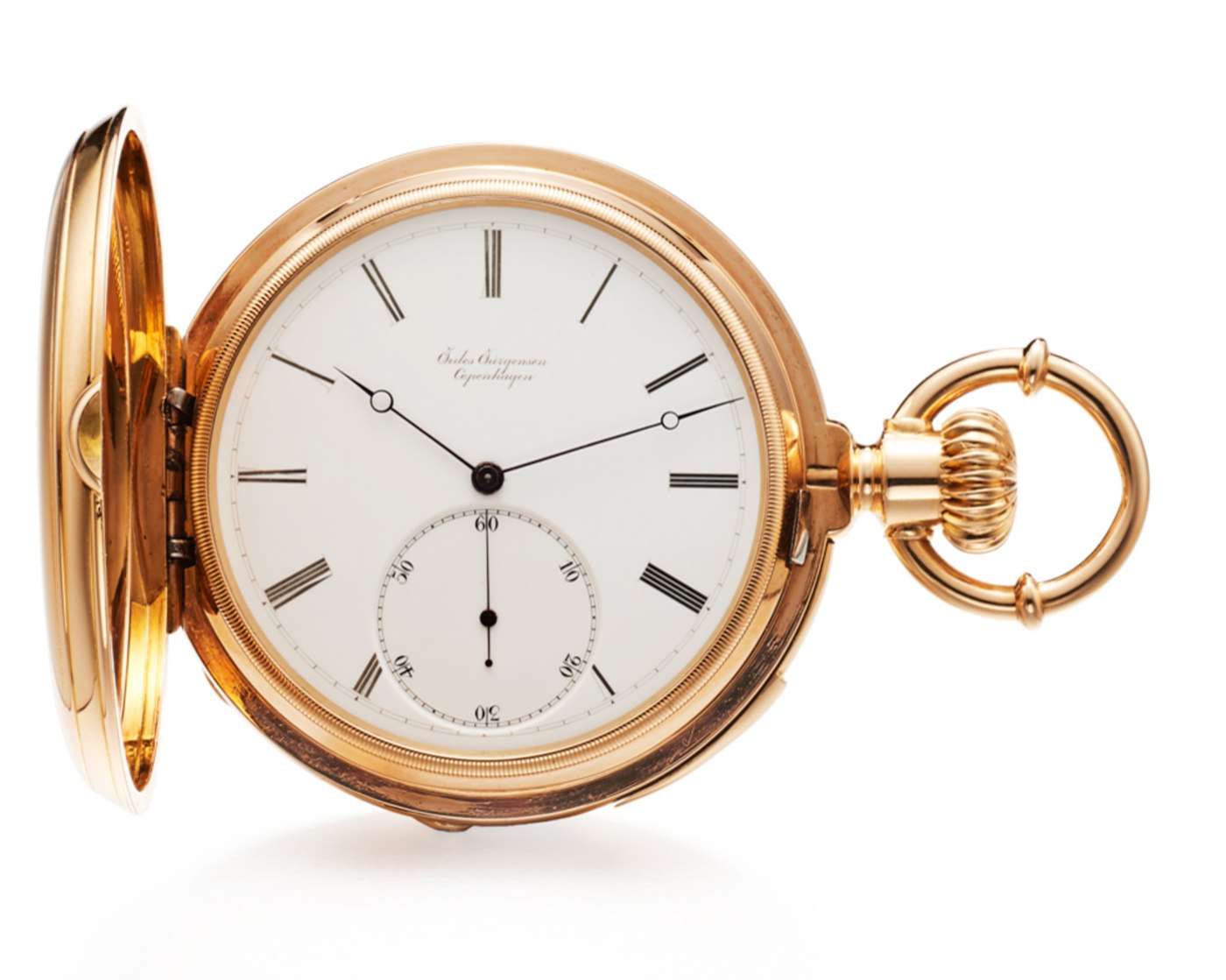
This hunting-case pocket watch is constructed in 18K pink gold and features a minute-repeater mechanism striking on two steel gongs, activated by a slide at the 4 o'clock position. The timepiece incorporates a patented hand-setting system developed by Jules Jürgensen; this mechanism involves lifting a glass cover and folding the pendant bow down against the glass to engage the winding crown for hand-setting, while in other positions the crown functions for winding. The dial features subsidiary seconds at 6 o'clock and Roman numeral hour markers. Records from the Jules Jürgensen manufacture books, currently held at the Château des Monts in Le Locle, confirm the production of this watch, serial number 12 666, and identify the components contributing to its total production cost.

Side profile of the Jules Jürgensen pocket watch with the hunting-case cover open, displaying the enamel dial with subsidiary seconds and Roman numeral indices.
Side profile of the Jules Jürgensen pocket watch with the hunting-case cover open, displaying the enamel dial with subsidiary seconds and Roman numeral indices. — Antiquorum. Rights pending — permission not yet requested. Original source

Catalogue identity

Source
catalog.antiquorum.swiss
Category
Pocket watch · Minute repeater pocket watch
Maker / attribution
Jules Jürgensen
Reference
Not recorded
Catalogue / lot identifier
408
Source-reported date
Circa 1871-1873
Source-reported place
Copenhagen and Le Locle
Source-reported serial
12 666

Source-reported attribution and specifications are not independent authentication. A listing does not establish present ownership, current display, availability or permission to reproduce.

Object description

Case and Dial

The pocket watch is housed in an 18K pink gold hunting-case measuring 54 mm in diameter. The design includes a subsidiary seconds register positioned at 6 o'clock on the enamel dial, which features Roman numeral hour markers and is signed for Jules Jürgensen.

The auction description reports that the dial exhibits a hairline crack, and the gold case shows evidence of slight scratching. The overall condition of the dial is graded as good within the auction house's system.

Evidence for this section
  • “18K pink gold, hunting-case”
  • “Diameter 54 mm”
  • “Hairline”

Movement and Mechanism

The movement features a minute-repeater mechanism that strikes on two steel gongs, which is engaged via a slide located on the side of the case at the 4 o'clock position.

The movement incorporates a patented hand-setting system. By throwing up the glass cover and folding the pendant bow down onto the glass, the winding crown becomes engaged for setting the time. When the bow is in any other position, the crown functions as a traditional winding mechanism.

Evidence for this section
  • “Calibre 19’’’ (ebauche by Piguet & Lecoultre, probably Vallée de Joux)”
  • “minute-repeater on two steel gongs (activated by the slide at 4 o’clock)”
  • “For setting the hands, throw up the glass cover and turn the pendant bow close down upon the glass.”

Provenance and Documentation

Documentation for this watch, including its serial number 12 666, is preserved in the Jules Jürgensen manufacture books, which are currently housed at the horological museum at the Château des Monts in Le Locle. These records detail the craftsmen involved in the assembly and note the final production cost of the watch to be 1,066.45 Francs.

The watch is accompanied by copies of the original invention patents related to its specific keyless-winding and stem-setting features.

Evidence for this section
  • “The page concerning the watch No. 12 666 gives us the name of all the craftsmen who contributed to the realization of this watch”
  • “final production cost amounts to 1 066.45 Francs”
  • “Overhaul recommended, at buyer's expense”

Open research questions

  • What is the specific historical context of the partnership between Jules Jürgensen and Piguet & Lecoultre for the supply of ebauches?
  • To what extent did the patented folding-bow hand-setting mechanism influence the long-term durability of the watch's glass and pendant assembly?

Source evidence

Recorded claims and source quotations for Jules Jürgensen 18K Pink Gold Minute-Repeater Pocket Watch
FieldSource-reported valueSource quotation
MakerJules Jürgensen“Jules Jürgensen, Copenhagen and Le Locle”
Serial Number12 666“Movement No. 12 666”
Case Material18K Pink Gold“18K pink gold, hunting-case”
Diameter54 mm“Diameter 54 mm”
Movement Calibre19 ligne“Calibre 19’’’”
EscapementLever“lever escapement”
Production Cost1066.45 Francs“final production cost amounts to 1 066.45 Francs”

Visible details

  • Hunting-case design
  • Subsidiary seconds dial at 6 o'clock
  • Movement serial number 12 666 inscribed on bridge
  • Two steel repeater gongs visible in movement view

Research qualifications

  • Movement ebauche is only 'probably' attributed to Piguet & Lecoultre
  • Condition reports ('slightly scratched') are based on the auction house grading system

Photograph identity and source facts were screened before import; rights clearance remains pending.

Terms in this record

Glossary explanations for terms named in this object’s record.