
Skip to content
The Encyclopedia of Horology

Clock · Wall clock

John W. Carter Wall Clock

Partially verified

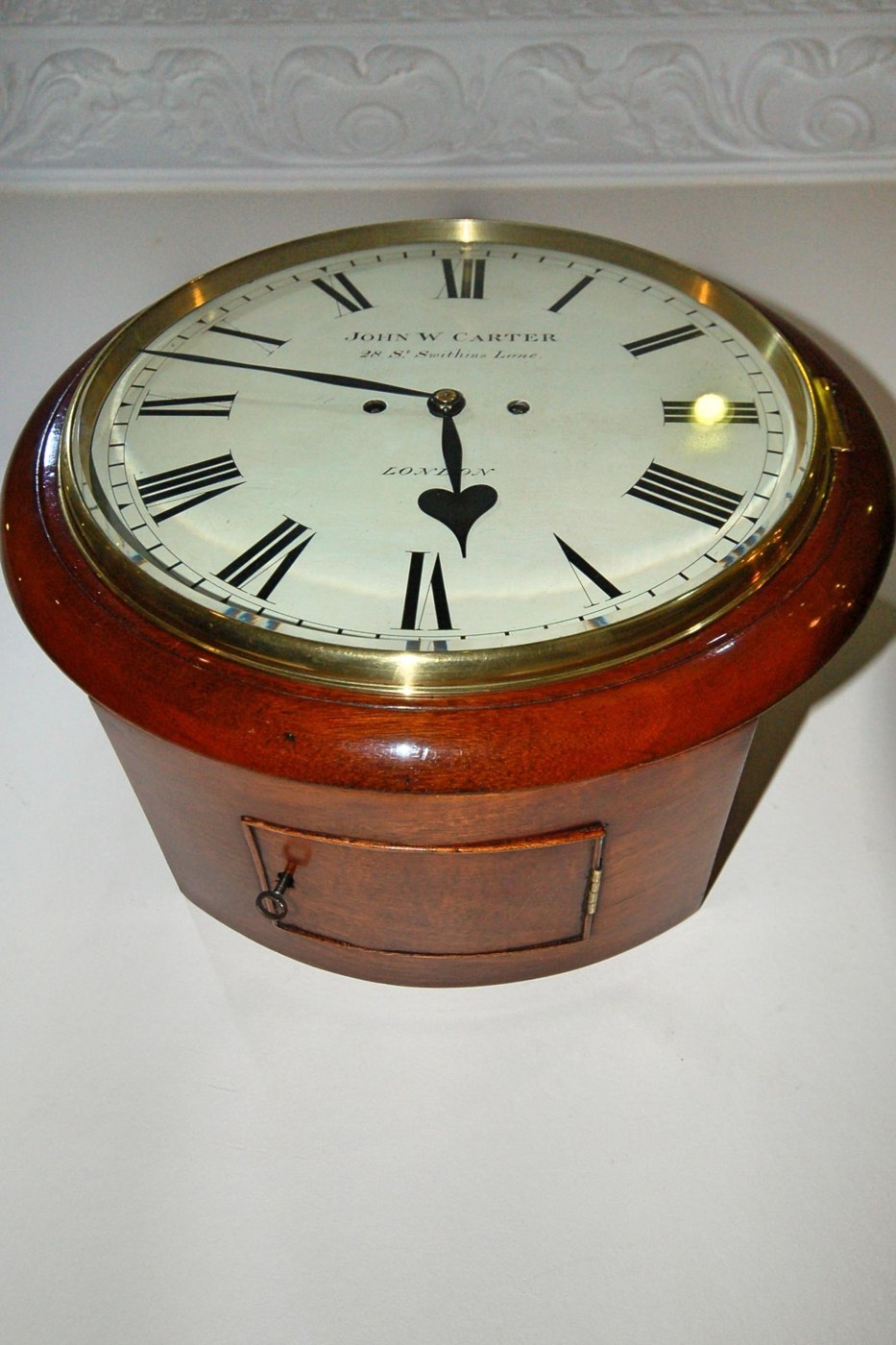
This antique wall clock was manufactured in London during the mid-19th century by the clockmaker John W. Carter. The clock features a mahogany case equipped with both side and bottom access doors, the latter including a winding key. The dial measures 12 inches in diameter and is finished in white with black Roman numerals, minute track markers, and dark metal hands, with the hour hand designed in a heart shape. The movement is a spring-driven twin fusee mechanism with an eight-day duration, designed to strike on a single bell at the top of every hour. The dial bears the inscription of the maker's name and his business address at 28 St Swithins Lane in London. The clock is framed by a cast brass bezel with a protective glass cover.

Front view of the 12-inch dial with Roman numerals and heart-shaped hour hand, signed 'John W. Carter, 28 St Swithins Lane, London'.
Front view of the 12-inch dial with Roman numerals and heart-shaped hour hand, signed 'John W. Carter, 28 St Swithins Lane, London'. — Pendulum of Mayfair. Rights pending — permission not yet requested. Original source

Catalogue identity

Source
zamanito.com
Category
Clock · Wall clock
Maker / attribution
John W. Carter
Reference
Not recorded
Catalogue / lot identifier
Source URL identifies the listing
Source-reported date
mid 19th century
Source-reported place
United Kingdom

Source-reported attribution and specifications are not independent authentication. A listing does not establish present ownership, current display, availability or permission to reproduce.

Object description

Case and Dial

The wall clock is housed in a mahogany case, which incorporates side and bottom doors to allow access to the movement and pendulum. The face is protected by a cast brass bezel and glass, enclosing a 12-inch circular white dial. The dial displays black Roman numerals and a minute track, complemented by dark metal hands, with the hour hand featuring a distinctive heart-shaped tip.

The dial is signed with the maker's name and address, indicating a workshop location at 28 St Swithins Lane, London. The inclusion of two winding holes confirms the presence of dual gear trains dedicated to timekeeping and the striking function.

Evidence for this section
  • “بدنه ساعت از چوب ماهون (Mahogany) با روکش و جلای کلاسیک ساخته شده و دایره دور صفحه دارای قاب برنجی ریخته‌گری‌شده (cast brass bezel) همراه با شیشه محافظ است.”
  • “صفحه گرد ۱۲ اینچی ساعت به رنگ سفید بوده و دارای ارقام رومی مشکی، نشانگرهای دقایق ریلی و عقربه‌های فلزی تیره است که عقربه ساعت‌شمار دارای طرح سرقلبی کلاسیک می‌باشد.”

Movement and Functionality

The clock is powered by a mechanical spring-driven movement featuring a twin fusee system, which provides an eight-day duration. The mechanism is configured to sound on a single bell at the top of each hour.

The presence of two winding holes on the dial corresponds to the twin fusee movement design, managing the separate power requirements for timekeeping and striking. As the internal components were not visible in the provided photographs, the auction description advises that a professional assessment is needed to confirm the state of the chains, springs, and hammer assembly.

Evidence for this section
  • “موتور این ساعت یک سازوکار کوکی فنری با سیستم حلزونی دوگانه (twin fusee) و مدت کارکرد ۸ روزه (8-day duration) است.”
  • “این مکانیزم زنگ‌دار بوده و راس هر ساعت ضربات زمان را بر روی یک زنگ تکی (single bell) به صدا درمی‌آورد.”

Maker and Documentation

John W. Carter was active as a clockmaker in London during the mid-19th century. Historical documentation identifies him as a member of the Clockmakers Company beginning in 1829. He attained the position of Master within the company on three separate occasions, in 1856, 1859, and 1864.

The auction description reports that while the clock exhibits the characteristics of a London-made piece from this era, physical inspection of the movement's components—specifically the fusee chains and internal strike train—is required for verification of operational condition and integrity of the original hardware.

Evidence for this section
  • “جان کارتر از سال ۱۸۲۹ میلادی عضو صنف ساعت‌سازان لندن (Clockmakers Company) بوده و در سال‌های ۱۸۵۶، ۱۸۵۹ و ۱۸۶۴ به مقام ریاست (Master) این صنف دست یافته است.”
  • “سلامت اجزای داخلی، فنرها، زنجیرها یا سیم‌های فیوزی، سلامت چکش و زنگ، و همچنین اصالت قفل و لولاهای درهای چوبی بدنه به دلیل عدم نمایش تصاویر مستقیم از داخل موتور، نیازمند بررسی تخصصی و اعتبارسنجی مستقل هنگام کارشناسی است.”

Open research questions

  • Does the movement contain any specific serial numbering to confirm its date of manufacture?
  • Are the internal movement plates or components signed by John W. Carter?

Source evidence

Recorded claims and source quotations for John W. Carter Wall Clock
FieldSource-reported valueSource quotation
MakerJohn W. Carter“John W. Carter”
Datemid 19th century“mid 19th century”
LocationLondon, UK“London”
Address28 St Swithins Lane“28 St Swithins Lane”
Movement8-day twin fusee“8-day duration”
StrikingSingle bell hourly“راس هر ساعت ضربات زمان را بر روی یک زنگ تکی (single bell) به صدا درمی‌آورد”
Case MaterialMahogany“چوب ماهون (Mahogany)”

Visible details

  • Mahogany case with side and bottom access
  • 12-inch white dial with Roman numerals
  • Twin fusee winding holes on the dial
  • Dark metal heart-shaped hour hand

Research qualifications

  • Condition of internal components including springs, chains, and fusees is unverified
  • Integrity of locks and hinges requires independent inspection

Photograph identity and source facts were screened before import; rights clearance remains pending.

Consulted source

Antique Wall Clock by John.W.Carter – London mid 19th century

Reviewed 2026-11-02 · Record ee7be8f565

Terms in this record

Glossary explanations for terms named in this object’s record.