
Skip to content
The Encyclopedia of Horology

Clock · Carriage clock

Jean Romilly carriage clock

Partially verified

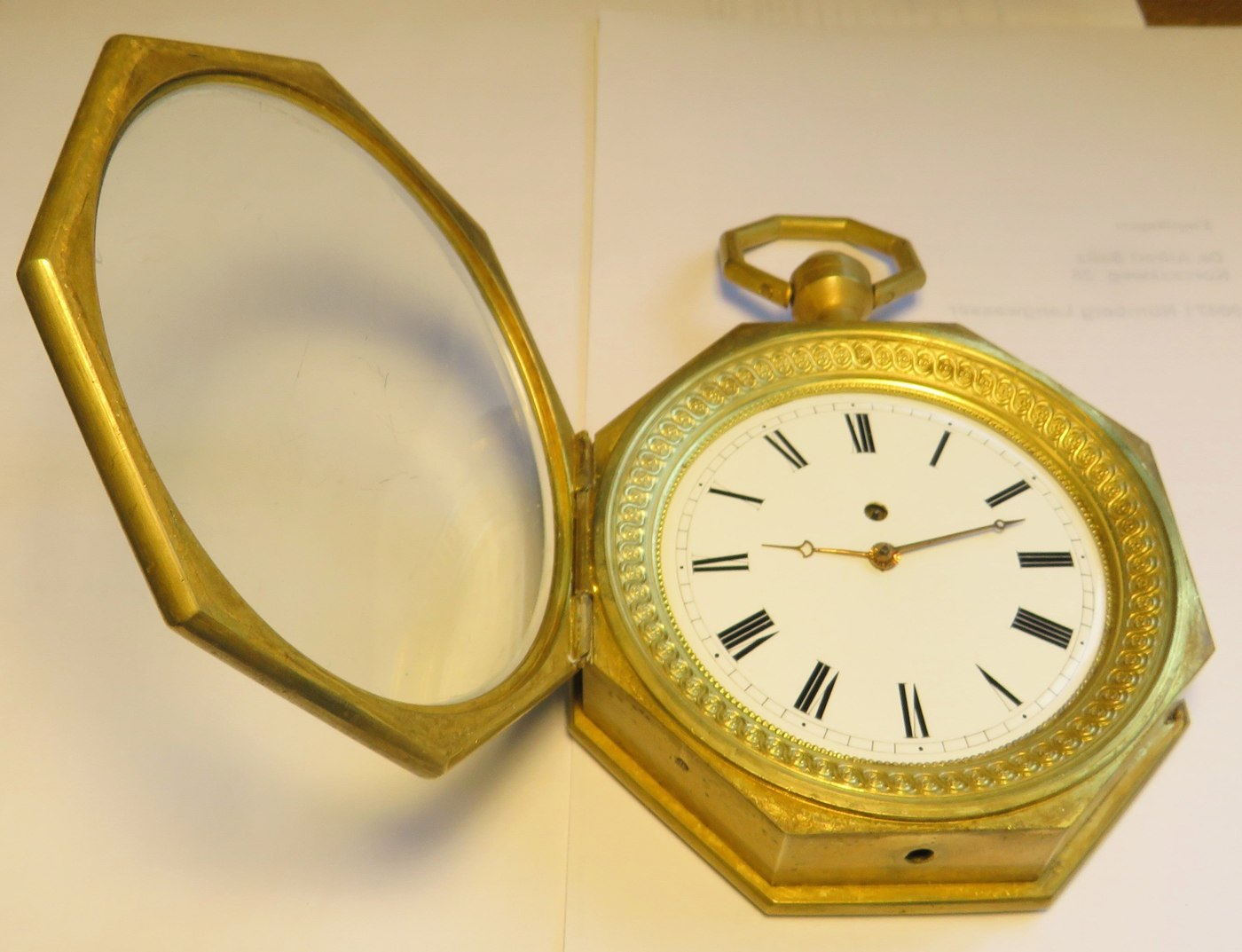
This object is a carriage clock, attributed to the French horologist Jean Romilly, dated to circa 1760. It features a circular brass case with a diameter of 10.5 cm and a height of 15.5 cm including the bow, with a recorded weight of approximately 700 grams. The case is fitted with hinged covers on both sides. The white enamel dial displays black Roman numerals with a railway-style minute track and gold Breguet-style hands. The movement is a gilt full-plate mechanism with a spindle bridge, signed "Romilly á Paris". The auction description reports that the object may be a marriage, involving the combination of a genuine carriage clock case from the 18th century with a potentially unrelated movement. The case exhibits features suggesting a repeating mechanism, such as a bore for a pull cord, though the presence of an active repeating function remains unverified by the source.

Front view of the Jean Romilly carriage clock with the lid opened, showing the white enamel dial.
Front view of the Jean Romilly carriage clock with the lid opened, showing the white enamel dial. — Sammler-Uhren. Rights pending — permission not yet requested. Original source

Catalogue identity

Source
sammler-uhren.com
Category
Clock · Carriage clock
Maker / attribution
Jean Romilly
Reference
Not recorded
Catalogue / lot identifier
Source URL identifies the listing
Source-reported date
circa 1760
Source-reported place
France

Source-reported attribution and specifications are not independent authentication. A listing does not establish present ownership, current display, availability or permission to reproduce.

Object description

Case and Dial

The clock is housed in a substantial, circular brass case measuring 10.5 cm in diameter and 15.5 cm in height, including the crown. The construction includes hinged covers on both sides that allow for access to the internal components. The dial is composed of white enamel and is decorated with black Roman numerals and an external railway-style minute chapter ring. The time is indicated by two gold hands executed in the Breguet style.

The auction description identifies the casing as a genuine 18th-century carriage clock component. Visible evidence of its original function includes a specific bore designed for the installation of a pull cord associated with a repeating mechanism, as well as a corresponding aperture in the case structure for the operation of the cord. The auctioneer describes the case condition as having minimal signs of age or wear.

Evidence for this section
  • “Massives, rundes Messinggehäuse, Gehäusedurchmesser mächtige 10,5cm, Höhe mit Krone 15,5cm”
  • “Zweifellos handelt es sich um ein echtes und authentisches Gehäuse einer Repetitions Kutscheruhr aus dem 18. Jahrhundert”
  • “man erkennte deutlich die Vorrichtung/Bohrung zum Anbringen des Zugseils für den Repetitionsmechanismus”

Movement and Signatures

The movement is a gilt, full-plate assembly equipped with a spindle escapement, described as featuring a finely crafted spindle bridge. The plate bears the signature "Romilly á Paris".

The auction house reports that the movement is operational, although the specific timing accuracy has not been tested or verified as part of their assessment. The presence of the signature and the construction of the spindle assembly are cited as key aspects of the object's attribution to the work of Jean Romilly.

Evidence for this section
  • “Vergoldetes Vollplatinenwerk mit fein gearbeiteter Spindelbrücke, Werk bezeichnet und signiert "Romilly á Paris”
  • “ich glaube nicht, dass es über einen Repetitionsmechanismus verfügt, obwohl das auch schon in Spindeluhrwerken gemacht wurde”

Provenance and Attribution

The vendor identifies the object as an artifact attributed to Jean Romilly, who served as an horologist to the French royal household. The listing notes that original works by Romilly are represented in international collections including the Louvre, the Metropolitan Museum of Art, and the Palace of Versailles. While the maker is highly regarded, the vendor suggests that the object presented is a potential marriage, referring to the assembly of a carriage clock case with a secondary movement.

Historical context provided regarding the maker confirms Jean Romilly was born in Geneva in 1714 and established himself in Paris by 1734. He held the title of master horologist and contributed to the Encyclopédie. The vendor maintains that regardless of the marriage status of the movement, the casing remains a genuine example of 18th-century horological production.

Evidence for this section
  • “vermutlich handelt es sich umd eine Marriage”
  • “Ich vermute, dass die Uhr eine Marriage darstellt (Zusammenführung eines vorhandenen Gehäuses mit einem fremden Werk)”
  • “Jean Romilly war französischer Meisteruhrmacher und Hofuhrmacher des französischen Königshauses”

Open research questions

  • What is the specific provenance or previous ownership history of this carriage clock?
  • Can the movement serial number be cross-referenced with known Romilly archives to confirm the date of production?

Source evidence

Recorded claims and source quotations for Jean Romilly carriage clock
FieldSource-reported valueSource quotation
MakerJean Romilly“Hofuhrmachers Jean Romilly”
Datecirca 1760“ca. 1760”
Diameter10.5 cm“Gehäusedurchmesser mächtige 10,5cm”
Height15.5 cm“Höhe mit Krone 15,5cm”
Weight700g“ca. 700g schwer”
Dial materialEnamel“Zifferblatt aus edler, weisser Emalie”
SignedRomilly á Paris“Werk bezeichnet und signiert "Romilly á Paris”

Visible details

  • Enamel dial with Roman numerals
  • Gold Breguet-style hands
  • Hinged case covers
  • Spindle bridge visible in description

Research qualifications

  • Potential marriage of case and movement
  • Unverified functionality of the repeating mechanism

Photograph identity and source facts were screened before import; rights clearance remains pending.

Consulted source

Jean Romilly á Paris Hofuhrmacher Kutscher Kutschen Uhr Spindelhemmung ca. 1760

Reviewed 2026-11-02 · Record 98c5e84fa7

Terms in this record

Glossary explanations for terms named in this object’s record.