
Skip to content
The Encyclopedia of Horology

Pocket watch · Enamelled gold pocket watch

Jacques Huon Enamelled Pocket Watch

Partially verified

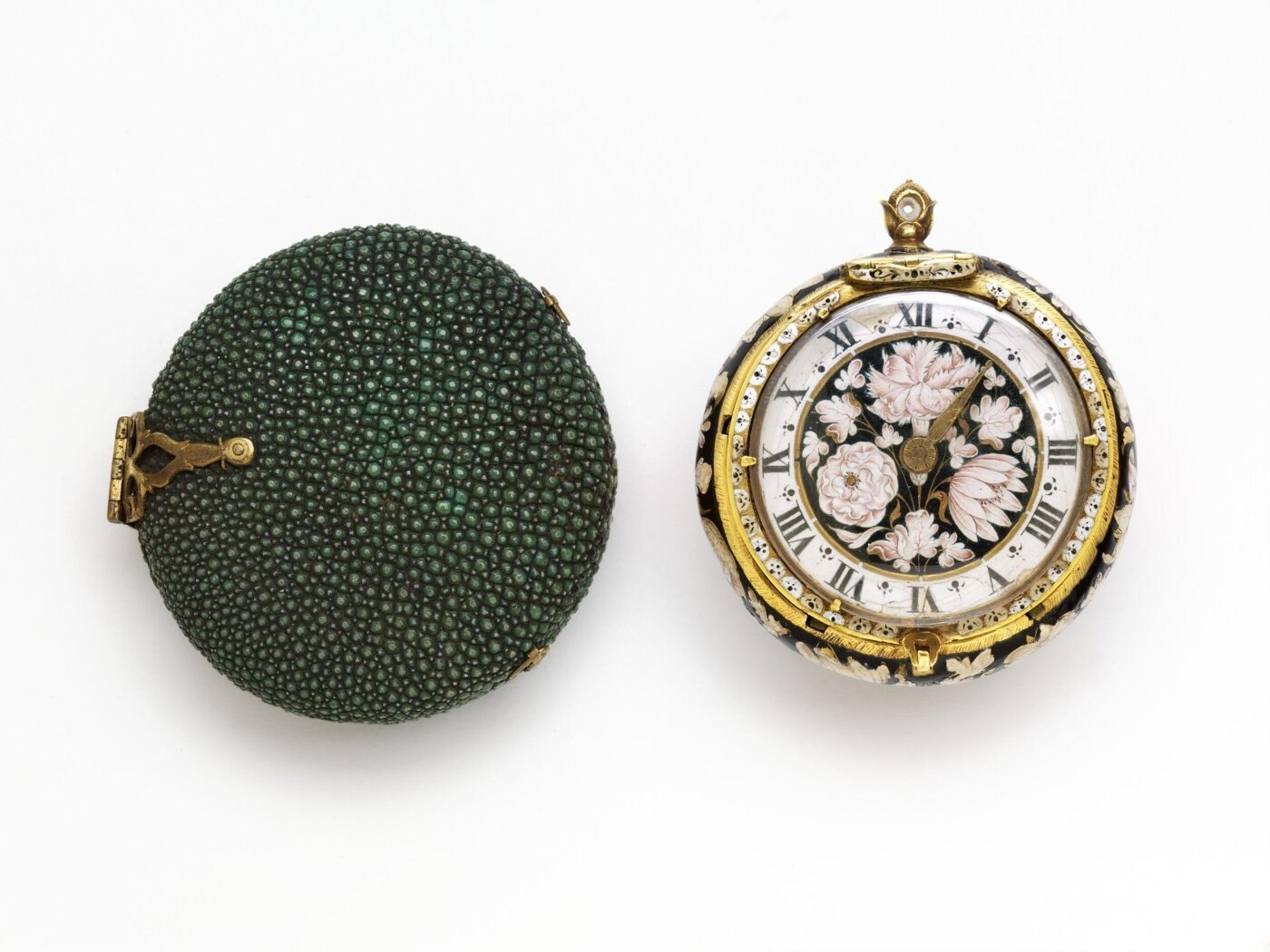
This seventeenth-century pocket watch features a gold case finished with enamel decoration in a floral style. The movement is attributed to the maker Jacques Huon of Paris. The timepiece is accompanied by a shagreen outer case. The dial center is decorated with painted enamel flowers, a design reminiscent of contemporary floral pattern books by Jacques Vauquer of Blois. During this period, advancements in enamel techniques allowed for the use of a wider spectrum of colors by utilizing metal oxides mixed with oil, which were fired onto an enamel ground. The case design is characterized by its wide, flat profile, which serves as a canvas for the detailed enamel work. This specific style of decoration, developed by enamelists and goldsmiths in cities including Paris, Blois, and Châteaudun, represents a shift toward more complex, multi-colored enamel compositions that emerged around 1630.

The Jacques Huon watch (right) displayed alongside its shagreen outer case (left).
The Jacques Huon watch (right) displayed alongside its shagreen outer case (left). — © Victoria and Albert Museum, London. Rights pending — permission not yet requested. Original source

Catalogue identity

Source
collections.vam.ac.uk
Category
Pocket watch · Enamelled gold pocket watch
Maker / attribution
Jacques Huon
Reference
Not recorded
Catalogue / lot identifier
7715&A-1862
Source-reported date
1640-50
Source-reported place
France

Source-reported attribution and specifications are not independent authentication. A listing does not establish present ownership, current display, availability or permission to reproduce.

Object description

Case and Dial Decoration

The watch is housed in an enamelled gold case that serves as an extensive surface for decorative painting. The flat, expanded profile of the case was intentionally designed to accommodate these detailed miniature compositions.

The dial exhibits a floral design that shares aesthetic connections with the 'Livre de fleurs propres pour Orfèvres et Graveurs' published by Jacques Vauquer. The enamel application involves a process of firing an enamel ground onto the metal, followed by the layered application and firing of metal oxides to achieve a nuanced range of colours.

Evidence for this section
  • “The case of this watch is finely enamelled in the floral style which was superbly executed in Paris and Blois in the middle of the seventeenth century.”
  • “The enamelled centre of the dial is similar to designs for dials in his Livre de fleurs propres pour Orfèvres et Graveurs published by Jacques Vauquer (1621-86) in Blois.”
  • “Such was the potential of the new technique that some watchcases, like this one, became wider and flatter to provide an extensive surface for enamelling.”

Technical Development of Painted Enamels

In approximately 1630, technical refinements in enamel production enabled the creation of miniature paintings with an expanded palette. This shift allowed for effects that could rival the complexity of oil paintings, moving away from previous limitations. The process required each colour to be individually fused to the enamel base through repeated kiln firing.

These developments were driven by a group of enamellers and goldsmiths working in Paris, Blois, and Châteaudun who maintained professional relationships with watchmakers. This movement, often associated with figures such as Jean Toutin, transformed the decorative potential of watchcases and allowed for the widespread adoption of high-detail enamel work.

Evidence for this section
  • “In about 1630 improved techniques made it possible to execute miniature painting in enamel in a wide range of colours, as on the inside of the case of this watch.”
  • “Each colour had to be fired in turn to fuse it onto the enamel ground.”

Object Provenance and Accession

It is catalogued under the accession number 7715&A-1862. The documentation confirms the watch includes a secondary protective shagreen outer case, which was a functional element intended to preserve the delicate enamel surfaces of the primary gold watch case.

The identification of the movement as the work of Jacques Huon connects the object to the Parisian horological output of the mid-seventeenth century. The combination of the movement, the gold enamelled case, and the outer case forms a complete historical unit as documented by the museum's acquisition records.

Evidence for this section
  • “Watch with enamelled gold case and movement by Jacques Huon, Paris, 1640-50; shagreen outer case”
  • “Bought for £30 in 1862.”

Open research questions

  • What is the internal condition of the Jacques Huon movement?
  • Are there any identifiable maker's marks or signatures on the movement plates aside from the attribution?

Source evidence

Recorded claims and source quotations for Jacques Huon Enamelled Pocket Watch
FieldSource-reported valueSource quotation
MakerJacques Huon“movement by Jacques Huon”
Date1640-50“1640-50”
Accession number7715&A-1862“7715&A-1862”
Acquisition price£30“Bought for £30 in 1862.”
Enamel techniquePainted enamel using metal oxides“It was then painted with metal oxides mixed with oil. Each colour had to be fired in turn to fuse it onto the enamel ground.”

Visible details

  • The dial features black Roman numerals on a white enamel chapter ring.
  • The outer protective case is covered in green shagreen.
  • The watch includes a single hand for time indication.
  • The case back exhibits an intricate floral enamel pattern against a dark ground.

Research qualifications

  • The exact extent of restoration or repairs to the enamel is not documented.
  • The functional status of the Jacques Huon movement is not specified.

Photograph identity and source facts were screened before import; rights clearance remains pending.

Consulted source

Watch

Reviewed 2026-10-26 · Record b131e183a9

Terms in this record

Glossary explanations for terms named in this object’s record.