
Skip to content
The Encyclopedia of Horology

Clock · Dial clock

J.Beckett of London wall clock

Partially verified

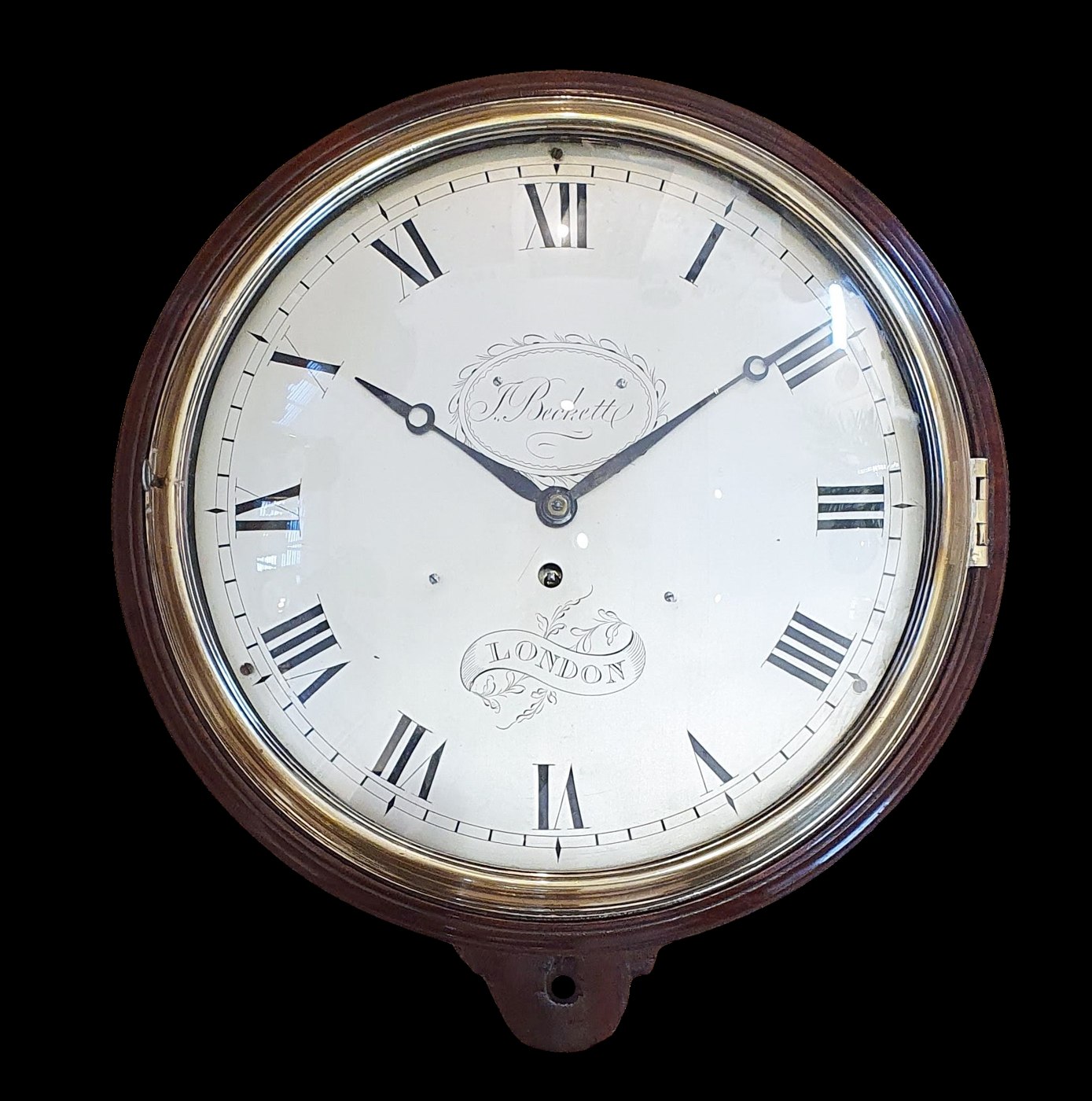
This wall-mounted dial clock is attributed to the maker J.Beckett of London. Constructed with a mahogany case, the piece features a transitional design with a pegged back box and a "Salt Box" shaped lower apron. The clock is powered by an eight-day fusee movement, which operates on a gut line and utilizes an anchor escapement. The dial is silvered and engraved, signed by the maker with the location "LONDON" appearing below the hands. The assembly is housed within a shaped cast bezel and is protected by a convex glass cover. The auction description notes that the dial has undergone restoration to its silvered finish and the movement has been subject to an overhaul in the seller's workshop. The overall dimensions of the object are 360 by 360 by 150 millimeters.

Front view of the J.Beckett wall clock showing the silvered, engraved dial with signature and location.
Front view of the J.Beckett wall clock showing the silvered, engraved dial with signature and location. — The Clock & Watch Shop. Rights pending — permission not yet requested. Original source

Catalogue identity

Source
theclockandwatchshop.co.uk
Category
Clock · Dial clock
Maker / attribution
J.Beckett
Reference
CL-WL-1533
Catalogue / lot identifier
Source URL identifies the listing
Source-reported date
1810
Source-reported place
London, UK

Source-reported attribution and specifications are not independent authentication. A listing does not establish present ownership, current display, availability or permission to reproduce.

Object description

Case and Dial Design

The wall clock features a circular, silvered dial that has been engraved with Roman numerals. The dial is held within a shaped cast bezel, which is fronted by a convex glass pane.

The wooden case is finished in mahogany and incorporates a pegged back box configuration. A characteristic design feature is the inclusion of a "Salt Box" shaped apron positioned at the lower end of the clock case, providing a specific profile to the housing.

The overall appearance of the clock is very good, the mahogany case has good colour, the glass is convex, the dial has been carefully restored back to a silvered finish

Evidence for this section
  • “the mahogany case has good colour”
  • “the glass is convex”
  • “the dial has been carefully restored back to a silvered finish”
  • “The clock still retains the Salt Box shaped lower apron, shaped cast bezel, silvered, engraved dial”

Movement and Escapement

The timepiece is powered by an eight-day fusee movement, which utilizes a gut line for force transmission. This movement is identified as a transitional design, substituting an anchor escapement for the earlier verge type.

The seller reports that the mechanical components have been fully overhauled in their on-site workshops to ensure proper functionality. This maintenance was performed as part of the preparation for the clock's current offering.

Evidence for this section
  • “this is a transitional 'dial' clock with a pegged back box and anchor escapement instead of 'Verge'.”
  • “original shaped fusee movement on a gut line.”
  • “the movement has been fully overhauled in our workshops (on site)”

Maker and Dating

Historical records indicate a maker named J.Beckett of London working around 1700.

Given the stylistic indicators and research conducted by the seller, the piece is dated to approximately 1800-1810.

Evidence for this section
  • “There is a J.Beckett of London recorded working circa 1700. The J.Beckett who made this clock would have been working circa 1790, it's difficult to know if this could be the same J.Beckett or maybe the son ?”
  • “Circa 1800-1810.”

Open research questions

  • What is the specific genealogical or professional relationship between the J.Beckett active in 1700 and the maker of this 19th-century clock?
  • Are there additional internal marks or stamps on the movement plates that can confirm the maker's identity beyond the signature on the dial?

Source evidence

Recorded claims and source quotations for J.Beckett of London wall clock
FieldSource-reported valueSource quotation
MakerJ.Beckett“J.Beckett of London”
EscapementAnchor“anchor escapement”
Movement8 Day Fusee“8 Day Fusee”
Case MaterialMahogany“the mahogany case has good colour”
Dimensions360 x 360 x 150 mm“360 × 360 × 150 mm”
DialSilvered and engraved“silvered, engraved dial”
Datecirca 1800-1810“Circa 1800-1810.”

Visible details

  • Silvered, engraved circular dial
  • Shaped cast metal bezel
  • Convex glass over dial
  • Mahogany case with 'Salt Box' lower apron

Research qualifications

  • Uncertain if maker is the same J.Beckett recorded circa 1700 or a successor
  • Exact date of production is estimated within a 1800-1810 range

Photograph identity and source facts were screened before import; rights clearance remains pending.

Consulted source

J.Beckett of London

Reviewed 2026-11-02 · Record 14ead9429c

Terms in this record

Glossary explanations for terms named in this object’s record.