
Skip to content
The Encyclopedia of Horology

Tool · Nuremberg diptych dial

Ivory Diptych Dial by Hans Troschel

Partially verified

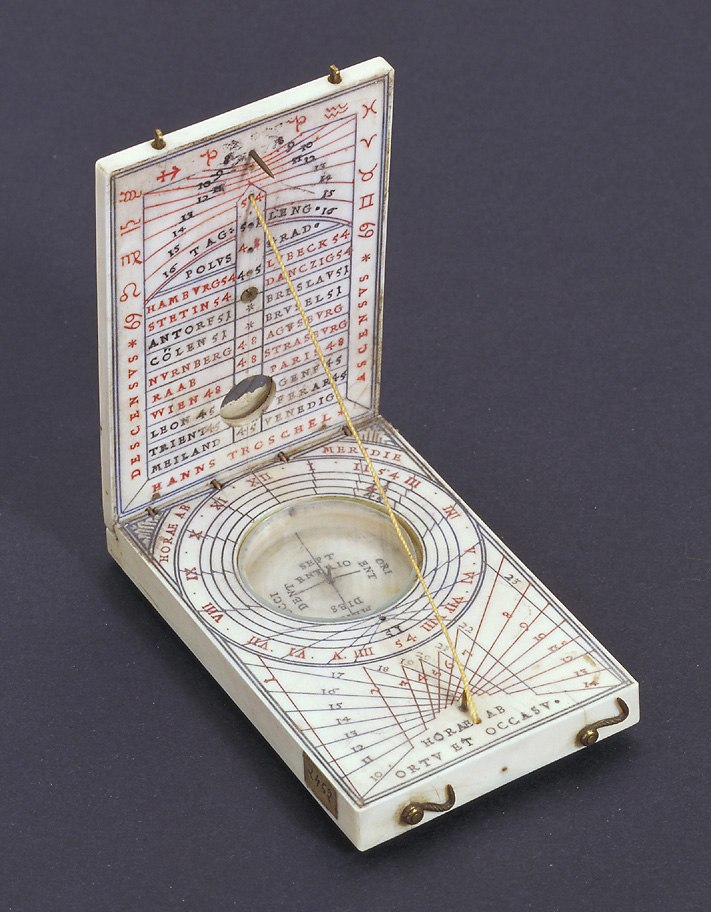
This diptych dial is an ivory instrument measuring 90 x 55 mm, constructed in Nuremberg during the early 17th century. Signed by the instrument maker Hans Troschel, it functions as a horizontal string gnomon sundial adjustable for four different latitudes. The interior lid features a table of geographical latitudes and a wind rose with a central pointer, alongside a compass inset into the base. The instrument incorporates a string gnomon that can be attached to various holes on the base corresponding to specific latitudes to indicate solar time. On the rear of the device, a lunar volvelle tracks moon phases, integrated with a scale for lunar and solar time conversion. The dial faces include diagrams for day length, zodiac symbols, and various hour scales, including markings for Italian and Babylonian hours. The object is marked with the maker's signature and a six-pointed star mark.

Ivory diptych sundial by Hans Troschel, showing the open faces with the string gnomon, compass, and latitude reference list.
Ivory diptych sundial by Hans Troschel, showing the open faces with the string gnomon, compass, and latitude reference list. — Istituto e Museo di Storia della Scienza, Firenze. Rights pending — permission not yet requested. Original source

Catalogue identity

Source
www.mhs.ox.ac.uk
Category
Tool · Nuremberg diptych dial
Maker / attribution
Hans Troschel
Reference
Not recorded
Catalogue / lot identifier
2462
Source-reported date
Early 17th century
Source-reported place
Nuremberg

Source-reported attribution and specifications are not independent authentication. A listing does not establish present ownership, current display, availability or permission to reproduce.

Object description

Construction and Functionality

The instrument is a diptych dial crafted from ivory, comprising a hinged lid and base. The internal assembly includes a horizontal string gnomon, which provides time-keeping functionality when the string is anchored in selected holes corresponding to specified latitudes. The device is designed to be adjustable, allowing the user to determine the hour by reading the shadow projected onto the marked hour lines.

Integrated into the design are multiple astronomical and geographical aids. The base houses an inset compass, which features a magnetic declination mark set for approximately 6 degrees East. The lid interior contains a wind rose with a hand-shaped pointer, while the reverse of the dial serves as a lunar volvelle, which displays the phases of the moon and enables conversions between solar and lunar time using a 2 x 12 hour scale.

Evidence for this section
  • “This ivory diptych dial has a horizontal string gnomon sundial which is adjustable for four latitudes”
  • “Inset compass with the cardinal points named and magnetic declination mark, for approximately 6? East”
  • “Central lunar volvelle with 2 ? 12 hour scale used for converting between lunar and solar time”

Dial Faces and Markings

The interior faces of the dial are detailed with various scales and diagrams. Face Ia displays a thirty-two point wind rose surrounded by the inscription 'PERGE SECVRVS MONSTRO VIAM'. Face Ib presents a diagram depicting the length of the day, marked with zodiac symbols in red and hour lengths in black. This section also includes a detailed list of European cities paired with their respective latitudes, which serves as a reference for the latitude-dependent gnomon settings.

Face IIa features the horizontal string-gnomon dial with four distinct hour rings to accommodate different latitude adjustments. Additionally, a pin gnomon dial is included for indicating Italian and Babylonian hours. Face IIb contains the lunar volvelle, surrounded by Gregorian and Julian epact scales, labeled 'DIES ?TATIS LUN? ET HOR? NOCTIS', providing comprehensive astronomical data beyond basic timekeeping.

Evidence for this section
  • “Surrounding the wind-rose is the inscription 'PERGE SECVRVS MONSTRO VIAM'”
  • “four hour rings corresponding to the four different latitudes”
  • “Pin gnomon dial for Italian and Babylonian hours marked 'HORAE AB ORTV ET OCCASV'”

Signatures and Identification

The instrument bears the clear signature of Hans Troschel, who is noted as an instrument maker from Nuremberg. His identity is confirmed by the textual signature located below the latitude list on Face Ib. The authenticity and manufacture of the piece are further indicated by a specific maker's mark consisting of a six-pointed star, which is repeated twice on the reverse side of the instrument.

The object is held in the collection of the Istituto e Museo di Storia della Scienza in Firenze under inventory number 2462. The documentation identifies Troschel as a maker recognized for his work in ivory, and the stylistic and technical features of the dial are consistent with early 17th-century Nuremberg production standards.

Evidence for this section
  • “Signed by Hans Troschel”
  • “maker's mark of a six pointed star repeated twice”
  • “Hans Troschel , an instrument maker from Nuremberg famous for his work in ivory”

Open research questions

  • Does the magnetic declination of 6 degrees East provide a narrower window for dating this instrument within the early 17th century?
  • Are the specific groupings of latitudes on the dial reflective of a particular regional market for Troschel's instruments?

Source evidence

Recorded claims and source quotations for Ivory Diptych Dial by Hans Troschel
FieldSource-reported valueSource quotation
MakerHans Troschel“Signed by Hans Troschel”
Dimensions90 x 55 mm“90 x 55 mm”
Inventory Number2462“Inventory number: 2462”
DateEarly 17th century“Early 17th century”
Place of OriginNuremberg“Nuremberg”
Maker's MarkSix-pointed star“maker's mark of a six pointed star repeated twice”

Visible details

  • Ivory casing with inset compass
  • String gnomon for variable latitude adjustment
  • Lunar volvelle featured on the rear of the instrument
  • Compass includes a magnetic declination mark for approximately 6 degrees East

Research qualifications

  • Attribution to Hans Troschel is based on the signature on the face
  • The magnetic declination mark is estimated at approximately 6 degrees East

Photograph identity and source facts were screened before import; rights clearance remains pending.

Consulted source

Diptych Dial

Reviewed 2026-10-26 · Record cef07d8bb9

Terms in this record

Glossary explanations for terms named in this object’s record.