
Skip to content
The Encyclopedia of Horology

Tool · German inclining dial

Inclining string gnomon sundial by Markus Purmann

Partially verified

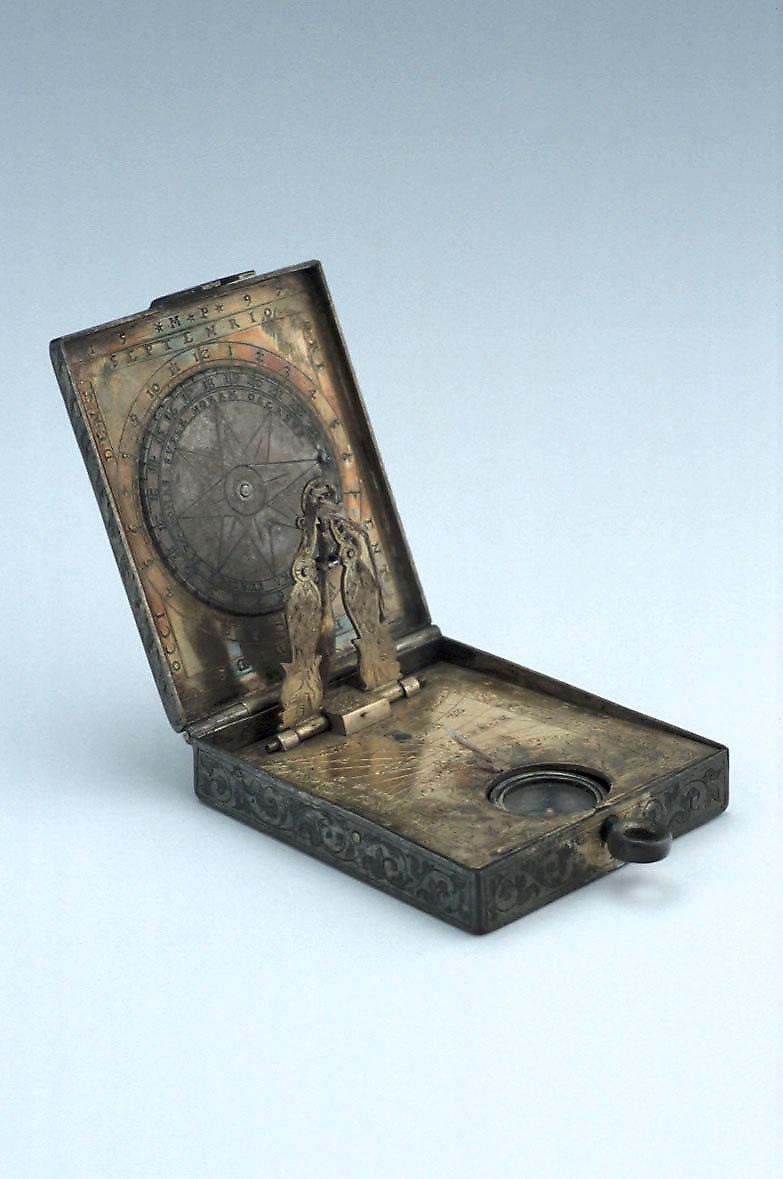
This inclining string gnomon sundial was crafted in 1597 by Markus Purmann. Constructed from gilt brass and silver, the instrument measures 57 x 47 x 12 mm. It functions as a portable timekeeping device, providing time in both ordinary and Italian hours. The dial features a suspension ring that acts as a locking mechanism for the hinged lid. Internally, the instrument includes an inclining dial plate with a folding, decorated gnomon support and a plummet to assist in setting the instrument for latitudes between 40 and 52 degrees. It also contains two volvelles for time conversion, an inset compass, and an engraved table of latitudes on the underside listing 32 locations. The sides of the box are decorated with foliage engravings. This instrument, formerly part of the Roussel and Lewis Evans collections, is currently housed in the Museum of the History of Science, Oxford.

Inclining string gnomon sundial by Markus Purmann, 1597, showing the open lid with internal volvelle and the main dial plate with folding gnomon and compass.
Inclining string gnomon sundial by Markus Purmann, 1597, showing the open lid with internal volvelle and the main dial plate with folding gnomon and compass. — Museum of the History of Science, Oxford. Rights pending — permission not yet requested. Original source

Catalogue identity

Source
www.mhs.ox.ac.uk
Category
Tool · German inclining dial
Maker / attribution
Markus Purmann
Reference
Not recorded
Catalogue / lot identifier
42672
Source-reported date
1597
Source-reported place
Germany

Source-reported attribution and specifications are not independent authentication. A listing does not establish present ownership, current display, availability or permission to reproduce.

Object description

Construction and Design

The dial is housed in a gilt brass box with a hinged cover, measuring 57 mm by 47 mm by 12 mm. The exterior sides of the box feature foliage engravings. A suspension ring is attached to the exterior, which serves as both a method for carrying the dial on a chain or belt and as a clasp to lock the lid in a closed position.

The interior of the lid contains a volvelle for converting between equal and Italian hours, centered around a star engraving. The main interior box features an inclining dial plate equipped with a folding gnomon support that is held in a perpendicular position by a spring and includes an integrated plummet for leveling. The dial plate itself is pivoted to allow for latitude adjustment.

Evidence for this section
  • “The instrument consists of a main box and a hinged lid.”
  • “The box has a suspension ring which fastens the lid shut and the sides of the instrument are engraved with foliage decoration.”
  • “The main box carries an inclining string-gnomon dial with a decorated folding gnomon support”

Horological and Geographic Functions

The instrument is designed to indicate time in both ordinary and Italian hour systems. The dial plate includes a latitude scale ranging from 40 to 52 degrees, marked in two-degree increments, allowing the user to adapt the instrument to different geographic locations. An inset compass, measuring 12 mm in diameter, is mounted into the dial plate to assist with orientation.

The underside of the base plate features a table titled 'Tabula latitudinis Regionum', which provides the latitudes for 32 distinct locations. Additional functionality is provided by the two volvelles, which permit the conversion of hours, utilizing the sun's declination and local sunset times.

Evidence for this section
  • “The dial plate can be adjusted to provide the time in latitudes from 40 to 52?”
  • “The dial plate also has an inset compass 12 mm in diameter and its silvered base is marked for variation.”
  • “On the underside of the instrument is a table marked 'Tabula latitudinis Regionum' giving the latitudes of 32 places”

Signatures and Provenance

The signature '15 [star]M[star]P[star] 97' is engraved on the plate inside the cover, identifying the maker as Markus Purmann. The stylistic execution of the volvelle is compared to similar instruments produced by Ulrich Schniep.

The instrument's history is documented through its inclusion in the Roussel Collection and the Lewis Evans Collection, specifically listed as G. 362. It is currently held by the Museum of the History of Science, Oxford, under inventory number 42672.

Evidence for this section
  • “At the northern end of the plate is the signature '15 [star]M[star]P[star] 97'.”
  • “This volvelle is all but identical to the type which appears in earlier instruments by Ulrich Schniep”
  • “Provenance: Roussel Collection; Lewis Evans Collection G. 362.”

Open research questions

  • What is the historical significance of the specific 32 locations listed in the table of latitudes?
  • To what extent did Markus Purmann collaborate with or adopt designs from Ulrich Schniep beyond this specific volvelle?

Source evidence

Recorded claims and source quotations for Inclining string gnomon sundial by Markus Purmann
FieldSource-reported valueSource quotation
MakerMarkus Purmann“Signed by Markus Purmann”
Date1597“Dated 1597”
Dimensions57 x 47 x 12 mm“57 x 47 x 12 mm”
MaterialGilt brass and silver“Gilt brass and silver”
Latitude Range40 to 52 degrees“provide the time in latitudes from 40 to 52?”
Inventory Number42672“Inventory number: 42672”
ProvenanceRoussel and Lewis Evans collections“Provenance: Roussel Collection; Lewis Evans Collection G. 362.”

Visible details

  • Hinged lid with internal volvelle and star engraving
  • Folding, ornately shaped gnomon support
  • Inset compass on the main dial plate
  • Cardinal directions engraved on the plate edges

Research qualifications

  • The specific intended function of the knot or bead on the string gnomon remains theoretical
  • Exact manufacturing location within Germany is not specified beyond the national attribution

Photograph identity and source facts were screened before import; rights clearance remains pending.

Consulted source

Inclining Dial

Reviewed 2026-10-26 · Record 6c24f24efc

Terms in this record

Glossary explanations for terms named in this object’s record.