
Skip to content
The Encyclopedia of Horology

Tool · German inclining dial

Inclining Dial by Ulrich Schniep

Partially verified

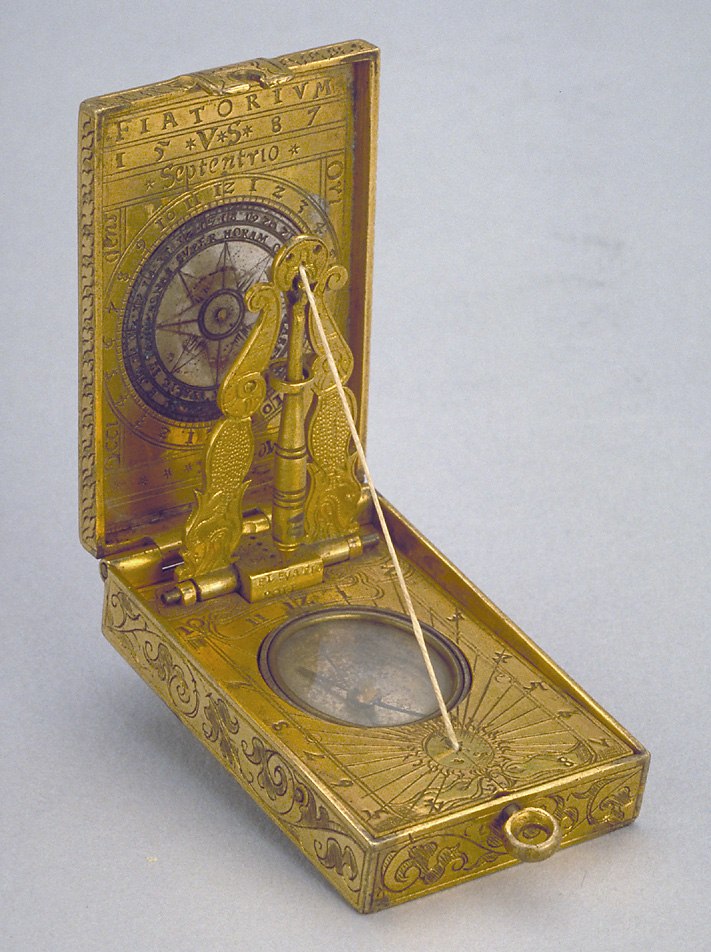
This brass inclining dial, measuring 55 x 37 x 14 mm when closed, is a portable timekeeping instrument signed by Ulrich Schniep and dated 1587, Munich. The instrument functions as a box with a hinged lid. The exterior lid surface displays a table of latitudes for 31 European cities. The interior of the lid contains a volvelle for converting common hours into Italian hours, surrounding cardinal direction markers and the maker's inscription. The base contains a string gnomon dial featuring a folding plummet holder engraved with sea monster motifs, and a magnetic compass mounted on a rotating silvered disc. The dial plate is pivoted, allowing it to be tilted for use at latitudes ranging from 42 to 52 degrees. The outer surfaces are decorated with strapwork and scrollwork. It was donated to the British Museum in 1844 by J. B. Heath.

Inclining dial in brass by Ulrich Schniep, 1587, with lid open to reveal the string gnomon, magnetic compass, and internal volvelle.
Inclining dial in brass by Ulrich Schniep, 1587, with lid open to reveal the string gnomon, magnetic compass, and internal volvelle. — © British Museum, London. Rights pending — permission not yet requested. Original source

Catalogue identity

Source
www.mhs.ox.ac.uk
Category
Tool · German inclining dial
Maker / attribution
Ulrich Schniep
Reference
MLA 1844, 7-30.1
Catalogue / lot identifier
MLA 1844, 7-30.1
Source-reported date
1587
Source-reported place
Germany

Source-reported attribution and specifications are not independent authentication. A listing does not establish present ownership, current display, availability or permission to reproduce.

Object description

Construction and Design

The inclining dial is fabricated from brass and designed as a portable box with a lid. It features an integrated string gnomon dial and a magnetic compass. The exterior surface of the box is embellished with decorative strapwork and scrollwork. The internal components include a tilting dial plate that allows the instrument to be adjusted for specific geographic latitudes.

The folding mechanism includes a plummet assembly, which is engraved with images of dragon's heads or sea monsters. The magnetic compass is mounted on a rotatable silvered disc that permits adjustment for magnetic declination. The hour lines on the dial are focused around a central sun effigy, numbered 4 through 12 to 8.

Evidence for this section
  • “The instrument in the shape of a box with a lid consists of a list of latitudes , a volvelle for converting common hours into Italian hours , a string gnomon dial and a magnetic compass .”
  • “The outer surface and the edges of the box are decorated with strapwork and scrollwork.”
  • “The plummet holder is engraved with a pair of dragon's heads or sea monsters.”

Timekeeping and Latitude

The lid functions as an information source, listing 31 European cities with their respective latitudes. Inside the lid, a volvelle provides a means to convert common hours into Italian hours, utilizing a fixed outer ring and a central silvered disc. An inscription inside provides the instruction for this conversion.

The dial plate is pivoted at the edges of the box to accommodate varying latitudes. A plummet on the dial base indicates the tilt required for latitudes between 42 and 52 degrees. The compass can be rotated to account for magnetic declination between 0 and 30 degrees in either direction from true north.

Evidence for this section
  • “The outer surface of the lid is inscribed with the names and latitudes of 31 European cities”
  • “An inner circle is labelled 'HABETVR HORA ITALIC SI XXIIII PONAS SVPER HORAM OCCASVS'.”
  • “The dial plate is pivoted to the edges of the box so that it can be tilted and is therefore adaptable to a range of latitudes 42? to 52? as marked on the base of the plummet.”

Signatures and History

The instrument is signed 'VS' with the date '1587'. This item is identified as one of the final instruments created by Ulrich Schniep before his death in 1588.

The instrument was acquired by the British Museum in 1844 following a presentation by J. B. Heath. It is documented in the catalogue of European Scientific Instruments by F. A. B. Ward.

Evidence for this section
  • “Above 'Septentrio' is the inscription 'FIATORIUM' and the date and initials of the maker '15 VS 87'.”
  • “This brass inclining dial is one of the last instruments made by Ulrich Schniep shortly before his death in 1588.”
  • “The instrument was presented by J. B. Heath in 1844 and is described in F. A. B. Ward, A Catalogue of European Scientific Instruments in the Department of Medieval and Later Antiquities of the British Museum (London, 1981), p. 43, no. 105.”

Open research questions

  • What is the specific significance of the designation 'FIATORIUM' in the context of 16th-century portable dials?
  • Are the listed latitudes for the 31 cities consistent with standard geographical knowledge available to Schniep in 1587?

Source evidence

Recorded claims and source quotations for Inclining Dial by Ulrich Schniep
FieldSource-reported valueSource quotation
MakerUlrich Schniep“Signed by Ulrich Schniep”
Date1587“Dated 1587; Munich”
MaterialBrass“Brass; 55 x 37 x 14 mm closed”
Inventory NumberMLA 1844, 7-30.1“Registration no. MLA 1844, 7-30.1”
Latitude Range42 to 52 degrees“adaptable to a range of latitudes 42? to 52? as marked on the base of the plummet”
Dimensions55 x 37 x 14 mm“55 x 37 x 14 mm closed”
ProvenanceJ. B. Heath“The instrument was presented by J. B. Heath in 1844”

Visible details

  • Hinged brass box construction with engraved strapwork and scrollwork
  • Folding plummet assembly engraved with twin sea monsters or dragon heads
  • Rotating magnetic compass set on a silvered degree scale disc
  • Volvelle on inner lid for common-to-Italian hour conversion

Research qualifications

  • The exact identification of the sea monster motifs on the plummet holder is descriptive rather than documented
  • The full range of latitude adjustment is stated as 42 to 52 degrees based on plummet markings

Photograph identity and source facts were screened before import; rights clearance remains pending.

Consulted source

Inclining Dial

Reviewed 2026-10-26 · Record 6b7a1ee7f3

Terms in this record

Glossary explanations for terms named in this object’s record.